
The marriage amendment vote

The next 10 months are likely to be as contentious as Minnesotans have ever seen. What about afterward?

April 14, 2012 at 10:58PM
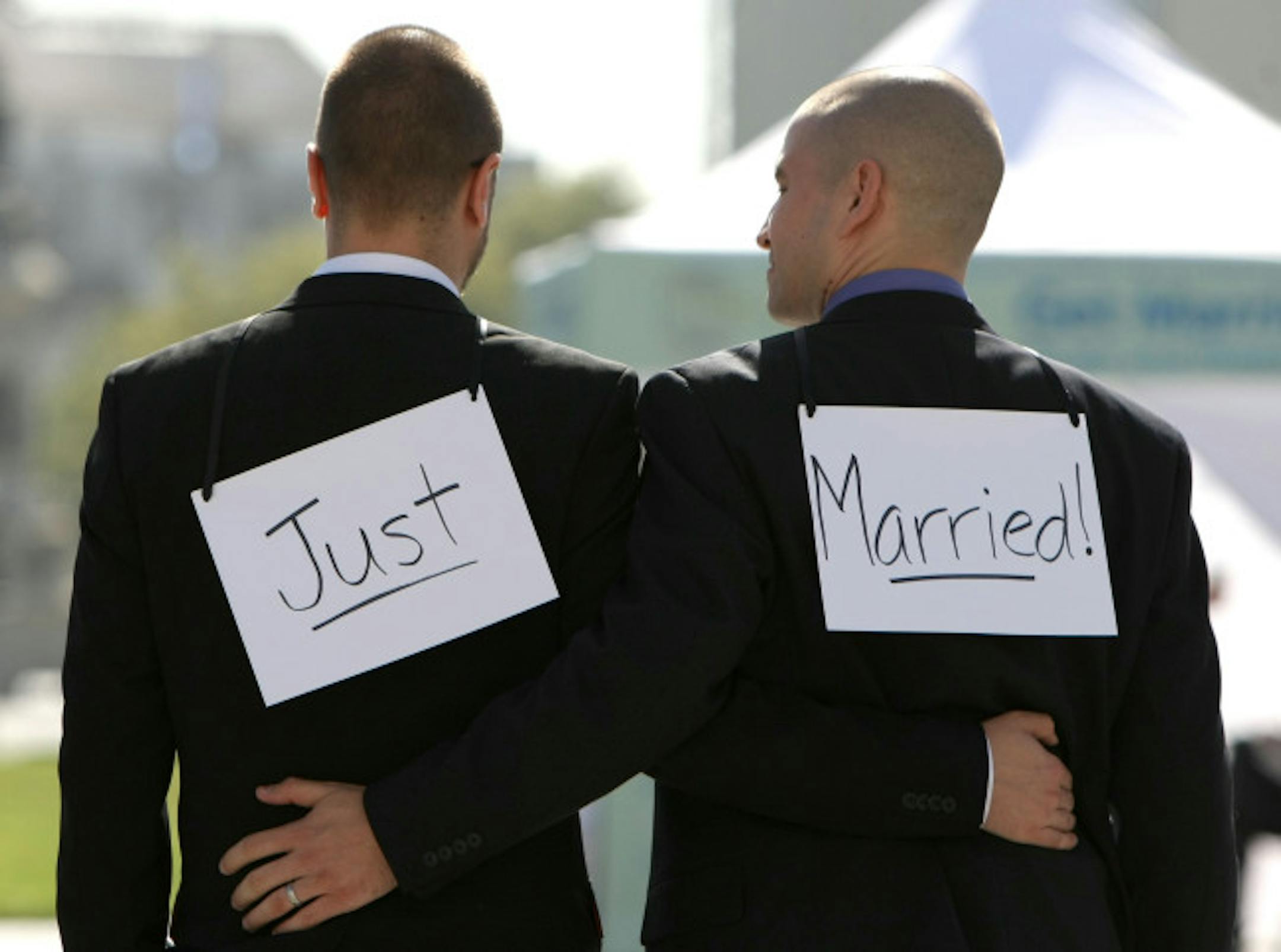
SAN FRANCISCO - JUNE 17: Same-sex couple Ariel Owens (R) and his spouse Joseph Barham walk arm in arm after they were married at San Francisco City Hall June 17, 2008 in San Francisco, California. Same-sex couples throughout California are rushing to get married as counties begin issuing marriage license after a State Supreme Court ruling to allow same-sex marriage.
SAN FRANCISCO - JUNE 17: Same-sex couple Ariel Owens (R) and his spouse Joseph Barham walk arm in arm after they were married at San Francisco City Hall June 17, 2008 in San Francisco, California. Same-sex couples throughout California are rushing to get married as counties begin issuing marriage license after a State Supreme Court ruling to allow same-sex marriage. (Elliott Polk (Clickability Client Services) — Getty Images/The Minnesota Star Tribune)

The official midweek story line at the State Capitol involved serious stuff -- jobs, taxes, stadium. (Well, two out of three were serious, anyway.)

But the buzz was about yet another report, via KSTP-TV, of an "inappropriate relationship" between a Republican legislator and a staffer. And the first thing a lot of scribes, bloggers and newly sensitized citizens did when the story broke?

Check to see how the accused legislator voted on the amendment that's been placed on the November ballot to define marriage.

To his credit, the legislator in question, Rep. Steve Smith of Mound, was one of four House Republicans who voted against tossing that incendiary device at the Minnesota body politic.

(He's also single, and the woman in question quietly left her House job last month. He denies having an "inappropriate" relationship. Sounds like he's got a point.)

I raise the Smith gossip not to dwell on the personal lives of state politicians, diverting though that topic has been of late.

Rather, my attention is drawn to how quickly a nexus developed between reported affairs of the heart and other body parts, and legislators' votes for the anti-same-sex-marriage amendment last May.

When news of former Senate Majority Leader Amy Koch's indiscretion broke the day after she resigned her leadership post last month, it took about a nanosecond for the stinger "hypocrite" to appear next to online reports about her woes.

Koch wasn't a ringleader in putting this wedge issue on the ballot. But she gave it her consent and her vote.

For people who hate what that amendment would do, that was enough to justify angry name-calling.

And worse? Not yet. But I'm worried about the next 10 months.

The debate over whether to permanently deny committed same-sex couples the same legal status afforded two-sex ones is likely to dominate state politics between now and November.

I'd lay odds that Minnesotans will see, hear and talk more about that topic in the next 10 months than they will about the U.S. Senate race. (Does Minnesota even have a Senate race this year? I haven't seen much sign of one so far ...)

When I opined to Larry Jacobs, the political scientist who heads the Humphrey School's Center for the Study of Politics and Governance, that this amendment could be the most divisive constitutional question ever called in this state, he didn't disagree.

"This engages people personally," Jacobs said. "This is a debate that cuts across family lines, generational lines, party lines. People are pushing hard for their points of view, and many of them are running into resistance from their own team."

Those who favor the amendment feel strongly that something fundamental to the state's culture is changing for the worse, and must be stopped. Those who oppose it are just as adamant that the amendment would enshrine bigotry in the state's foundational charter, and must be stopped.

Each side believes God and decency stand with them. When that much self-righteousness clashes, who cares about civility? Or about Minnesotans' ability to come together and govern this state after Nov. 6?

Allow an introduction: Wilfahrt is a 59-year-old former 3M engineer from Rosemount who lived a quiet, apolitical life until last Feb. 27, when his son Andrew, a U.S. Army corporal, died on patrol in Afghanistan. Andrew was openly gay.

Last week, Wilfahrt announced that he plans to run for the state House as a DFLer this fall against GOP Rep. Kurt Bills. Bills, a freshman, voted for the amendment last May. That has much to do with Wilfahrt's foray into politics.

Moments before the May 21 House floor vote, another GOP freshman, Rep. John Kriesel, distributed Andrew's photo.

"I cannot look at this picture and say, 'You know what, Corporal? You were good enough to fight for your country and give your life, but you were not good enough to marry the person you love.'"

But that's not the argument Jeff Wilfahrt intends to take to District 37B voters. He said last week that he prefers to talk about the Constitution that Minnesotans will be left with on Nov. 7 and beyond.

"No matter what happens to this amendment, on Nov. 7, gay marriage will be illegal in Minnesota," he noted. The circa 1997 state Defense of Marriage Act (DOMA) remains on the books.

"The issue this amendment raises is whether the LGBT minority community will have the right to stand before the courts and argue their case" that DOMA is unconstitutional. "This amendment is an assault on this minority group's constitutional right" to petition their government for redress of grievances.

On Nov. 7, Minnesotans in the two marriage amendment camps likely won't be left feeling very charitable toward one other. But what will matter more is whether Minnesotans are left with a Constitution that affords equal standing under the law to every citizen.

If they are not, this year's nasty campaign could be a prelude to something worse.

* * *

Lori Sturdevant is a Star Tribune editorial writer and columnist.

about the writer

about the writer

Lori Sturdevant

Columnist

Lori Sturdevant is a retired Star Tribune editorial writer and columnist. She was a journalist at the Star Tribune for 43 years and an Editorial Board member for 26 years. She is also the author or editor of 13 books about notable Minnesotans. 

See Moreicon

More from Commentaries

See More
card image
Richard Tsong-Taatarii/The Minnesota Star Tribune

It’s appalling that Minneapolis City Council would punish local businesses for hosting federal agents, as if the hotels could just turn away any person they dislike.

card image
card image