

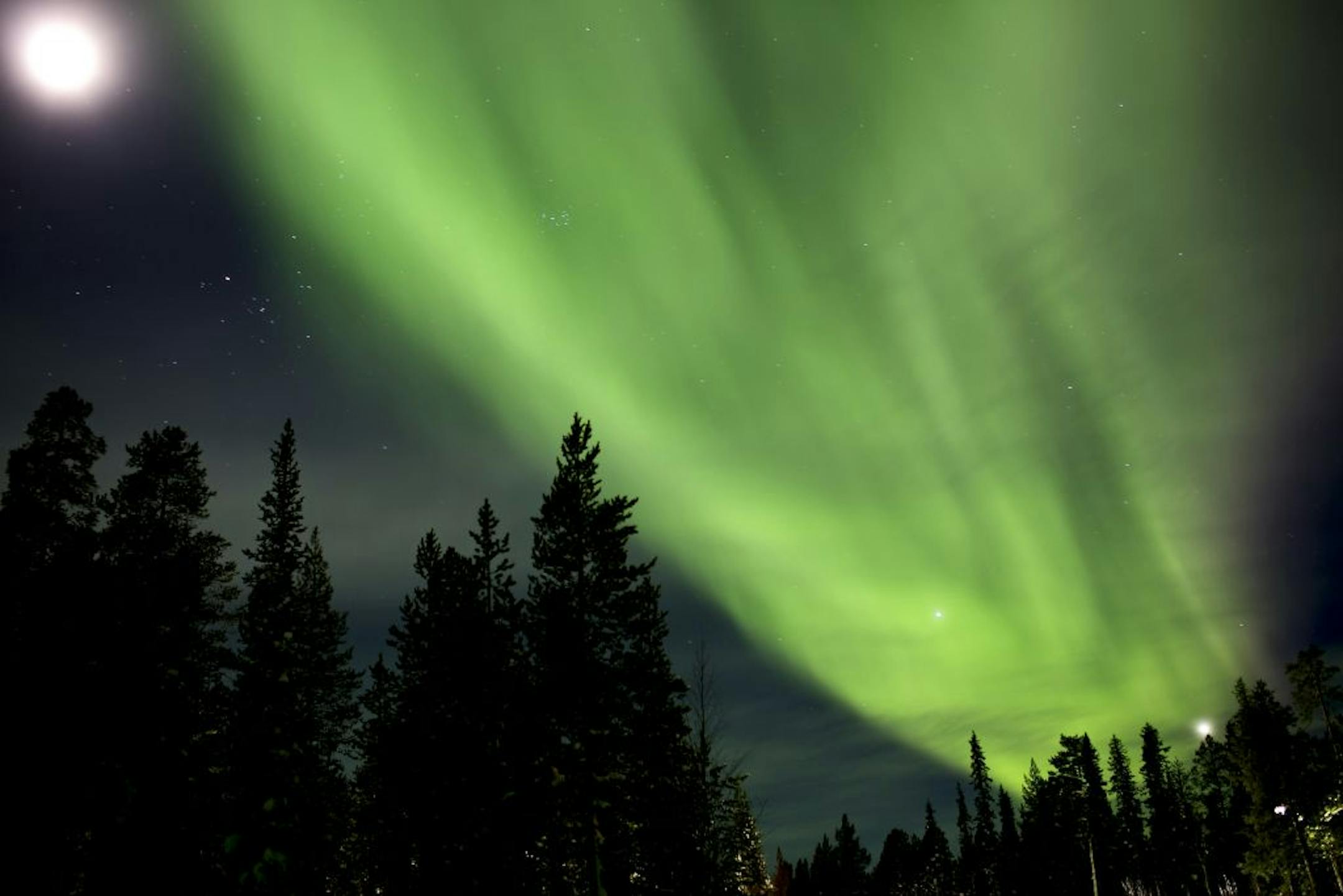
"Ladies and gentlemen, the northern lights are on," announced a member of our group, breaking the pre-dinner weariness.
It had been another long day of cross-country skiing, but his message spurred us to action. In a flash, the cabin was filled with the sound of crinkling jackets and snow pants; a few minutes later, Arctic air was blasting across our faces.
As I made my way across the snow, I craned my head skyward. Streaks of green plasma arced beyond silhouettes of slender pines. The effect was something like the swirls of phosphorescent plankton magnified a billion times. When I wandered back to our cabin hours later -- after bumping into a pair of aurora borealis-hunting Finns in the woods who offered swigs of coffee liquor -- I nearly stumbled into a reindeer.
Such is the magic of Finnish Lapland, a 38,000-square-mile region of dense pine forests, lakes and bald mountains.
There were seven of us on this weeklong trip last February in the small town of Akaslompolo, about 95 miles north of the Arctic Circle.
My Finnish friend Iina, our de facto guide, had sold us on the idea of renting a log cabin, with tales of dancing skies, burning saunas and the likelihood that "you'll become infected with Lapland madness, which makes you return again and again."
The madness began on our way there, with a 13-hour, 600-mile overnight train ride on the Aurora Borealis Express -- starting in Helsinki and skirting the Swedish border past the Gulf of Bothnia -- to Kolari, the northernmost passenger train station in Finland. And it was aided by cases of cheap Estonian booze. Although we had three train compartments among us, we all squeezed into one for a few hours, drinking, joking about what we'd just gotten ourselves into and watching a blur of pure-white landscape slip by outside the windows.
From the Kolari station -- tepee-shaped like a traditional Lapland hut and surrounded only by trees and snow -- it would take less than an hour by bus to get to the twin villages of Akaslompolo and Yllasjarvi (combined population around 600), on Yllas, a smooth, treeless mountain known as an Arctic fell.


