

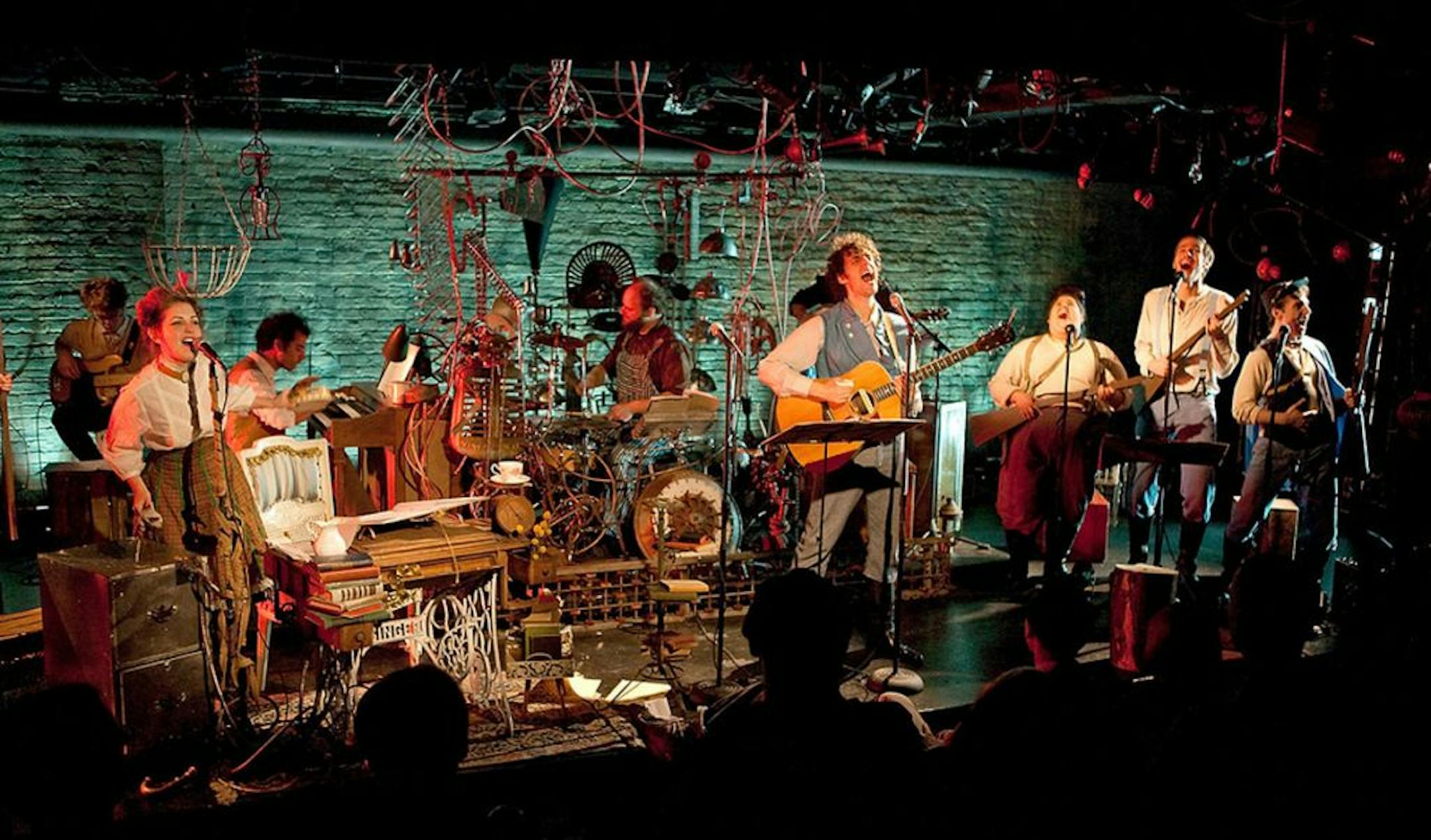
A soft-hearted idealism lies at the core of "Futurity: A Musical by the Lisps." Soldier Julian Munro, who lacks the taste for killing, dreams of building a machine that would eliminate war. Cue Joni Mitchell, deck everyone in 1960s daisies and love beads and bring out the Mary Jane.
Except that the Lisps have placed "Futurity" in the United States Civil War, a moment of even greater national agony, and Julian is not just a campus protester. He has skin in the game -- his own.
"Futurity" opened Thursday at the Walker Art Center, which commissioned the work from the Lisps, a Brooklyn-based indie band.
The piece desperately wants to believe in a future free from war, and it is difficult to criticize such earnest idealism. As theater, "Futurity" allows its lofty imagination to trudge through earthbound banality. Director Sarah Benson gets workmanlike performances and movement from her cast. Thank goodness for drummer Eric Farber, whose percussive energy drives a clanging and active rhythm, and set designer David Israel Reynoso's evocation of steampunk anachronisms. It feels a little like "The Wild, Wild West."
César Alvarez and Sammy Tunis, the band's front twosome, portray the central characters. He is Munro. She is Ada Lovelace, the 19th-century scientist who designed the first computer programs in concert with Englishman Charles Babbage, inventor of the Analytical Engine. As Munro heads off to war, he somehow has started an epistolary relationship with Lovelace. We are to believe that his simple scribblings animate her energies toward creating "Steam Brain," a machine that would stop war. Imagine that: "nothing to kill or die for."
The Lisps' music tends toward soft country and folk protest. On several occasions, it's no more than two-chord riffs filled with words. That might be OK, but Alvarez jams too many syllables into the meter. The lyrics to "Steam Brain," for example, are mostly lost, and I believe Alvarez is a serious enough writer that he wanted to say something. "Blacklick Creek" has real gospel energy, and "Thinking" is a lovely song that breaks the tonal pattern.
Alvarez and writer Molly Rice lean on the thoughts and character of Lovelace, for Munro is really just a foil to open up this brilliant mind. Lovelace had an artist's spirit and saw imagination as the catalyst for math and science. Imagination is the dynamic force that "makes the Earth tolerable," she said.
By the end of "Futurity," we are caught up in the good intentions and expansive vision. If only the diffuse strains here -- belief in peace, technology and most of all human imagination -- had come together with synergy and created something even greater. That would be an achievement to celebrate.


