

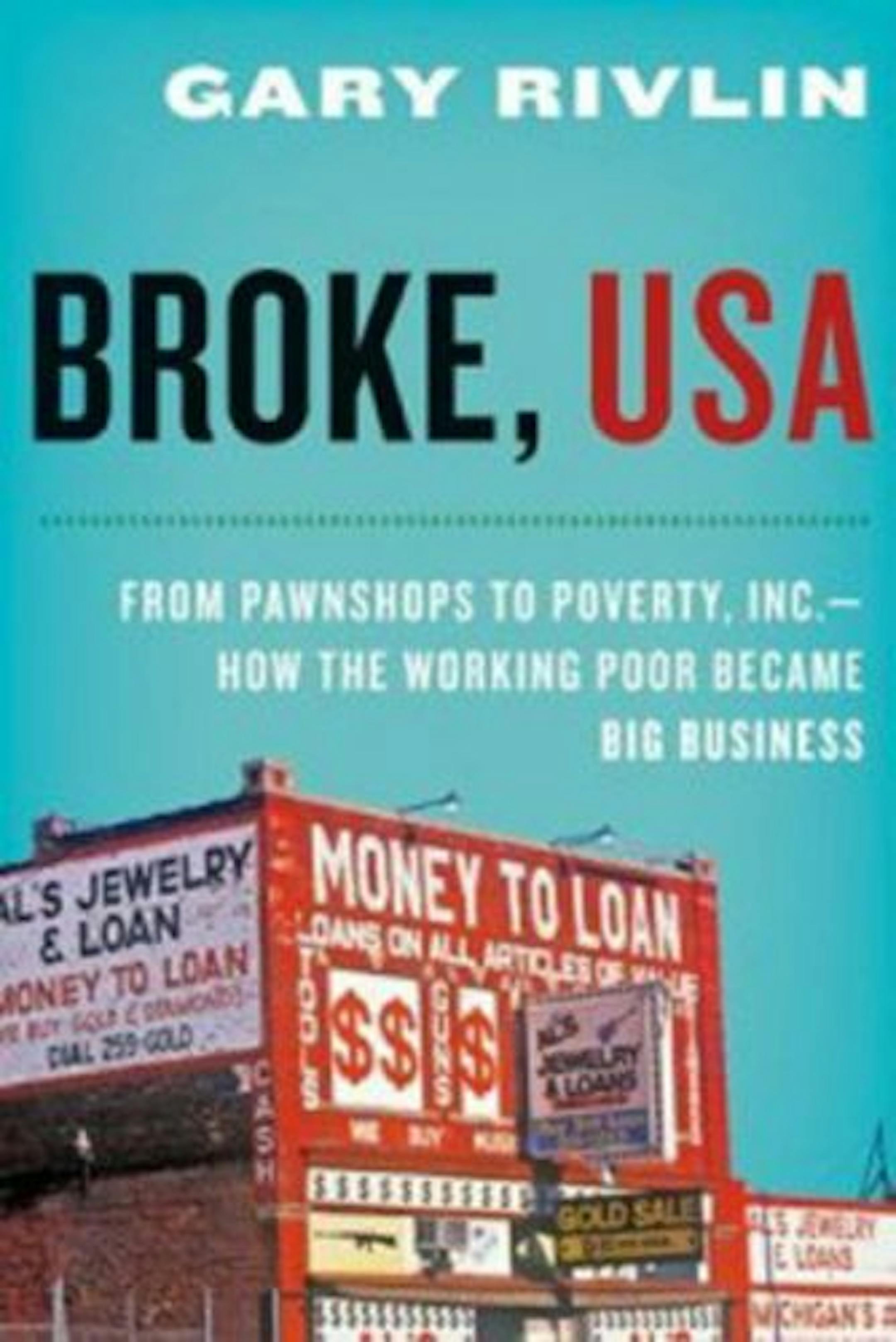
After her husband lost his job, North Carolina teacher Sandra Harris borrowed $500 from a payday lender. Because of the loan's breathtakingly high interest rate and its accumulating fees, she eventually lost both her car and her house. Larry and Martha Clay, a blind couple living on a monthly disability payment, owned a small home in Columbus, Ohio. An aggressive mortgage broker persuaded them to refinance, earning himself a $3,200 fee. The cash-strapped Clays ended up owing more than twice the assessed value of their house, and faced homelessness. In "Broke, USA: From Pawnshops to Poverty, Inc.," what investigative reporter Gary Rivlin does wonderfully well is relate these tragic tales while exploring how predatory lending works from the inside.
Most revelatory of all, Rivlin describes how big banks such as Bank of America, Wachovia and Citibank invested heavily in predatory lending, gobbling up payday loan companies and subprime mortgage lenders that operate in poor communities where those same big banks largely refuse to open branches. Rivlin's exhaustive investigation shows a disturbing trend of reverse redlining, with big banks targeting the poor with financial products so predatory that they've triggered a powerful backlash from consumer protection activists.
Rivlin describes the predatory lending industry in horrific detail, with its underhanded sales tactics, obscenely high interest rates and mammoth fees. As Rivlin shows, predatory lenders originated the "financial innovations" (e.g., subprime adjustable-rate mortgages) that would nearly bring down our entire financial system in 2008. Citigroup's relationship with its lucrative subprime subsidiary was typical: "A bank [like Citigroup] would say it was bringing integrity to the subprime enterprise it had just purchased," writes Rivlin, "but invariably the opposite happened."
With access to new capital, the subprime subsidiary would actually expand its operations, preying upon unsophisticated, cash-strapped borrowers. The big banks would then purchase and package the subprime loans, profitably selling them downriver to investors.
As the author shows, predatory lenders exact a high toll, saddling the poor with ballooning debts and taking away equity in their homes (as well as the homes). Rivlin also describes the grass-roots activists working to rein in predatory lenders in distressed communities like Atlanta and Dayton, Ohio; federal regulators have been largely passive. Georgia Gov. Roy Barnes spoke for many seeking to restrain predatory lenders in his state: "When I was a young prosecutor, we prosecuted people who charged more than 25 percent a year as loan sharks. Now Wall Street welcomes them as respectable businesses."
To call the practices Rivlin describes, and Wall Street has so eagerly adopted, unsustainable would be an understatement. Alas, the mess continues to bedevil our nation's economy.
Chuck Leddy, a member of the National Book Critics Circle, regularly reviews nonfiction for the Boston Globe and B&N Review.


