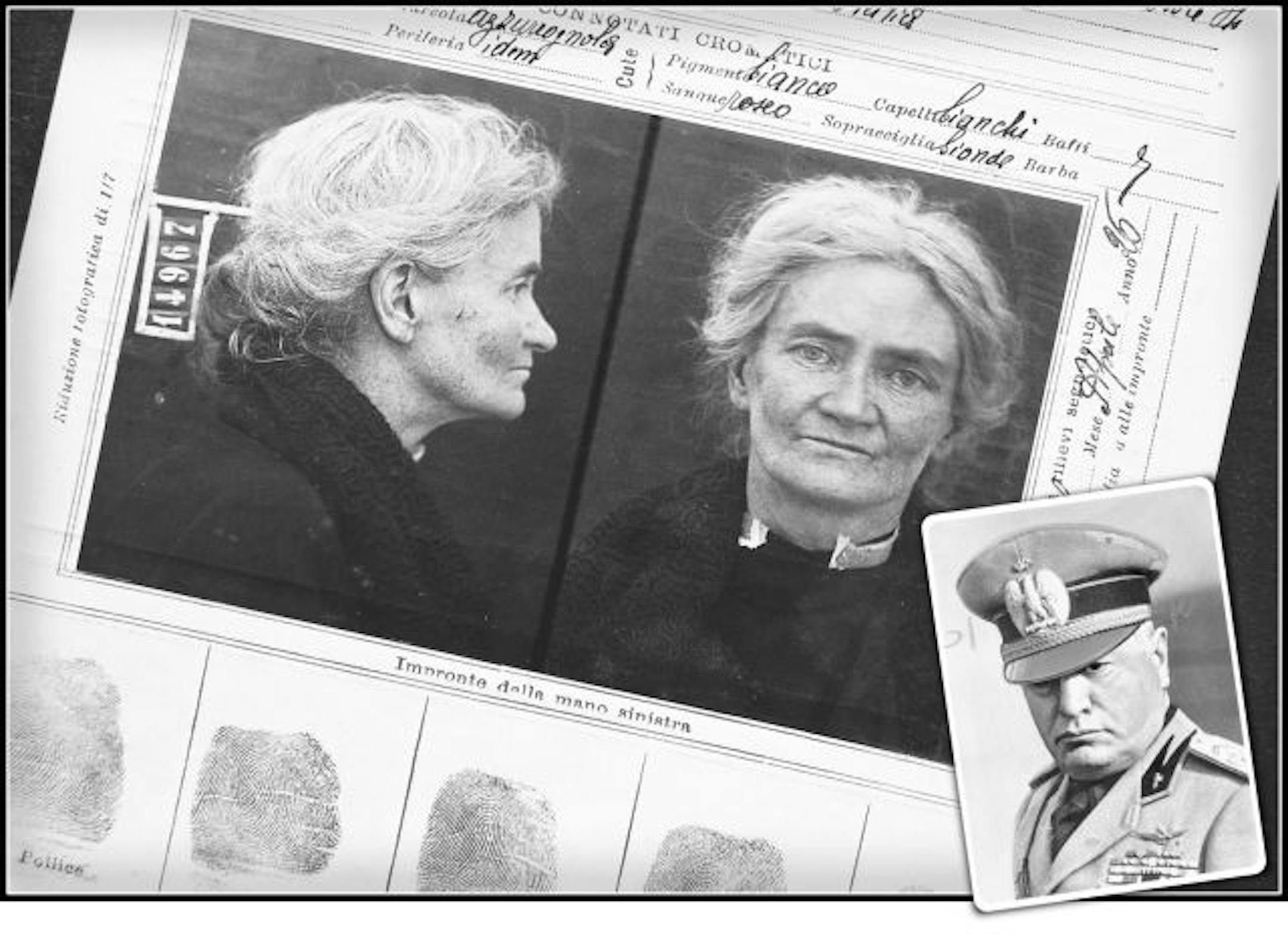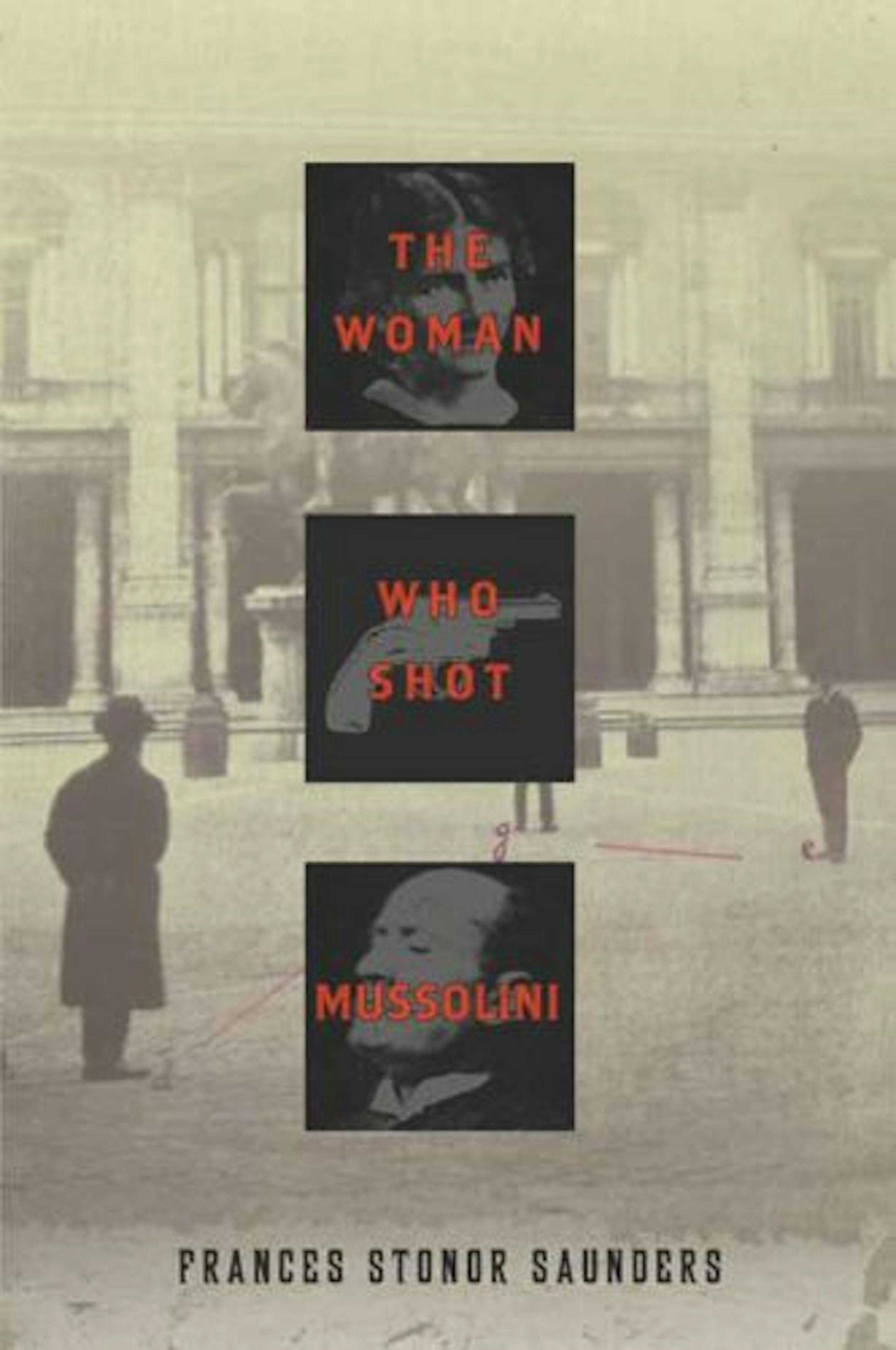
The event, trivial in the sweep of history yet momentous in its immediate context, is lost in the deep mists of time, all but forgotten. It is 10:58 a.m. on April 7, 1926. As the large throng at the entrance to Rome's Palazzo dei Conservatori roars its greeting to the recently appointed Italian prime minister, a diminutive, emaciated, gray-haired woman -- a nonentity, as witnesses were to describe her -- steps forward. Frances Stonor Saunders describes what happened next: "Duration, one, possibly two, seconds. In particle physics, an eternity. In history, the briefest of encounters, an infinitesimally small exchange. Two arms are raised, Benito Mussolini's in the Fascist salute, Violet Gibson's in the leveling of a pistol. The distance separating these two people, who have never met, is approximately eight inches. Close enough to breathe each other's breath. Murder can be a very intimate business." Attempted murder, that is. Gibson, despite her point-blank proximity to Mussolini, merely grazed the tip of his nose. Little damage but lots of blood, which Mussolini, the quintessential political showman, would subsequently use to immense advantage. Her attempt at a second shot failed; the revolver, a veritable Saturday night special, jammed. She was lucky to survive the crowd's ensuing fury -- or was she?
Gibson, who was 50 at the time, was anything but a nonentity. She was a daughter of Edward Gibson, first Lord Ashbourne and lord chancellor of Ireland. She also was a convert to Roman Catholicism, a breach of decorum among the Anglo-Irish nobility so shocking, Saunders tells us, that such items were covered by the Times of London in a column titled "Perversions."
Gibson's embrace of Catholicism was so intense, so mystical, a mania so profoundly inclusive, that it turned her own desire for the martyrdom experienced by the saints she venerated into an existential conflagration. Into this seething mix were added bracing measures of Irish republican radicalism and militant Catholic socialism. Saunders shows us that this brew drove Gibson to Italy, originally to assassinate Pope Pius XI for failing to act as she would have wished on social-justice issues.
Mad? Unquestionably, but Saunders refuses to let Gibson disappear "down the oubliette of history" without examining her life from every possible angle. It is a tour de force informed by the author's keen understanding of the social and political issues that galvanized the times. Moreover, Saunders' knowledge -- and use -- of English literature to animate Gibson's story gives it an elegance, depth and sensibility that would have eluded less competent biographers.
Gibson avoided trial in Italy for geopolitical reasons, and ended her days in a sanitarium on England. Her gravestone, Saunders remarks with interest, contains a comma after her name, "a breathing space, a tiny pause, before a further thought." There is no further thought, only the dates of her birth and death. "Her extraordinary story," told here with sensitivity and panache, "lies between the comma and the period."
Michael J. Bonafield lives in Apple Valley and is at work on a novel about Robert E. Lee.