

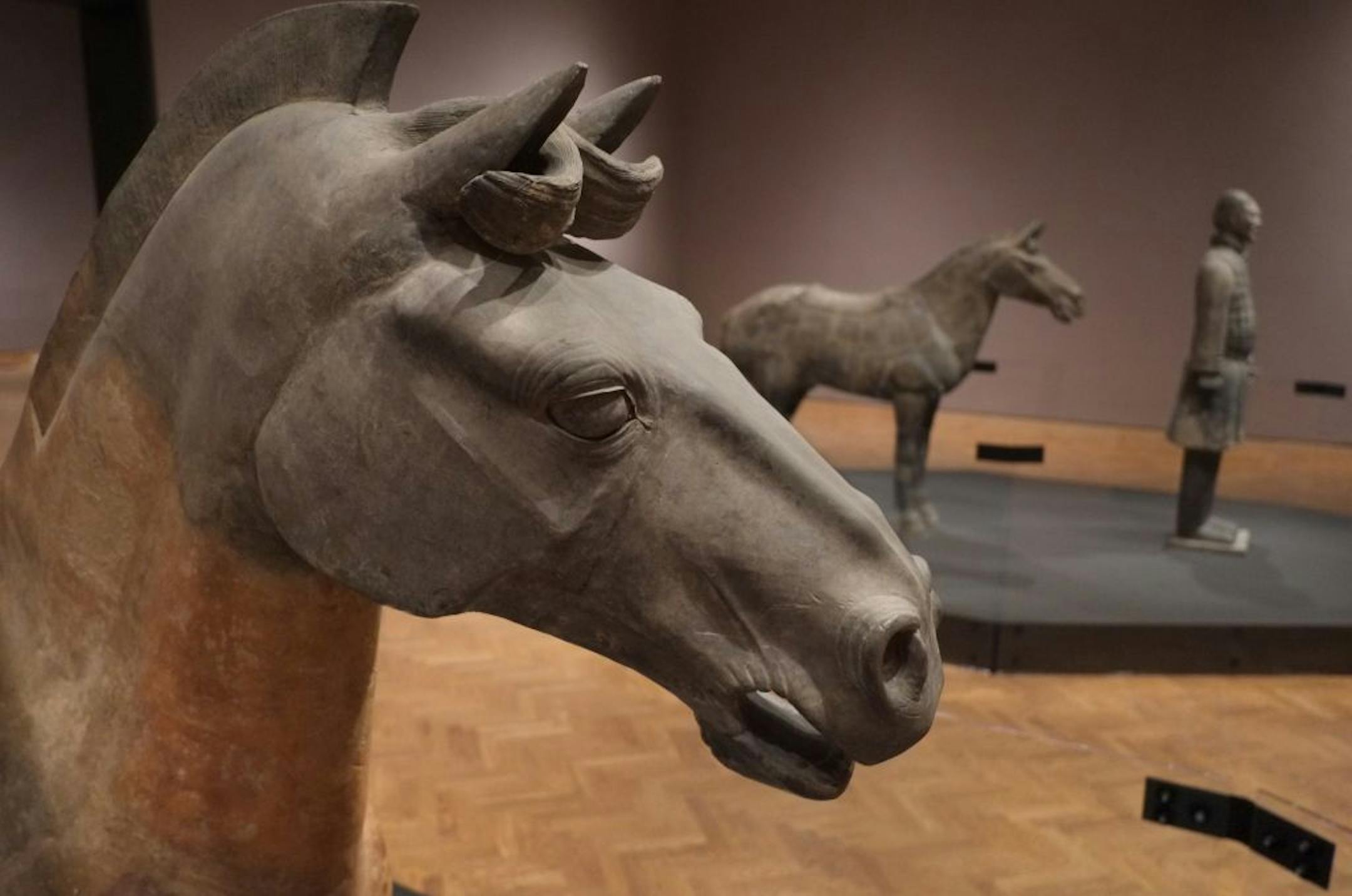
When China's first emperor ordered a tomb more than 2,200 years ago, he was just a teenager planning ahead. By the time he died nearly 40 years later, his burial complex was a vast underground city three miles wide and equally long. In its dark tunnels, row upon row of terracotta warriors -- 7,000-some archers, cavalry officers, generals and their lieutenants -- stood guard against tomb robbers and assaults from the realm of spirits.
According to legend, booby traps, poisons and rivers of deadly mercury reinforced their bulwarks.
It worked for centuries. Then came the well drillers. In 1974, farmers sinking a well pulled up shards of terra cotta. Soon, word of emperor Qin Shihuang's ghostly realm electrified the world.
Eight life-sized terracotta warriors and two horses from the tomb will star in a show opening Sunday at the Minneapolis Institute of Arts. "China's Terracotta Warriors: The First Emperor's Legacy" includes life-sized bronze birds, architectural fragments, ritual vessels and gold ornaments on loan from 13 Chinese museums.
While excavations in the central Chinese province of Shaanxi have been going on for 38 years -- exactly how long the original tomb construction took -- much of the exhibit's material came to light recently and some has never been shown outside China. It will travel to San Francisco's Asian Art Museum after closing in Minneapolis Jan. 20.
Curse of the emperor's tomb?
Guarding a dead ruler for two millennia was no picnic, and neither was the trip to Minneapolis.
"We've gone through just endless problems," said Liu Yang, the show's Chinese-born curator. Liu started planning in June 2011 immediately after he was picked to chair the institute's Asian Art department. With a doctorate in Chinese art and archaeology from the University of London, he knew the turf and had even organized a 2010 show from the emperor's hoard. Even so, he was nearly flummoxed by bureaucratic snafus.


