

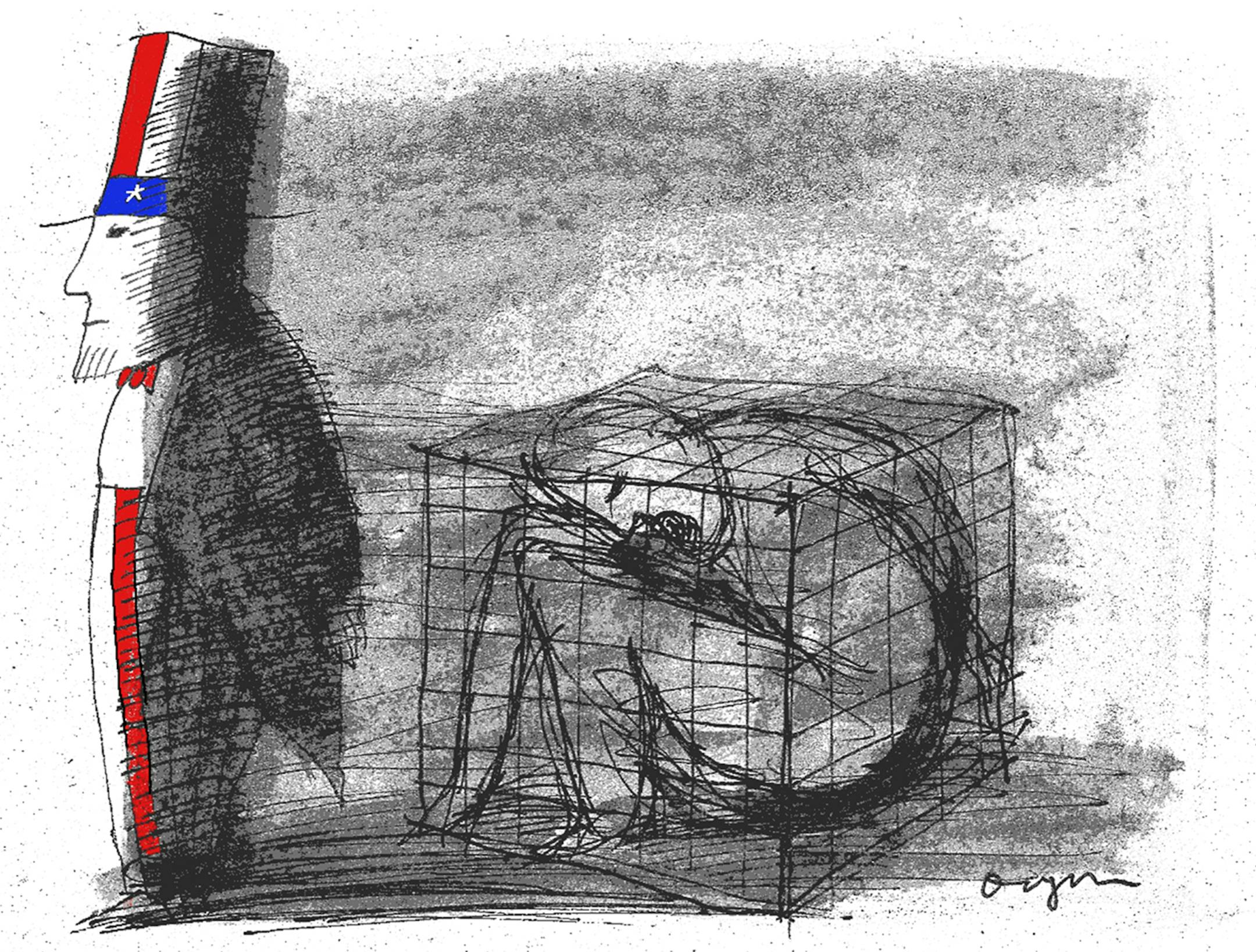
Now that the U.S. Senate report on the Central Intelligence Agency's torture practices is out, the question is whether its revelations do anything to fill the global vacuum of moral authority, which the United States created by reacting so violently to the 9/11 attacks. Will the United States once again be the world's moral leader? Global reaction so far suggests there's a lot of work to be done before it can assume that role.
The report is clearly meant to help re-establish the United States as a guardian of Western humanist values. In presenting it, Sen. Dianne Feinstein, D-Calif., said history would judge her and the other authors by their "commitment to a just society governed by law and the willingness to face an ugly truth and say 'never again.' " British Prime Minister David Cameron echoed that sentiment, telling reporters Tuesday that "those of us who want to see a safer, more secure world who want to see this extremism defeated, we won't succeed if we lose our moral authority."
What's uncertain, however, is whether the United States and its allies understand the basis for that moral leadership.
Sen. John McCain, R-Ariz., whom my Bloomberg View colleague Frank Wilkinson justly praises for breaking party ranks to support the report's release, spent too much time talking about torture's inefficiency at obtaining valuable intelligence before arguing that what's most important is to safeguard Western values. The entire discussion of efficiency, which permeates the report, is counterproductive if the United States wants to express closure and repentance.
The message needs to be "What we did was wrong," not "What we did failed to achieve results." Dwelling on the questionable value of information obtained under torture suggests that if more efficient methods of breaking down suspects' resistance can be devised, the United States would have no qualms about using them.
Germany, which has worked to exorcise the demons of its Nazi and Communist pasts, hasn't made this mistake: Its efforts to cleanse itself have always been about values rather than expediency. It never defended the perpetrators of war crimes, and it made life miserable for the torturers and informers of East Germany's Stasi secret police.
So it's easy for Germans to say that the publication of a heavily redacted report is not enough. "And what next?" asked Matthias Kolb in Germany's Süddeutsche Zeitung. "There is no answer to this question in Washington now. The 528-page report gives no indication as to whether the people responsible for the controversial CIA program will be held accountable and prosecuted."
In this century, however, Germany has built up its own record of relative leniency toward torturers, both domestic and foreign. It's one of 21 European countries — plus some U.S. allies outside Europe — that have cooperated with the CIA's extraordinary rendition program. This may explain why official reaction to the U.S. report has been slow to come and why even favorable comments from people in other countries have been accompanied with barbs at their own governments.


