

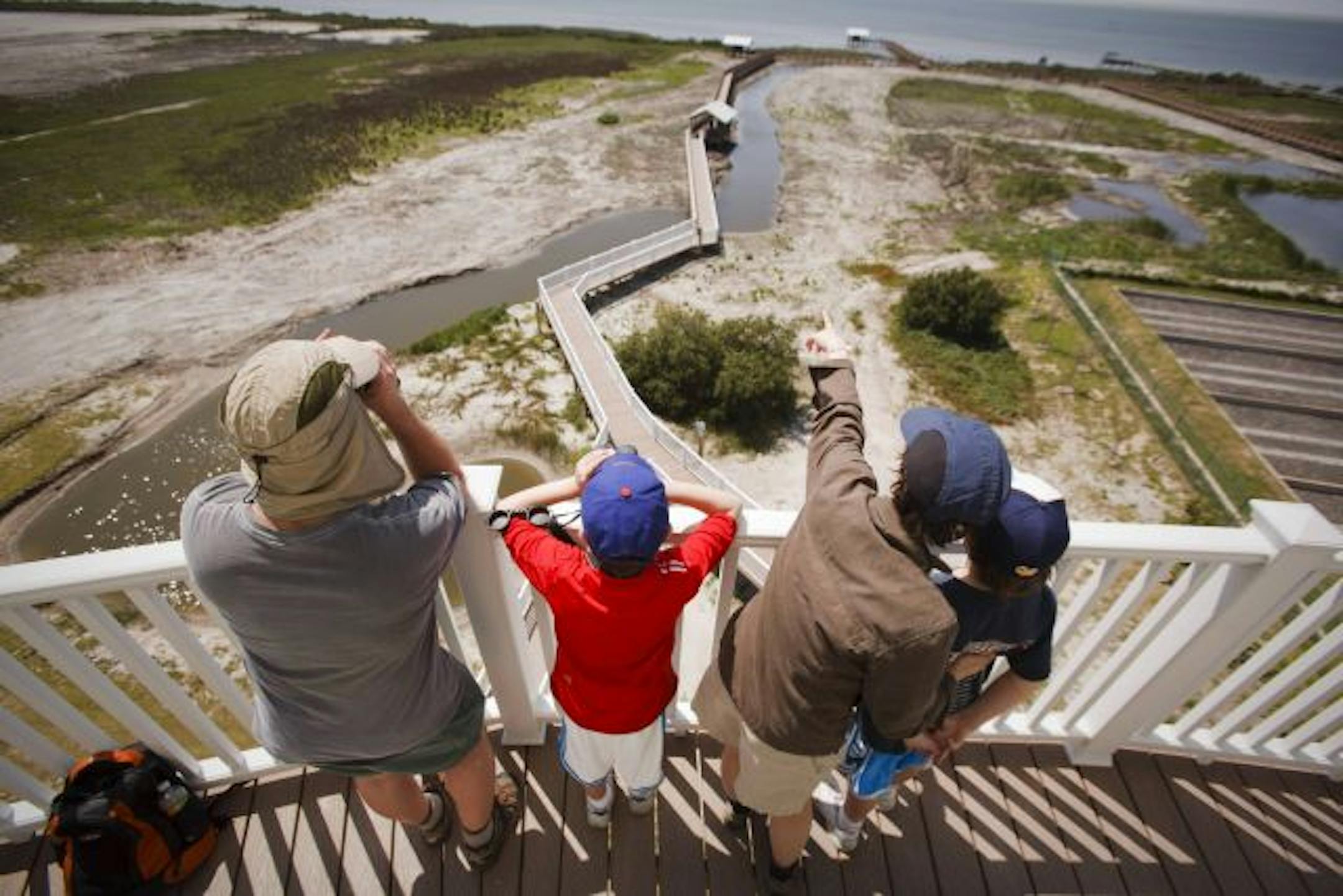
Eleven in the morning is not the best time of day to start birding. But when my plane landed at that hour in the Rio Grande Valley, reputedly one of the best places for bird-watching in the country, I just couldn't wait.
Driving 15 minutes from the McAllen airport to Edinburg Scenic Wetlands, I scored immediately, notching ringed kingfishers, blue-gray gnatcatchers, black-necked stilts, several varieties of herons, circling ospreys and ducks by the dozens before noon.
"I can easily get 50 to 60 species in a day," Gabe De Jong, a park naturalist, told me inside Edinburg's glass-walled interpretive center. The Lower Rio Grande Valley is perhaps the last place where you might consider communing with nature. Where it isn't plotted into RV parks serving northern retirees who come for the warmth and proximity to cheap prescription drugs in Mexico, the valley is sectioned into shopping malls or grapefruit and onion fields. Nonetheless, this narrow green hem has become one of the nation's top spots for bird-watching. A strip of native riparian vegetation (only 5 percent of the original woodlands remains) is a vital flyway for an estimated 500 bird species, both resident varieties and those migrating between North and Central or South America.
A getaway that's for the birds
In September the last of nine valley parks that comprise the World Birding Center opened on South Padre Island near the mouth of the Rio Grande. The center preserves more than 10,000 acres for animals -- from ocelots to orioles -- via sites strung along the 120 miles of river between the town of Roma and South Padre. A partnership among Texas Parks and Wildlife, the U.S. Fish and Wildlife Service and the nine valley communities aims to promote eco-tourism.
With a rental car, some binoculars and the tenacity to look beyond the billboards advertising surgical weight-loss procedures, I staged a four-day road trip along the south Texas border in March, stopping at all nine of the World Birding Center sites -- easily accessible along Interstate 83 -- with another wildlife preserve thrown in.
Though I traveled solo, I rarely bird watched alone. Birders are always eager to share their finds. At Estero Llano Grande State Park, the second World Birding Center I visited after Edinburg, I bumped into Colin Downey and Kharli Rose of Sarasota, Fla., staking out a hummingbird feeder. "We think it's a buff-bellied," whispered Rose, training her two-foot-long camera lens on the bird.
A safe, wild place


