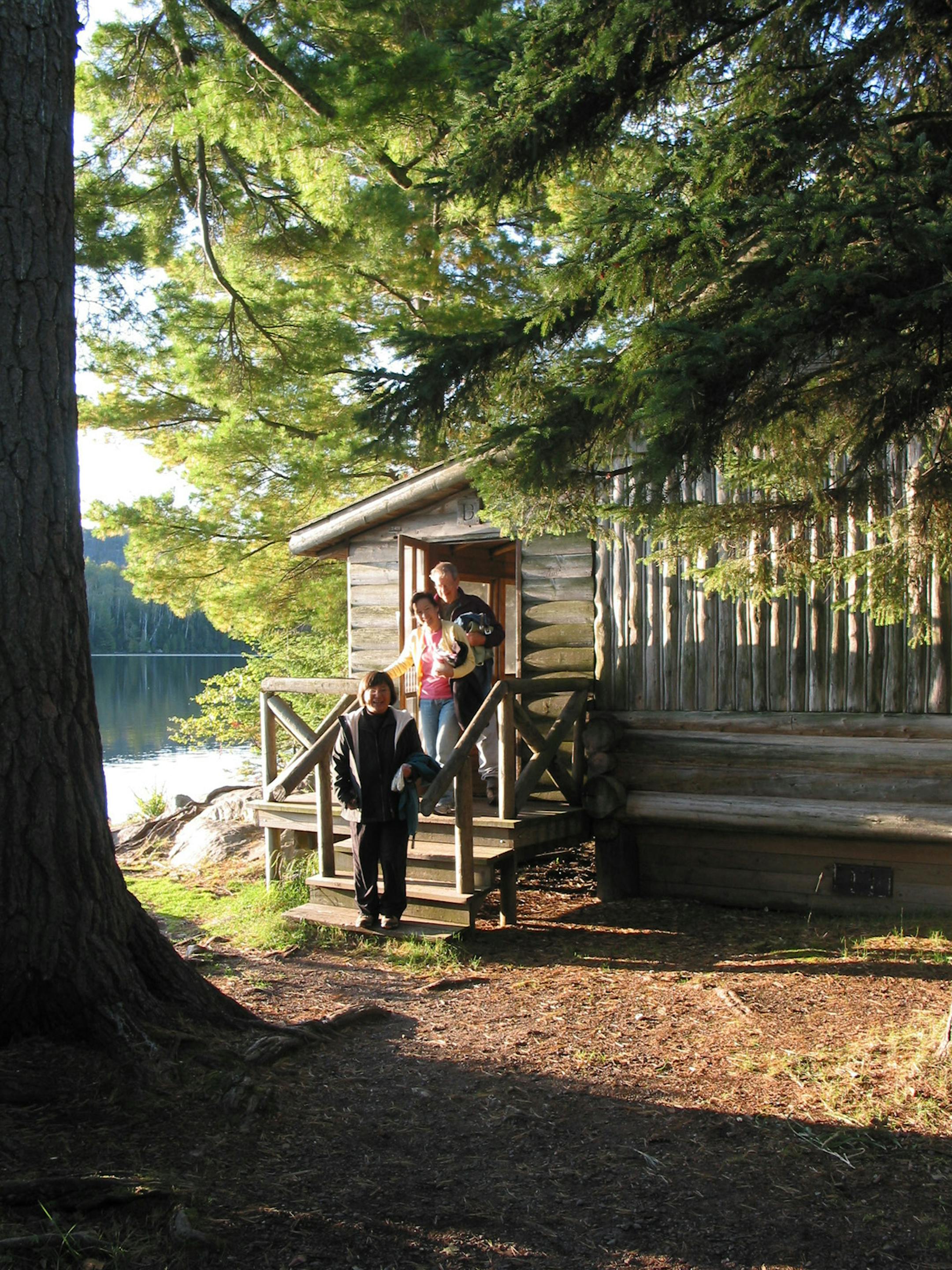
I parked our car on Hwy. 402, a county road several miles inland from Lake Superior's North Shore. My wife, Susan Binkley, and I shouldered our packs and began climbing the ridge into the back door of Tettegouche State Park. We took a rest at the ridge top, a good 300 feet above our starting point. Then we followed the long grade to where our friends waited in an ancient cabin of logs and cedar shingles, 20 feet from the shore of Mic Mac Lake. Birch, maples and conifers dressed the granite knobs surrounding the lake. Turkey vultures and bald eagles spiraled in the thermals rising from the rock ridges.
Why not, Susan wondered, just let people drive to the cabins? After all, the path we walked, described to one of our friends as "rugged," was a good gravel road, steep but not rugged at all.
To eliminate the congestion and noise of vehicles, I ventured. And, I added, I bet the mile and a half walk up the steep ridge makes people really appreciate the place because they had to plan and work to get there. The simple act of hiking creates a special experience that otherwise wouldn't be possible. Arriving on foot at our weathered cabin, sheltered in a thicket of conifers, felt like walking back in time.
•••
Tettegouche has four of these unusual hike-in cabins and a unique history among Minnesota's parks.
Like much of northern Minnesota, the craggy uplands overlooking the Baptism River were shaved of virgin pine in the early 20th century. The loggers worked for the Canadian Alger-Smith Lumber Co. They built their camp on the shore of Nipisiquit Lake, and named landmarks with Algonquin words, such as Micmac, from their native New Brunswick.
By 1910, the loggers had slicked the white and red pine. Alger-Smith sold the camp to Duluth businessmen for a hunting and fishing retreat they dubbed the Tettegouche Club. One member bought out the others in 1921 and maintained the camp in its rustic form for 50 years, till he sold to the deLaittres family. Within a few years, the deLaittres and the conservation group the Nature Conservancy worked out a deal to sell the land to the state Department of Natural Resources to add to Baptism State Park in 1979. The deal created 9,300-acre Tettegouche, the largest and most spectacular state park along the North Shore.
The land included the old hunting camp on the shore of Mic Mac Lake. Some buildings were restored. Others, too far gone to save, were removed. Some, already collapsed, were fenced off. One cabin was moved to make room for a shower building. Four cabins were opened for public rental in 1994--but without drive-in access.