

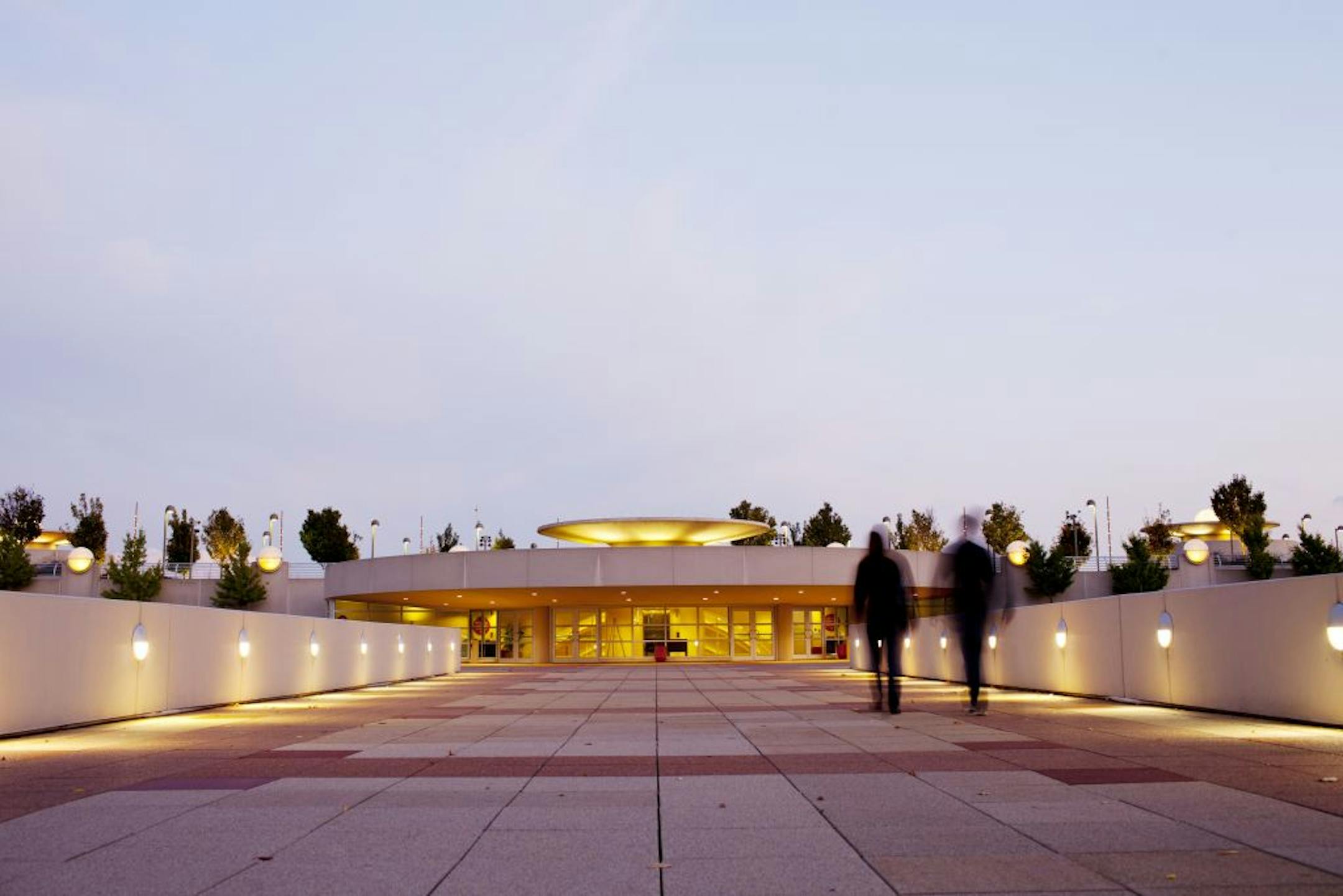
Wisconsin is Frank Lloyd Wright country, the place where he was born and reared and to which he kept returning. To travel there is to marvel at the contrast between the calm landscape and the delirious inventiveness of his work. Unlike books or paintings, the objects created by an architect are not always easily encountered. Most of Wright's 400-plus buildings are private homes scattered around the country and closed to the public. But besides the much-visited Taliesin, Wright's former home and studio in Spring Green, Wisconsin has two lower-profile Wright sites that are welcoming: Monona Terrace, a convention center in bustling Madison, and the Johnson Wax building in industrial Racine.
THE BASICS
Wright died in 1959 at age 91, just six months before his Guggenheim Museum opened in New York City. Wright, an elegant and imperious figure, could seem indifferent when clients complained about the water dripping onto their heads from roofs he had designed. It feels surprising to stumble upon Wright's jolting modernism in the Wisconsin countryside. Here, amid the emerald green fields, is Cubism (evoked in the jutting planes of his houses). Here is Surrealism (note his habit of turning a homely edge into a thing of curve and whimsy). Here are buildings whose forms must have once seemed as alien in this terrain as flying saucers.
WHAT TO SEE
Wright attended high school and college in Madison and eventually designed a masterpiece for the city. The Monona Terrace Community and Convention Center, despite its clunky name, is an unutterably lovely building, an all-white semicircle perched on the edge of Lake Monona. The rooftop terrace juts over the water and functions as a gargantuan public plaza, complete with a cafe. Suspended between views of the Wisconsin Capitol and the level blue stretch of the lake, the building offers a stark choice between the power of the state and the escapism of nature.
As I took in the terrace's perimeter walls, which swoop through space as if in a practice run for the dazzling curvilinearity of the Guggenheim Museum, I found myself thinking about Wright's suspected learning disabilities. According to Ada Louise Huxtable and his other biographers, he was a poor to middling student who probably never graduated from high school. He wangled his way into the University of Wisconsin, where he lasted less than three semesters.
Perhaps the insistent horizontality of Wright's work was rooted in a desire to overcome the indignity of his early academic struggles -- one "reads" his buildings from left to right, as opposed to up and down. If his school assignments saddled him with persistent frustration, he turned his limitations into a strength of his art, imprinting the American landscape with bravura forms that at times seem to echo the flow of sentences across paper.
A tour of Monona Terrace is offered daily at 1 p.m. The history of the building is a fascinating narrative of on-again-off-again city planning. Wright initially proposed his design in 1938. But the denizens of Madison were bitterly divided over whether to lavish taxpayer money on the work of an adulterer and a scoundrel, and the building was not completed until 1997. For this reason, some scholars characterize it as "Wright-inspired" rather than 100 percent undiluted Frank.
The next stop on our Wright tour was Racine, a factory town full of empty storefronts that has seen better times. Yet there remains one incredible draw. The Johnson Wax Administration Building went up in 1939 and continues to serve as headquarters for the company that started out making parquet flooring in the 19th century. Free tours are offered Fridays, and nothing about the red-brick building can prepare you for the breathtaking eccentricity of the space known as the "great workroom," a half-acre windowless, high-ceilinged space furnished with dozens of Art Deco desks. Wright designed furniture, too, and the desks are nifty affairs with wooden tops and curvy metal frames painted Cherokee red.
The grounds include a research library that is open to the public, a handsome room where biographies of Wright, scholarly tomes and historical black-and-white photographs share shelf space with displays of home-cleaning products, including antique cans of J-wax, Beautiflor ("cleans as it waxes") and Glade air freshener.


