

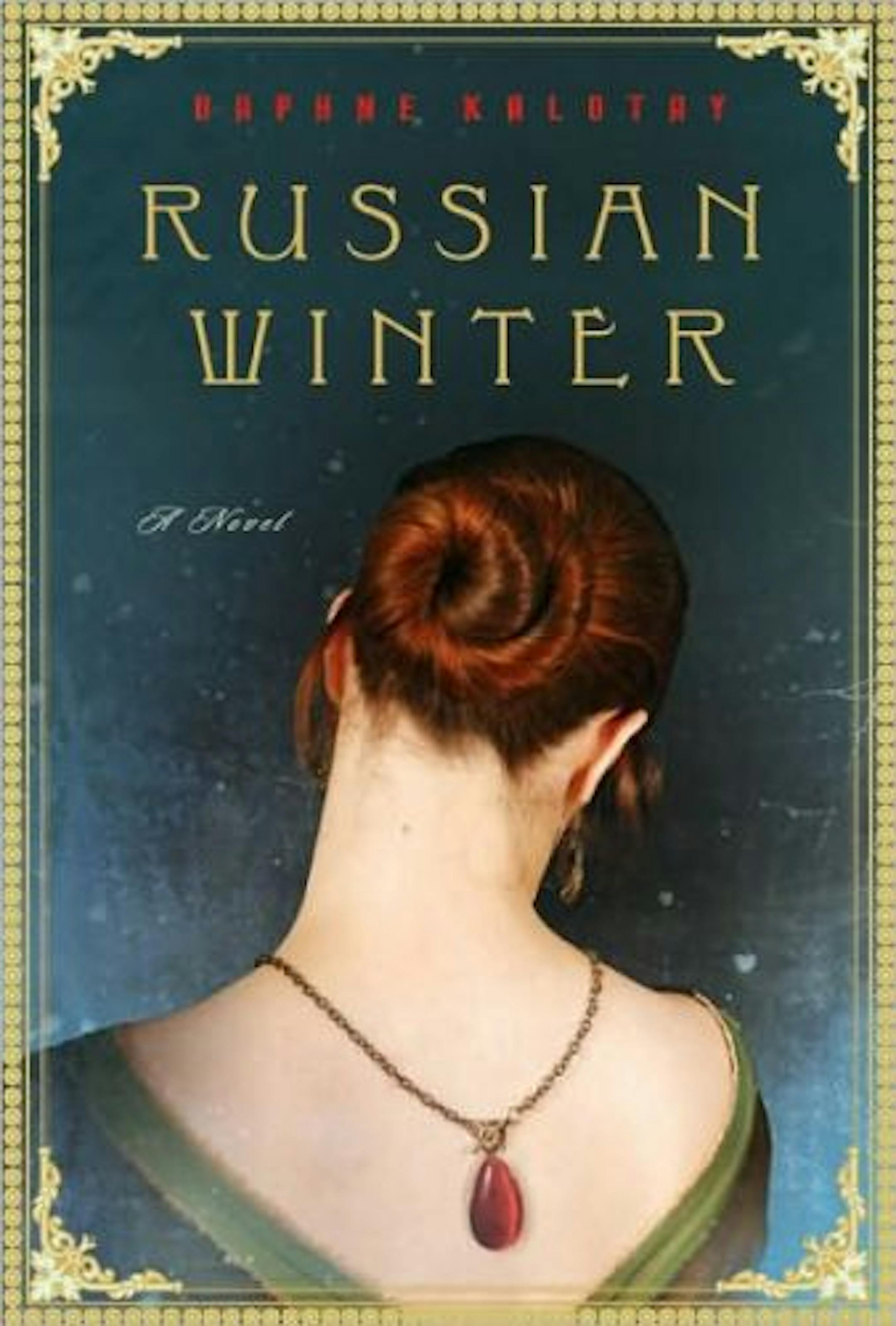
Set in present-day Boston and Cold War-era Russia, this sprawling first novel by Daphne Kalotay depicts the interconnected lives of Nina Revskaya, a long-retired Soviet ballerina; Grigori Solodin, a university professor of Russian literature, and Drew Brooks, a young auction house employee. Jewels, high art, and deception are all involved, and yet despite such tantalizing features, the novel struggles to fully captivate.
As the novel opens, thirtysomething divorcée Drew pays a visit to elderly Nina (now living in Boston), who for unclear reasons has decided to auction off her extensive fine jewelry collection. Meanwhile, Grigori has an overly mysterious, vested interest of his own in Nina; when he hears of the auction, he decides with some deliberation to contribute a piece that he believes belongs as a set with a couple of others. The scenes of "Russian Winter" (Harper, 480 pages, $25.99) alternate between Nina's present-day life and her former, youthful life as a star ballerina in Stalinist Russia, and the lives of Drew and Grigori -- with Drew finding a path for herself four years after her divorce, and Grigori working through the grief of his wife's death a couple of years previous.
"Russian Winter" does contain some good plot twists. However, in a book of nearly 500 pages, anticipation of such twists is stretched a little too thin, and what one has to contend with in the meantime doesn't help: a lot of banal imagery and obvious observations. Nina herself is practically a caricature; once a celebrated dancer, now gripped with a mystery illness that has her largely confined to a wheelchair and has made moving painful and/or difficult, she spends her time alone in her apartment, languishing dramatically. Elsewhere, characters trenchantly observe that reticence can make someone more intriguing, or that dancing can be rapturous and consuming.
Kalotay did a good deal of research for "Russian Winter" (including on the artist's experience in Stalinist Russia), which knowledge she weaves into the book skillfully. One can clearly see how the political environment was fundamental, as every relationship and romance in those portions of the book is beset with difficulties specific to Stalinist times (communal living, informing against one another, etc.). And while the book has some clever, incisive moments, overall its potential and flashes of smartness are weighed down by the volume of thoughts and stories that pass the time well enough, but don't stand out as exceptional.
Kim Hedges is an editor and book reviewer in San Francisco.


