

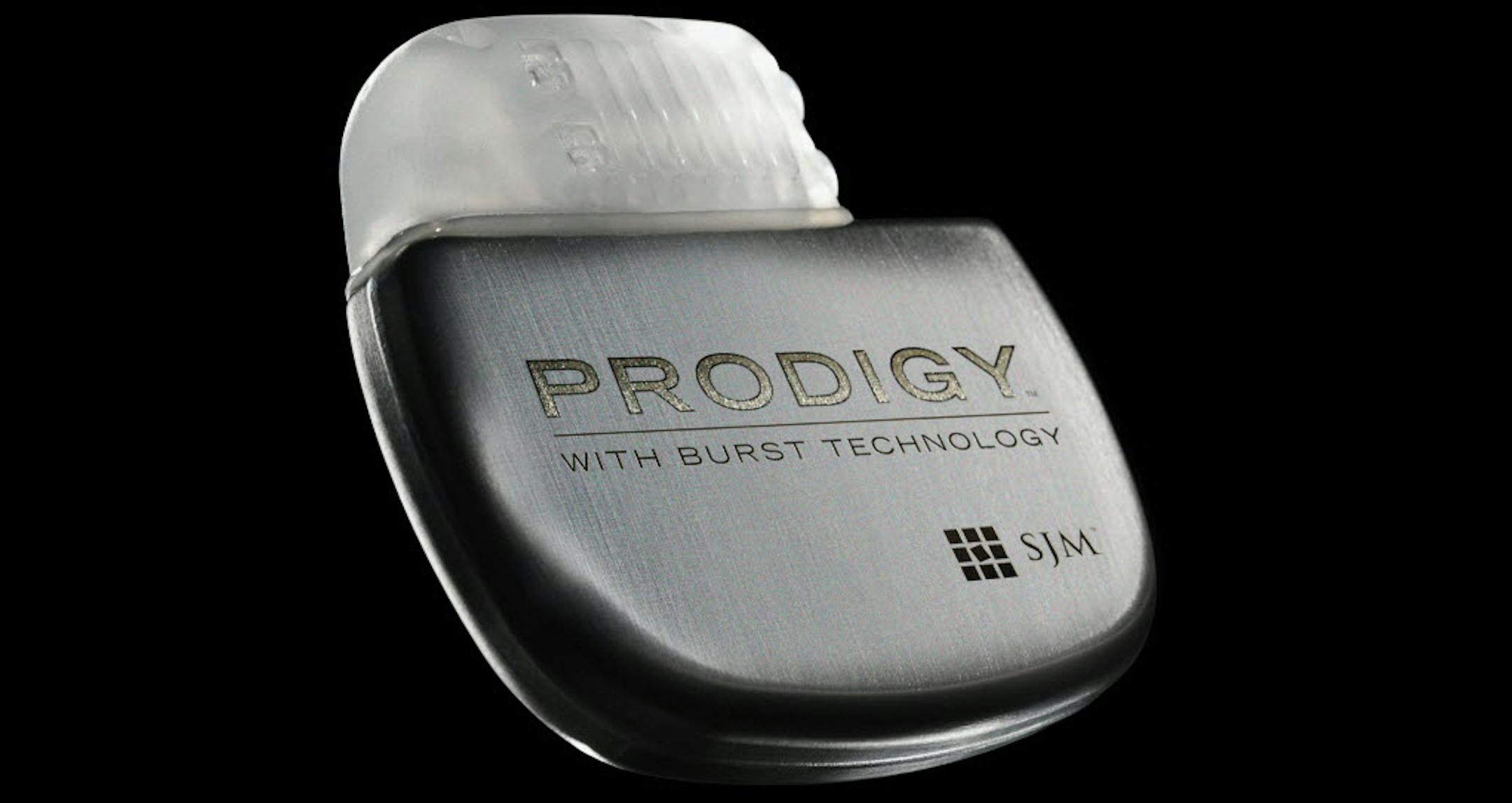
For people with chronic pain, the growth of neurostimulation — use of an electric current to block pain messages from reaching the brain — has been a welcome relief. But the technology loses its effectiveness over time and comes with a pesky tingling sensation.
St. Jude Medical Inc. is hoping to end those problems with its Prodigy neurostimulator. The Little Canada-based company said Tuesday it is beginning to enroll U.S. patients in a clinical study of its new spinal cord stimulation system, which delivers what it calls burst stimulation. Burst stimulation delivers closely spaced pulses of electrical energy to a patient's spinal cord, followed by stretches of quiet — no pulses at all.
The technology "represents an important advancement in neurostimulation therapy," said Dr. Mark D. Carlson, chief medical officer and vice president of global clinical affairs for St. Jude. "We are excited to be leading the effort ... to bring this novel stimulation mode to market."
St. Jude's SUNBURST (Success Using Neuromodulation with BURST) study will evaluate whether burst stimulation — the first of its kind — can be more effective in managing chronic pain than traditional tonic stimulation that sends a continuous stream of electricity to an area of the spine.
Dr. Timothy Deer, an interventional pain physician and chief executive of the Center for Pain Relief in Charleston, W.Va., said burst technology seems to block pain without side effects. "This is very exciting potentially," he said. "But until we get the study going and it is truly reproduceable, we can't say for sure."
Spinal cord stimulation to manage chronic pain has been around for more than 40 years and is given to patients whose pain can't be aided with medication. Implantable systems were made possible as batteries became smaller and could last longer. The procedure involves implanting thin wires along the spinal cord. Those wires are connected to a small pulse generator, similar to a pacemaker, that is usually implanted just beneath the skin. A constant low level of electrical energy is then delivered to interrupt or mask the transmission of pain signals to the brain.
But the therapy can lose effectiveness over time. About 20 percent of patients with leg or arm pain stop responding to the therapy after a few years. For those with chronic back pain, the therapy still works for about 60 percent of patients over time, Deer said.
"Considering everything they have tried before has failed, that's not terrible," he said. Still, the idea is to get better — and perhaps get even more patients off of long-term drug therapy.


