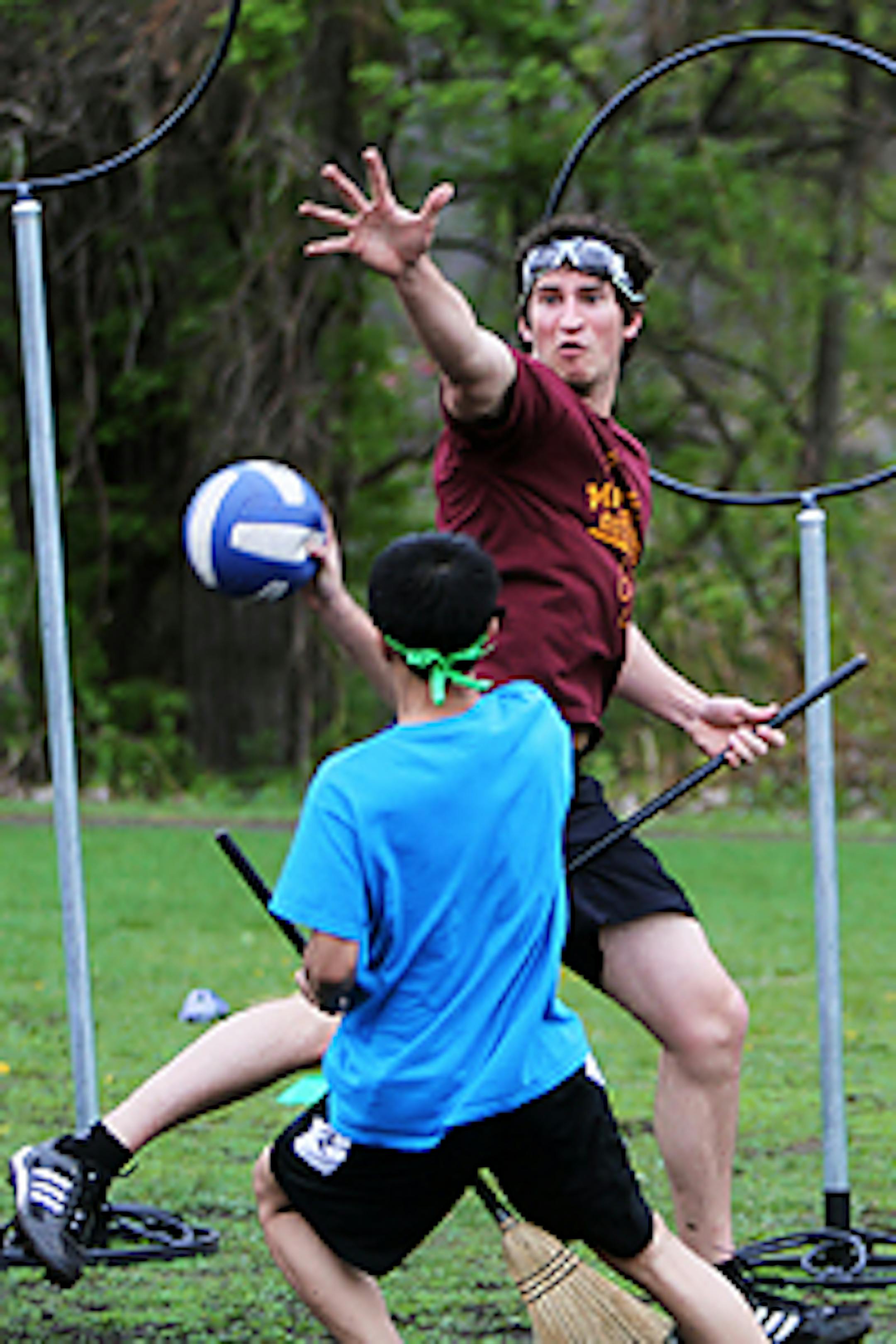
A universe that lacks flying brooms and enchanted Golden Snitches isn't enough to stop University of Minnesota students from playing quidditch, the magical sport invented by J. K. Rowling in her "Harry Potter" series. Locally, it's a big weekend for the University of Minnesota Quidditch League. The UMQL is competing against 10 of the country's best teams at the International Quidditch Association (IQA) Champion Series this Saturday in Boston. The next day, the top four U of M intramural squads do battle on the U's Northrop Mall in its spring tournament. We chatted with events and activities coordinator Cody Narveson to better understand the grounded version of the wizard game.
HISTORY
Non-magical (or "muggle") quidditch started at Vermont's Middlebury College in 2005, the same campus that spawned the IQA in 2007. The sport cropped up at the U in 2010, growing quickly to about 10 intramural teams and one competition team. "We sorta jumped in at a time when a lot of other colleges across the country started their teams," Narveson said.
GROWTH
The IQA has grown rapidly, with 100 teams traveling to New York to compete in the fifth annual World Cup last fall. (The U of M squad lost in the semifinals to Florida.) Even the 2012 Summer Olympics are getting the wizard treatment, as IQA officials are planning a large-scale exhibition match in London to coincide with the games.
The UMQL is well on its way to legitimacy. The club raised $7,000 via its Yule Ball fundraiser last winter at TCF Stadium, and the U of M recently awarded it $13,000 in student group fees for next year. "When this started out, it was more about wanting to play because we love 'Harry Potter,'" Narveson said. "In recent years, there have been people who play purely for the competitive aspect. I wouldn't be surprised if it develops into an all-ages sport."
Game play
Muggle quidditch is something of a rugby/dodgeball /lacrosse hybrid. The co-ed contact sport fields seven members per team, and scoring comes two ways: the chaser position putting the "quaffle" (volleyball) through hoops for 10 points, or each team's "seeker" can snatch the "snitch" (a tennis ball in a gold sock) from the waistband of the snitch runner for 30 points. The snitch runner doesn't have loyalties to any team and is prone to hiding and trickery. Players called beaters huck "bludgers" (dodgeballs) at other players to disrupt the game; the keeper acts as goalie in front of his or her team's set of hoops. Oh yeah, and all the athletes (with the exception of the snitch runner) play with an honest-to-goodness broom lodged between their legs.
Contact is limited to players stiff-arming and shoving. Those sniped by bludgers are forced to dismount their brooms and tag their team's hoops before getting back into the game (to simulate plummeting from the sky, Narveson explains). Referees versed in the official IQA rule book are on hand to prevent any potential Draco Malfoys from playing too dirty.
And the players themselves? "Generally, we strike a healthy balance between people who are athletes and people who love the shit out of 'Harry Potter,'" Narveson says, adding that in-jokes from the wizarding world abound.
Come by Northrop on Sunday to see if Narveson's team, the Chudley Cannons, can make a convert out of you.