

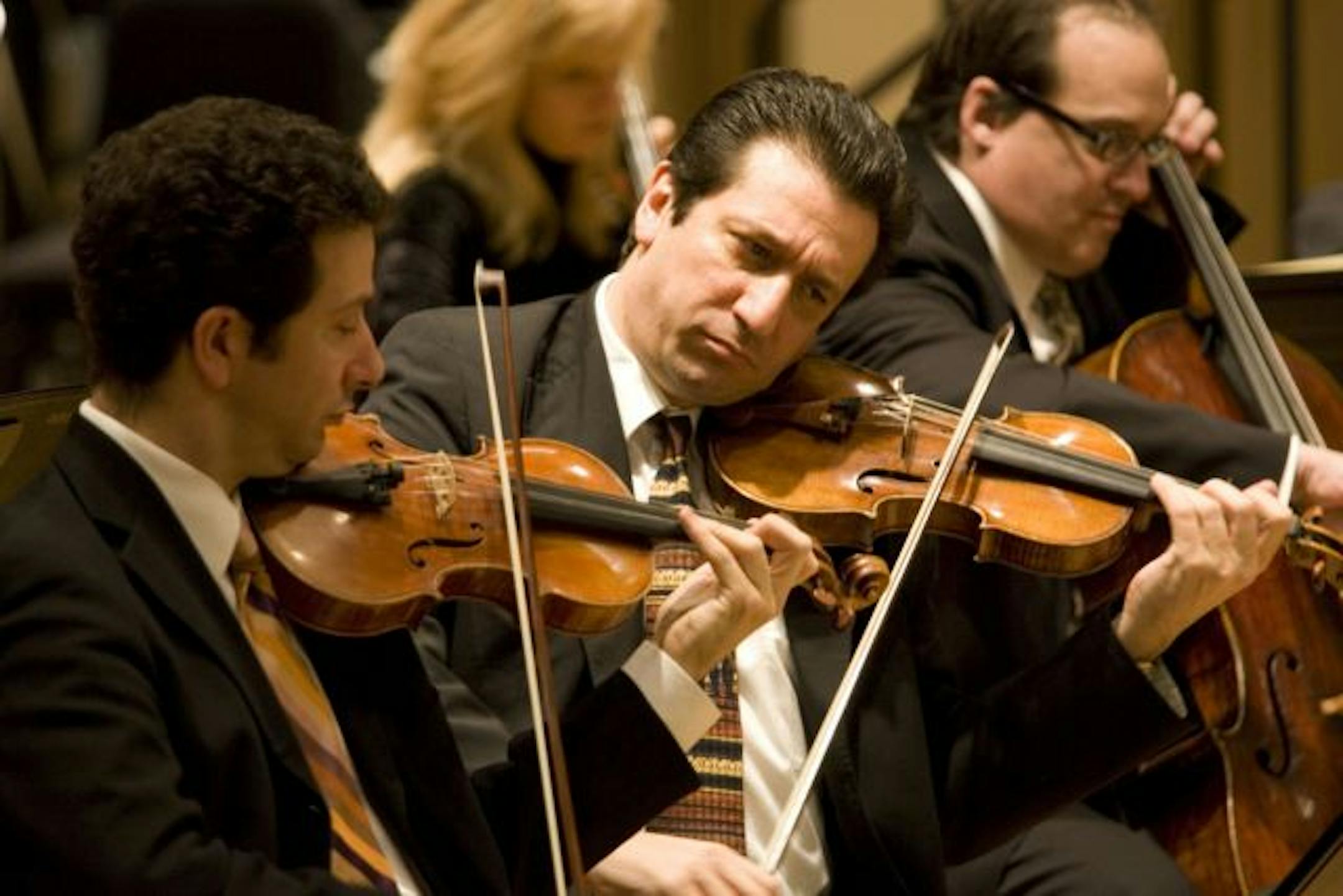
The picturesque, polychrome music of Jean-Philippe Rameau -- paramount figure of the French baroque and arguably France's foremost composer for the stage -- has been handsomely served by the St. Paul Chamber Orchestra this season. In October, Harry Bicket conducted a luscious suite from "Les Boréades," the composer's last opera, with fitting flair. And at Thursday's conductorless concert at Minneapolis' Temple Israel, with violinist Ruggero Allifranchini directing from the concertmaster's chair, the orchestra acquitted itself no less zestfully in a suite from "Les Paladins" (1760), written immediately before "Les Boréades" by the late-blooming, septuagenarian composer.
Only two years older than Bach and Handel, Rameau seems far more remote. Despite a so-called boom, few concertgoers know much about him. By all accounts he was prickly -- unsociable and sometimes uncivil. Formidably learned, he was the leading music theorist of his day. Yet he can bring a smile to the listener's lips just seconds into a piece. A marvelous orchestrator, he gave several instruments unprecedented prominence; piccolo players, in particular, speak his name reverentially. Historian Michael Chanan plausibly calls him "the most Mozartian of composers before Mozart."
"Les Paladins" tells a convoluted chivalric tale, replete with distressed damsel, knight-errant, fairies, furies and the rest. It may be best to forget the plot and revel in the wit and vivacity of the music, its "counterpoint of timbres" most of all.
Does Rameau sound better on period instruments? I think so. Should the SPCO -- not a period band -- continue playing him? By all means. Period and "modern" performances are now understood to be complementary, not antagonistic; audiences benefit from hearing both.
Following Rameau on Thursday's program were two postwar entertainments by Stravinsky, one greatly foreshortened. In "The Soldier's Tale," for seven players, the war in question is World War I, and the violin is first among equals. Concertmaster Steven Copes played brilliantly and bitingly in three tantalizing excerpts from the hourlong work.
Stravinsky's post-World War II Concerto in D for string orchestra, though played incisively, was less satisfying. Its energy feels artificial, its neoclassic displacements too studied; the beauty of its central Arioso seems encased in quotation marks. It is Stravinsky impersonating Stravinsky, a little distantly.
No such reservations attach to Joseph Haydn's "Mourning" Symphony, No. 44 -- one of the summits of his "storm and stress" period. Its finale, as turbulent as anything Haydn ever wrote, was rendered explosively.
Larry Fuchsberg writes regularly about music.


