

The Minnesota Artists Exhibition Program often pairs artists whose works dovetail in some way, a practice encouraged by its two adjoining gallery spaces at the Minneapolis Institute of Arts. But it's hard to recall two shows more conceptually in sync than the current exhibits by Eun-Kyung Suh and Mayumi Amada. Both interpret the fleeting transience of life with installations marked by spare elegance and mystical vision.
In her show "Kuon (Eternal Flow of Time)," Amada repeatedly employs flower motifs to imply that our lives are no more permanent than the lives of flowers. Upon entering, we find ourselves standing in a brightly spotlighted space between two flower-shaped mirrors suspended from the ceiling.
Looking into one of the opposing mirrors throws up the expected reflection of one's self receding into visual infinity. But the mild transparency of the mirror blends this view intriguingly with dim and ghostly images of exhibit visitors elsewhere in the room.
Along one wall Amada has attached a row of strange bouquets with stems made of aluminum strips and blossoms cut from sheer plastic egg cartons. They quiver and droop mournfully and transition nicely to a neighboring installation that brings to mind a graveyard, a kind of astral Elysian Fields. In the darkness, soft blue LED lights beautifully illumine a low expanse of flowers whose five-petal shapes are cut from plastic bottle bottoms.
Elsewhere a large white tarp hangs from the ceiling and drags on the floor. It is cut into doily-like flower patterns within which one reads the phrase: "Our Life on Earth: A Blip in Eternity." Unfortunately, such a bald statement of theme dilutes the exhibit's otherwise enchanting atmosphere of strange mystery.
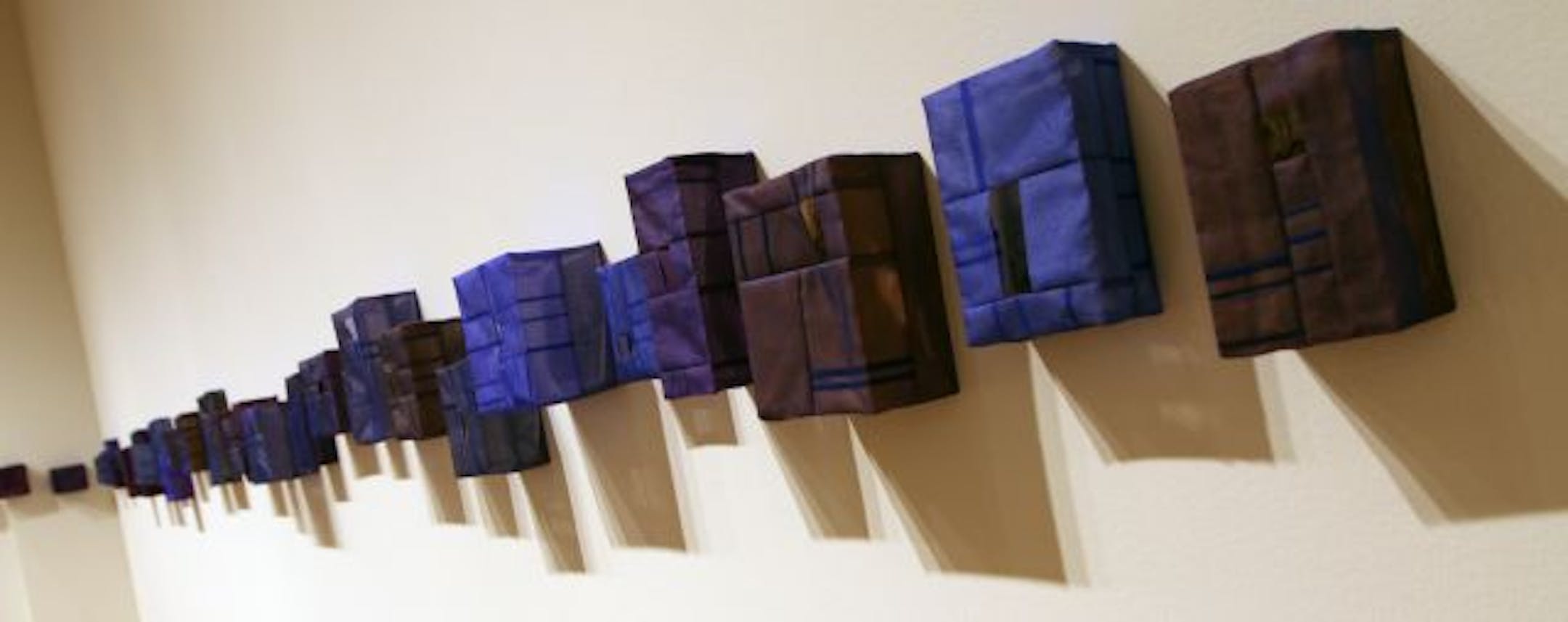
Silk boxes to hold memories
Next door, Eun-Kyung Suh has created a wonderfully nuanced installation dealing with our fragile memories of lives that come and go too quickly. The recent death of her father inspires large parts of her show, which is titled "The Voided."
The artist makes highly original use of bojagi, the ancient Korean practice of sewing together spare fabric pieces to make containers of all sorts. From squares and rectangles of silk organza, Suh patiently stitches boxes that serve as vessels for human memories. No larger than a foot on any side, each box contains a black-and-white family snapshot printed on white linen.


