

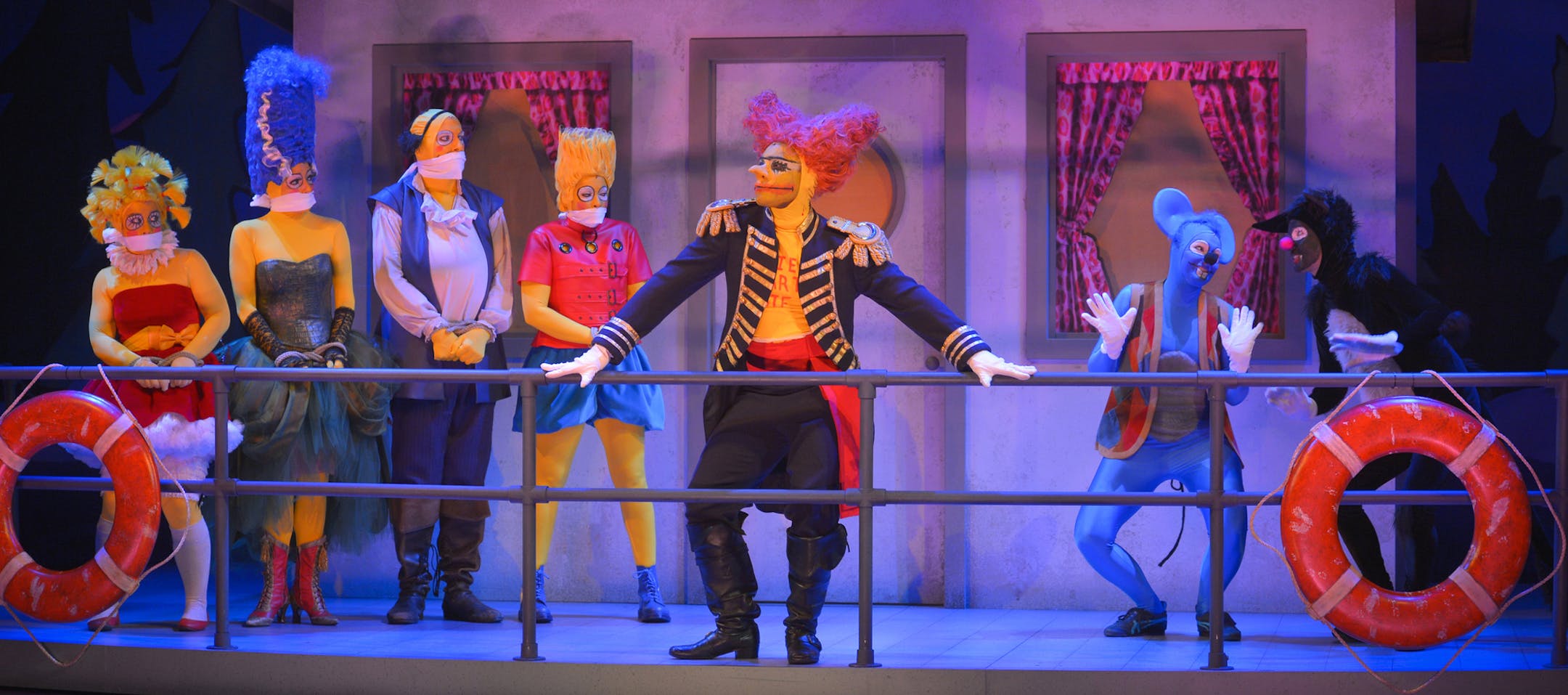
Last fall, as he prepared to direct "Mr. Burns, A Post-Electric Play" at UC-San Diego, Jack Reuler asked a friend for a list of "Simpsons" episodes that seemed essential to understand the first family of Springfield.
Reuler watched Kodos and Kang hijack the 1996 presidential election in "Citizen Kang," fell in love with "The Curse of the Flying Hellfish" and breezed through "A Streetcar Named Marge" and dozens of others — including "Cape Feare," which borrows from two suspense movies and a Gilbert & Sullivan operetta.
That last episode was the most important to Reuler. In writing "Mr. Burns," playwright Anne Washburn used "Cape Feare" as a MacGuffin — a device that takes on inflated importance in the telling of a deeper story, in this case how survivors of disaster remember their devastated culture.
"Mr. Burns" jumped into the theater consciousness for its invocation of that beloved and cheeky TV cartoon and for its exploration of how art is preserved. A co-production by ACT-San Francisco and the Guthrie Theater, directed by Mark Rucker, opens in Minneapolis this weekend.
So did Reuler find his 40-show "Simpsons" marathon worth the effort — even though Washburn admits that rabid fans of the show might be disappointed in the play?
"Completely," Reuler said. "It helps you understand the context, what certain lines of dialogue imply or what they lead to. You know the history of characters, why they say what they say."
Washburn's play assumes that an unnamed calamity has rocked civilization. Survivors huddled around a campfire recall the Simpsons' "Cape Feare" — similar to how we imagine prehistoric people might have told stories from their past, or how modern-day campers might fill an evening of beer in the woods.
Certainly you recall the "Cape Feare" episode. It follows the plot of the 1991 and 1962 suspense films. A convict bent on revenge terrorizes a family, the action culminating on a houseboat floating down a river.


