

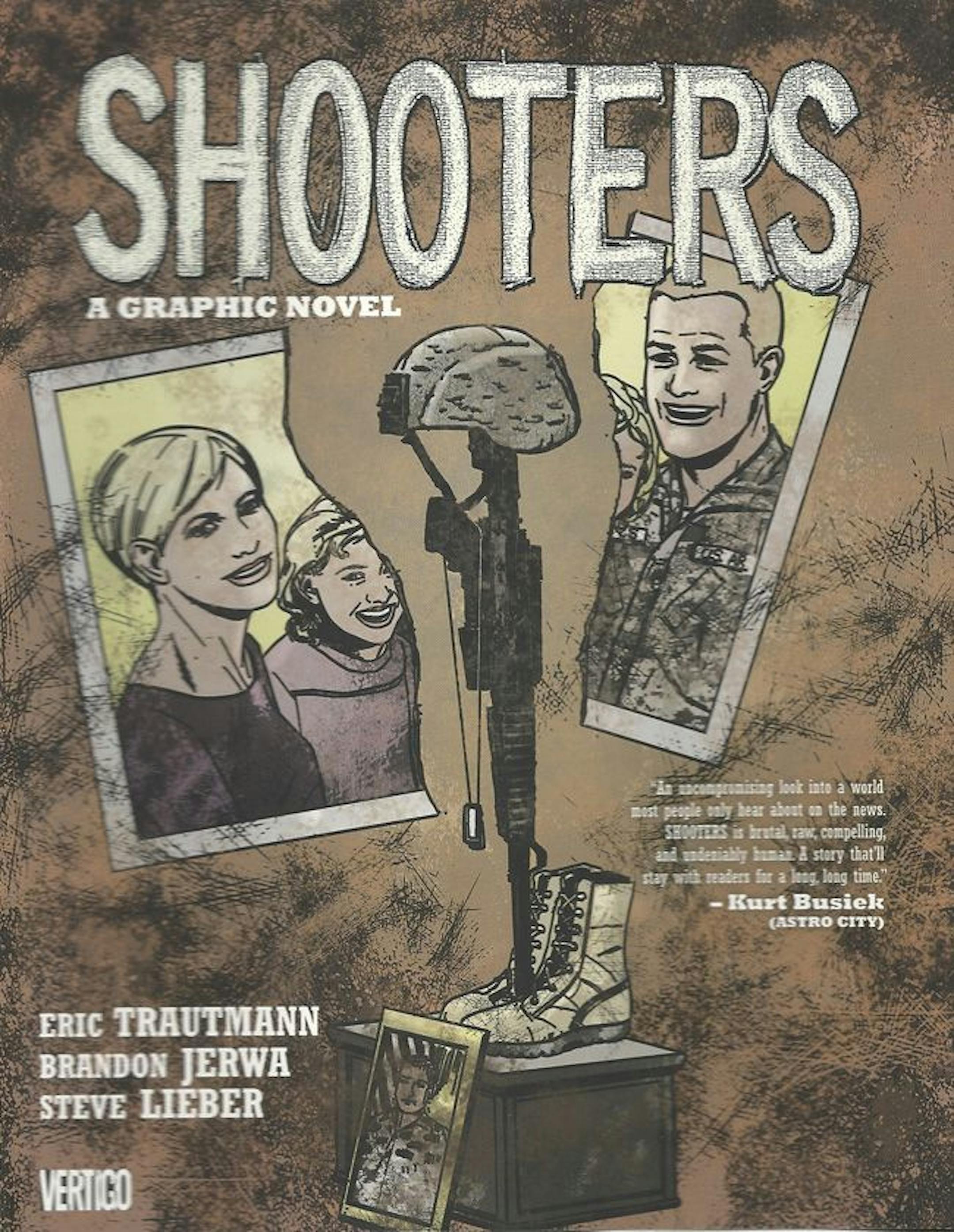
"Shooters" is a new graphic novel that puts the emotional journey of its warrior protagonist at the center of the story. As such, it's a "war book" that takes us into places few other war books have.
"Shooters" (DC/Vertigo, $23) follows Terry Glass, a chief warrant officer serving with U.S. forces in Iraq in the early 2000s. A dedicated soldier, Glass' world explodes in a way that wipes out most of his unit and leaves him terribly injured. We follow a traumatized Glass in his rehabilitation, during which his marriage disintegrates and the rest of his life falls apart. He even resigns from the military.
It all makes him a ripe recruit for a private military contractor named Steel River (read: Blackwater). Blackwater did a lot of things in Iraq, but we're fuzzy on exactly what. Authors Eric Trautmann ("Checkmate") and Brandon Jerwa ("G.I. Joe") take us into this world. Even though "Shooters" is fiction, their view inside Blackwater feels eerily plausible, even likely.
Despite all the jargon and detail, "Shooters" isn't a military procedural. Nor does it stand on a soapbox; it neither glorifies war nor decries it. It takes no positions on the politics of the war. The Iraq War -- it really could be any war -- is simply the environment in which Glass' character is forged.
So "Shooters" is, specifically, Glass' story. It's a painful tale of conflict, but not just the outer one that shapes Glass. It's the story of his conflict with war, the military, post-traumatic stress disorder, injury and recovery, his wife, his emotions. As his name implies, he reflects all these conflicts so that we may see them, just as he furiously deflects them away -- until the climax, where he must face them all at once.
Is that a war story? It is, although it bears almost no resemblance to what passed for war stories in comics for a long time, such as Sgt. Rock or the Haunted Tank. There's a place for jingoistic war books, one where the super-competent American always wins, or one that dwells on the cool equipment and jargon to the point of fetishism.
But the best war comics focus on the human element, such as Harvey Kurtzman's 1950s stories for EC's "Two-Fisted Tales" and "Frontline Combat," or Garth Ennis' current "Battlefields" for Dynamite. "Shooters" falls into this paradigm, and it's a powerful story.
Strangely, I was less impressed with the art. Steve Lieber seems to be going for a minimalist approach, which is usually the sign of a maturing artist. But here it had the effect of looking bare and plain. Still, Lieber's storytelling is impeccable.


