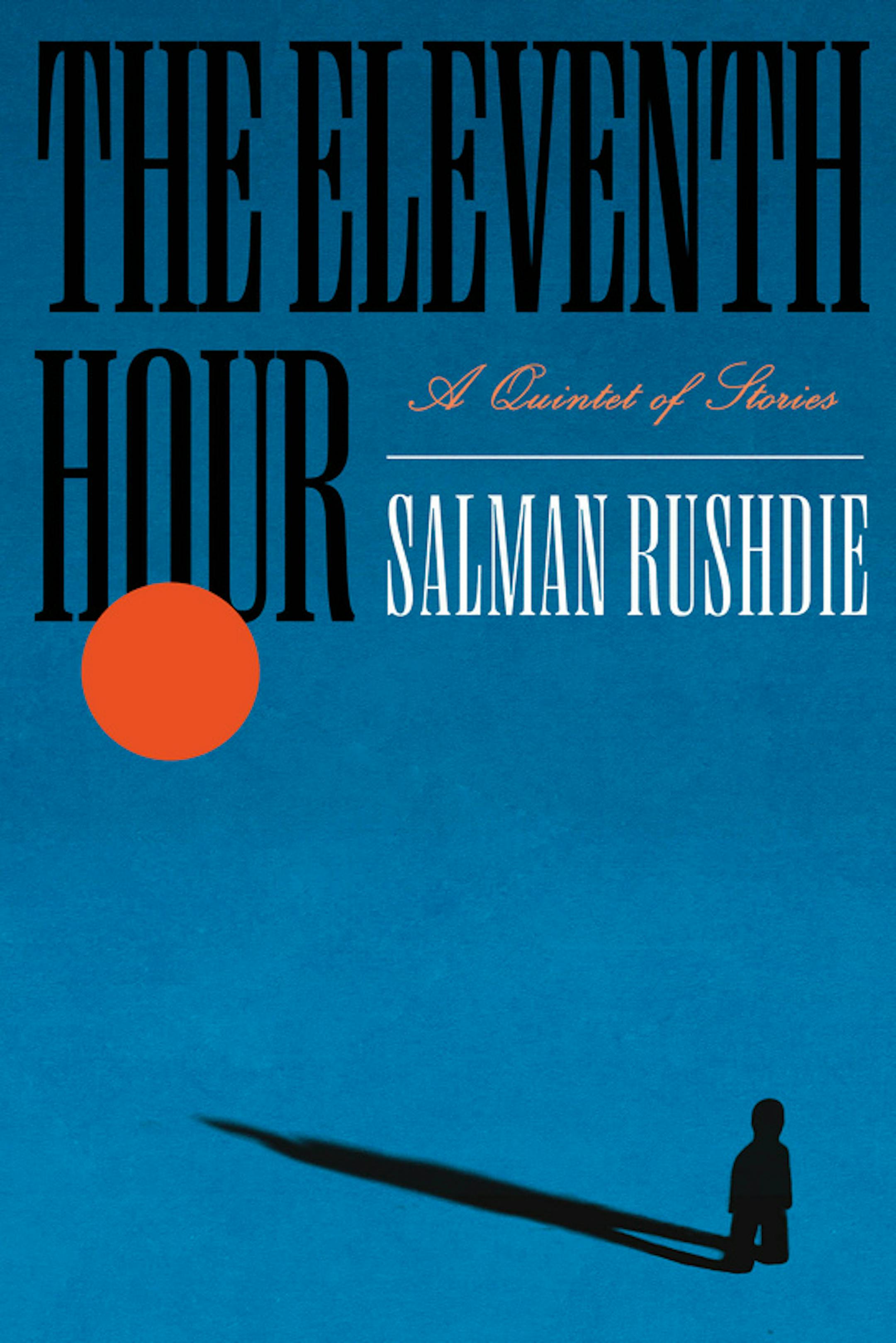
Call him a master wordsmith, formal innovator, Booker prize winner, Nobel laureate-in-waiting, a sorcerer. Call him Sir Salman Rushdie.
He slips into a story as gracefully as Laurence Olivier vanished into a Shakespearean role. Rushdie’s towering talent is evident throughout “The Eleventh Hour,” a quintet of tales that are his follow-up to “Knife,” a searing memoir of his near-fatal 2022 stabbing. Here, his fiction blends the real with the fable-like. No Anglophone writer does it better.
Set amid a city on India’s southeast coast, “In the South” features Senior and Junior, two elderly men who share a last name and adjoining balconies and who contemplate philosophy and religion. “Oklahoma” is a text embedded within a text, brimming with mesmerizing mystery, befuddled characters and an afterword that offers as much clarity as the Sphinx’s riddle.
“The Musician of Kahani” unfolds in a city not unlike Mumbai: An unhappily married couple of mathematicians marvel at their daughter, who fixates on an old piano. “Its presence was a kind of prophecy. One day the little girl lifted the piano’s lid, struggled up onto the stool, and simply began to play. Her astounded parents came into the room and stood and watched as people do before whose eyes a miracle is taking place.”
Years later the daughter, Chandni, catches the eye of a super-wealthy playboy; their own baby recalls the arrival of another holy child in Arundhati Roy’s “The Ministry of Utmost Happiness.” The narrator toys with us, commenting on schisms between rich and poor.
The prose here is Rushdie at his supple best, restrained yet daring. He nods to non-western traditions: a college provost enters a room “as regally as he always did, floating forward as if conveyed on a small airborne rug, the invisible bejeweled crown glittering as usual on his shining head, the imaginary orb and scepter of kingship in his hands.”
In the wake of the author’s recent attack (he lost an eye), his characters brood on mortality; a few are ghosts, such as a dead 61-year-old academic who wakes up one morning, still sentient: “Things he would never do. He would never visit the Pyramids or Greece or his mother’s grave. Things he would never do again: sex would be at the top of the list for many people, but in his case it hadn’t been a subject for a long time, so it didn’t count. He should put ‘eat Chinese food’ up there instead.” There’s a twist in this piece, “Late,” that underscores Rushdie’s wizardry on the page.
While diverse in technique, each story in “The Eleventh Hour” springs from a common argument: Language, whether spoken or read or imagined, transforms us all. The collection’s concluding piece — “The Old Man in the Piazza,” an austere allegory — evokes the somnolence of a Giorgio de Chirico painting and the necessity of finding a voice.