

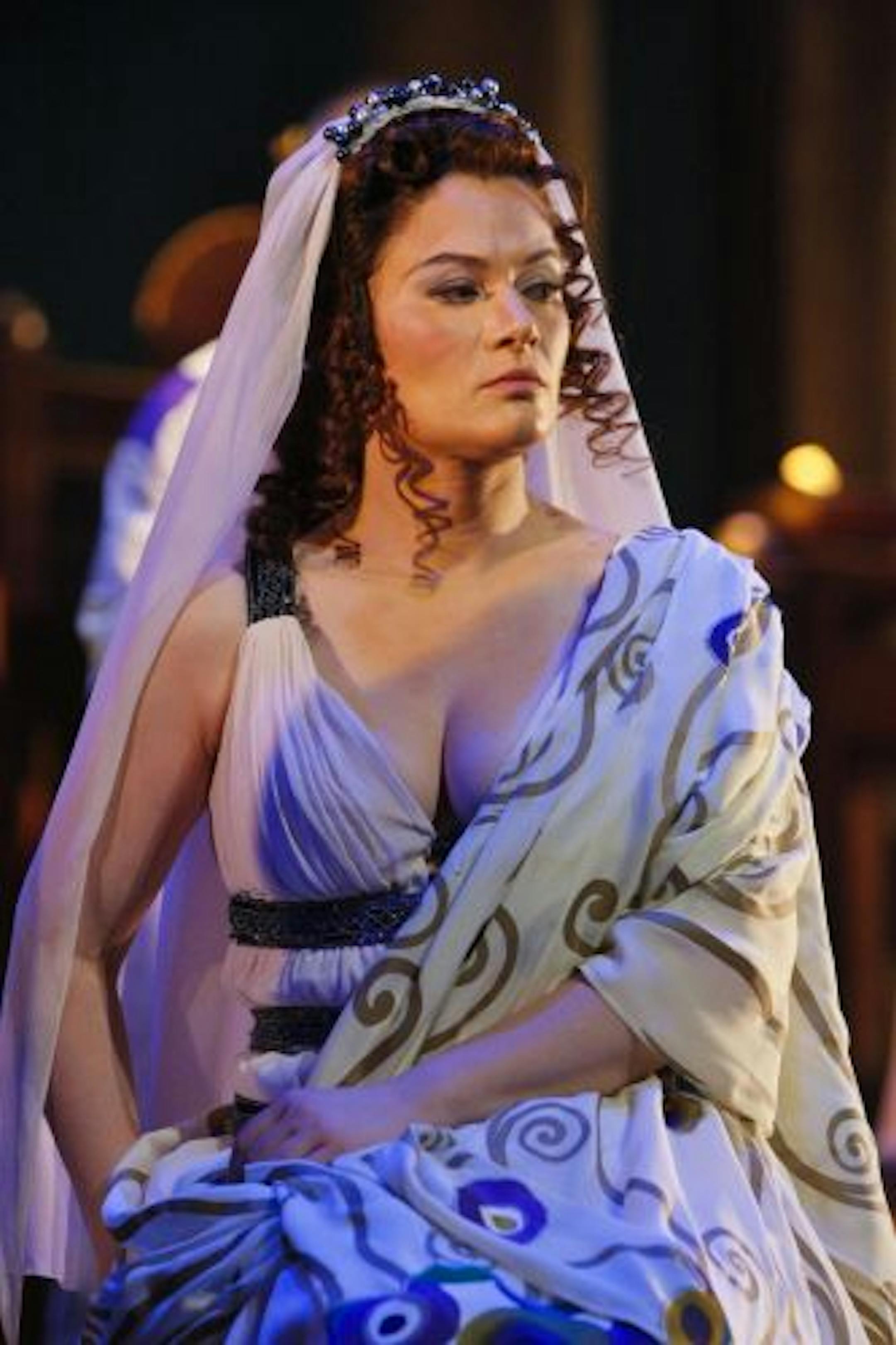
Richard Strauss' lurid, one-act "Salome" (1905), which opened Saturday at St. Paul's Ordway Center in a superbly sung new production by the Minnesota Opera, is a canny essay in depraved carnality, more sensationalist than unsettling.
In its second century, it has lost its power to shock, if not to titillate; its misogyny and anti-Semitism, never attractive, have grown odious. So why does it hold the stage?
Efficiency is one answer: Barely 100 minutes long, the piece seizes the attention and never lets go. Then there's the singing, which for many operagoers is what the medium is all about. "Salome" climaxes in one of the greatest of operatic monologues, an 18-minute psychodrama that provides a matchless vehicle for the right soprano. And if a severed head is part of the bargain, well, such are the sacrifices we make for Art.
But if the soprano gets the ovation, the orchestra is arguably the real protagonist: It moans, shrieks and insinuates, making vividly audible the psychopathological stew in which Strauss' characters swim. While the 68 musicians of the Minnesota Opera Orchestra seemed up to the task, they were held in check by conductor Emmanuel Joel-Hornak, who showed too much deference to his singers. Often the orchestra simmered when it should have boiled; Salome's famous dance, which buys her the head of John the Baptist, was decidedly unslithery.
Billed as "scandalously erotic," the production is hardly that. Steve TenEyck frames the action with slender, symmetrical columns; his resourceful lighting does much of the heavy lifting. Jennifer Caprio's handsome costumes have a touch of Hollywood Biblical about them.
Director/choreographer David Lefkowich's largely static staging leaves unexploited many dramatic opportunities in the libretto (a German abridgement of Oscar Wilde's French original). Lefkowich turns Salome's dance into a quartet, adding three trained female dancers who, in undressing her, introduce a homoerotic component. But for the crowning monologue he deposits his heroine on an otherwise bare, brilliantly lit stage, as if to acknowledge that it's her show.
Mlada Khudoley is incandescent as Salome, at once perverted and sympathetic. In her final minutes she finds a macabre, necrophiliac ecstasy from which it's impossible to look away. Her high B-flats are secure, her low notes shudder-inducing.
Khudoley has a worthy foil in Jason Howard's commanding, sonorous John; his "Never, daughter of Babylon," hurled at her, is the evening's most chilling moment. Dennis Petersen's Herod is musically impeccable but a bit under-acted; the character is more manic than Petersen lets on. Elizabeth Byrne, herself an accomplished Salome, makes something memorable of Herodias' every line.


