

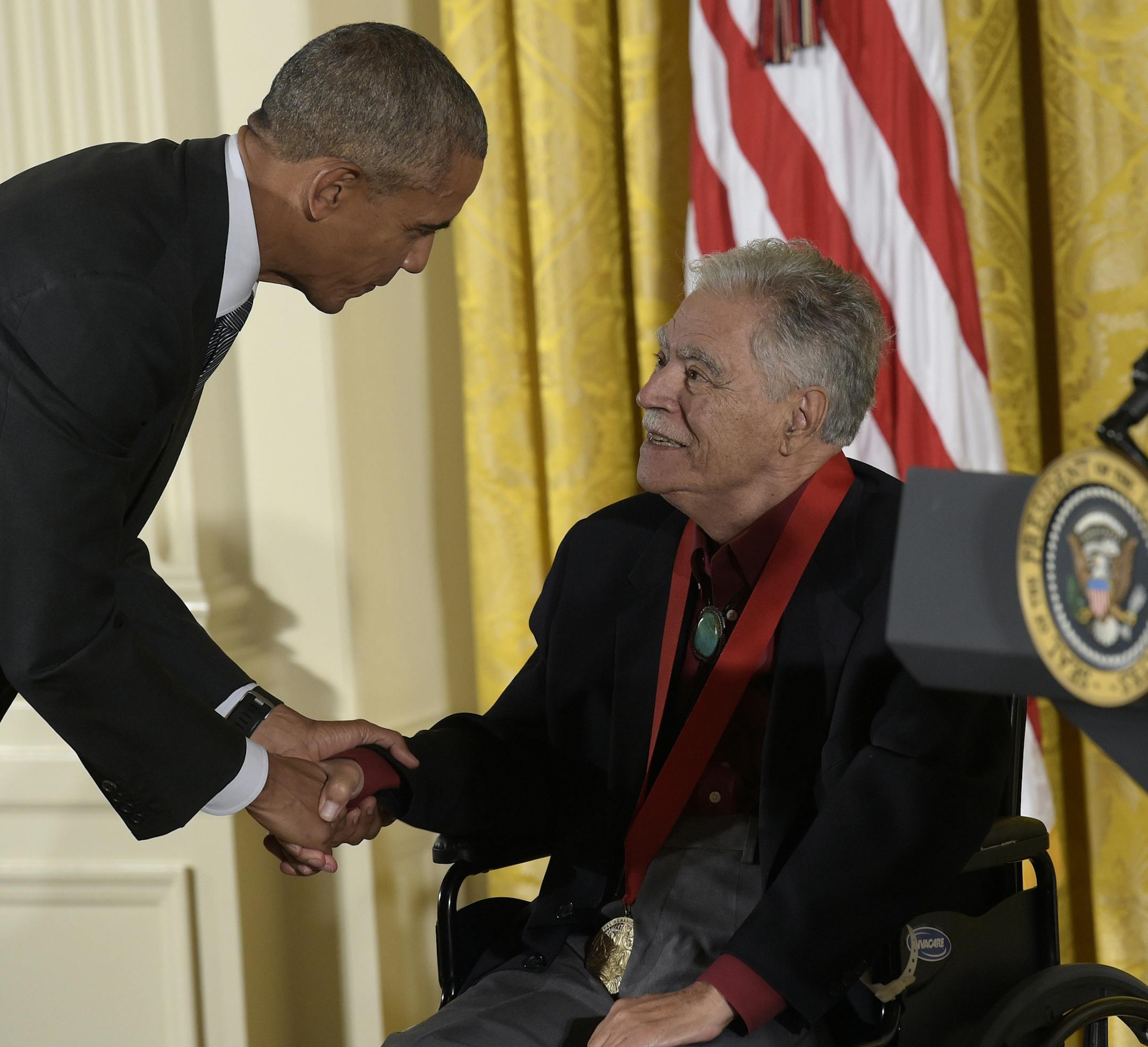
Rudolfo Anaya, 82, who helped spark a Chicano literary renaissance with his 1972 novel "Bless Me, Ultima," a lyrical coming-of-age story that drew on Southwestern myth and folklore while exploring Mexican-American identity, died June 28 at his home in Albuquerque.
Anaya was dubbed the godfather of the Chicano novel, a title that was largely the result of his critically acclaimed debut. Mixing Spanish and English in its descriptions of the New Mexico llano, or flatlands, where Anaya was raised, the book sold hundreds of thousands of copies and was adapted into a 2013 film.
He later wrote dozens of novels, plays, nonfiction books and poetry collections while teaching at his alma mater, the University of New Mexico in Albuquerque, and in 2016 received the National Humanities Medal.
"His works of fiction and poetry celebrate the Chicano experience and reveal universal truths about the human condition — and as an educator, he has spread a love of literature to new generations," the White House said at the time.
Anaya rose to prominence during the Chicano Movement, which began in the 1960s as Mexican-Americans campaigned for political, economic and cultural empowerment. It took him seven years, and at least as many drafts, to write and publish "Bless Me, Ultima."
The manuscript was rejected by dozens of publishers before receiving a newly created Chicano literary prize from Quinto Sol, a small California press that published the novel and other milestones of Chicano literature.
"Bless Me, Ultima" was followed by two semi-autobiographical books that formed a loose trilogy: "Heart of Aztlán" (1976), about a family that moves from the countryside to the city; and "Tortuga" (1979), about a boy recovering from a crippling accident that mirrored Anaya's own childhood neck injury.
Rudolfo Alfonso Anaya was born in Pastura, N.M., on Oct. 30, 1937, and grew up in rural Santa Rosa.


