

Looking for information on a piece you were told is "antique Royal Vienna porcelain"? You'll find it in price guides and other online sources listed with "beehive" porcelain.
The first mark used by the Royal Porcelain Manufactory in 1744 was actually a line drawing of the outline of a shield. But when turned upside down, it looked like a beehive.
Collectors today call the mark a beehive and the porcelain, "Royal Vienna." The factory closed in 1864. But since then, porcelains have been made in Germany, Austria, Japan and other Asian countries that are reproductions of the expensive original antique pieces. Be very careful to examine any piece called Royal Vienna or any piece with a beehive mark before you buy it.
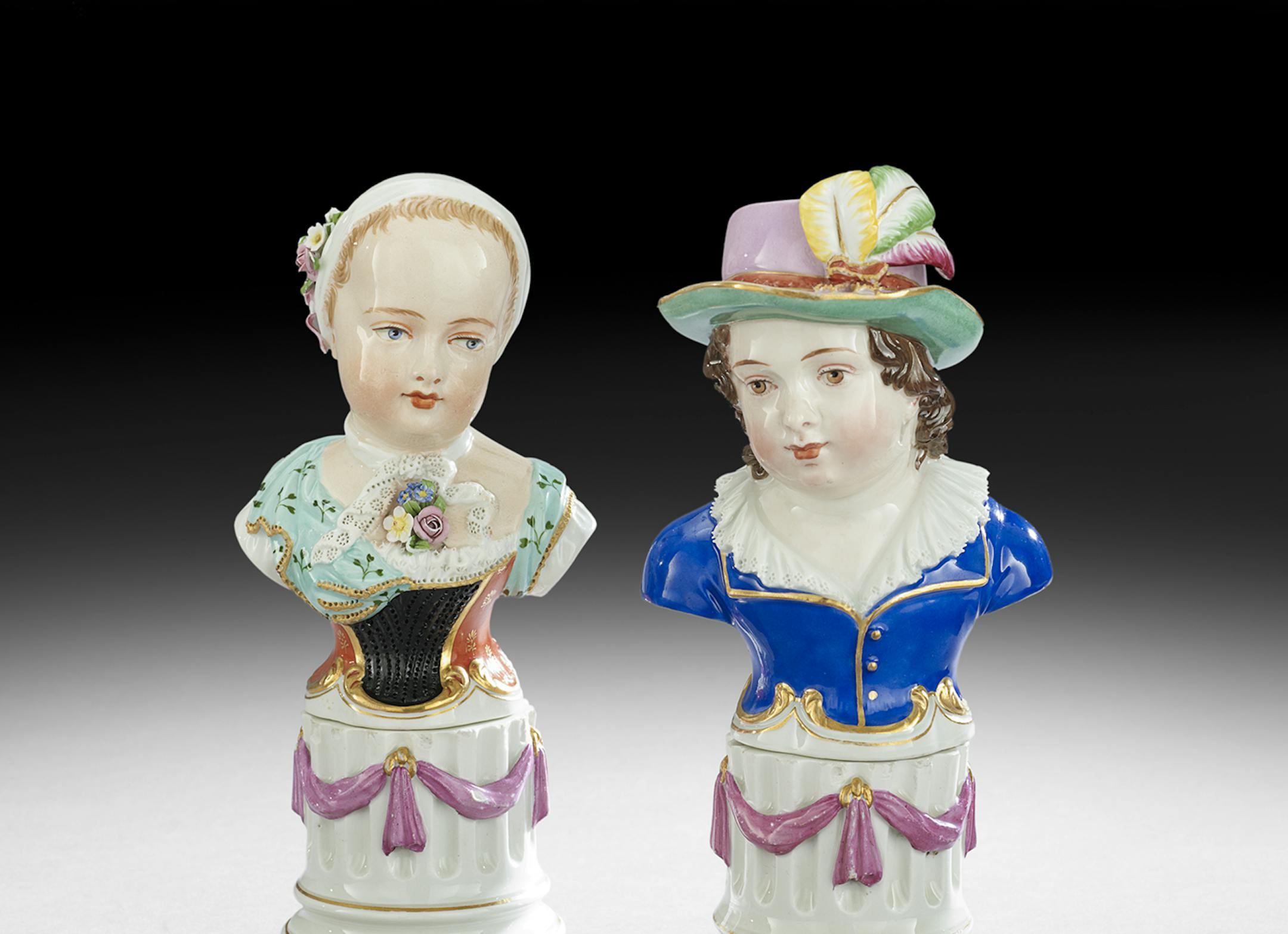
A December 2014 auction by New Orleans Auction Co. sold a pair of Royal Vienna Porcelain "Kinderkopf" busts that were copies of figures designed by J.J. Kaendler at the German Meissen factory in the 1770s. A figure made by Kaendler in the 18th century would cost thousands of dollars. The pair, sold in New Orleans, were made about 1860 at the Konigliche Porcelain Factory in Berlin and brought $676.
Mission bookcase
Q: We inherited an oak bookcase from my grandmother. It has five shelves that can be separated from each other. Each shelf has a lift-up glass door. The bookcase is labeled, "Mission Bookcase Unit, manufactured by The Globe-Wernicke Co., Cincinnati, O." Please tell us its value.
A: Globe Furniture Co. of Cincinnati bought Wernicke Co. of Minneapolis in 1899 to form the Globe-Wernicke Co. Otto Wernicke had patented his sectional bookcase in 1892 and it became a bestseller for the company. The bookcases, made in oak, ash, walnut or mahogany, became known as "barrister bookcases." They were sold not only to lawyers, but also to libraries, government offices and storefronts. Today, the bookcases are sought by collectors. A five-shelf unit in excellent condition would sell for more than $1,000.
Keane books
Q: I have a hardbound book titled "Walter Keane," part of the Tomorrow's Masters Series by Johnson Meyers. It's a first printing by Johnson Meyer Publishing Co. of Redwood City, Calif., and has a copyright date of 1964. Is there any collectible value to this book because of the 2014 movie, "Big Eyes," depicting the scandal about Walter Keane not painting the pictures sold as his work? I also have the book "MDH Margaret Keane" with the same copyright date.
A: These books originally were sold as a boxed two-volume set. Margaret Keane signed some of her paintings with her initials, MDH, and her last name. Some of these are in the book about her. Walter claimed credit for her paintings of big-eyed children, and those paintings are included in the book about him.


