

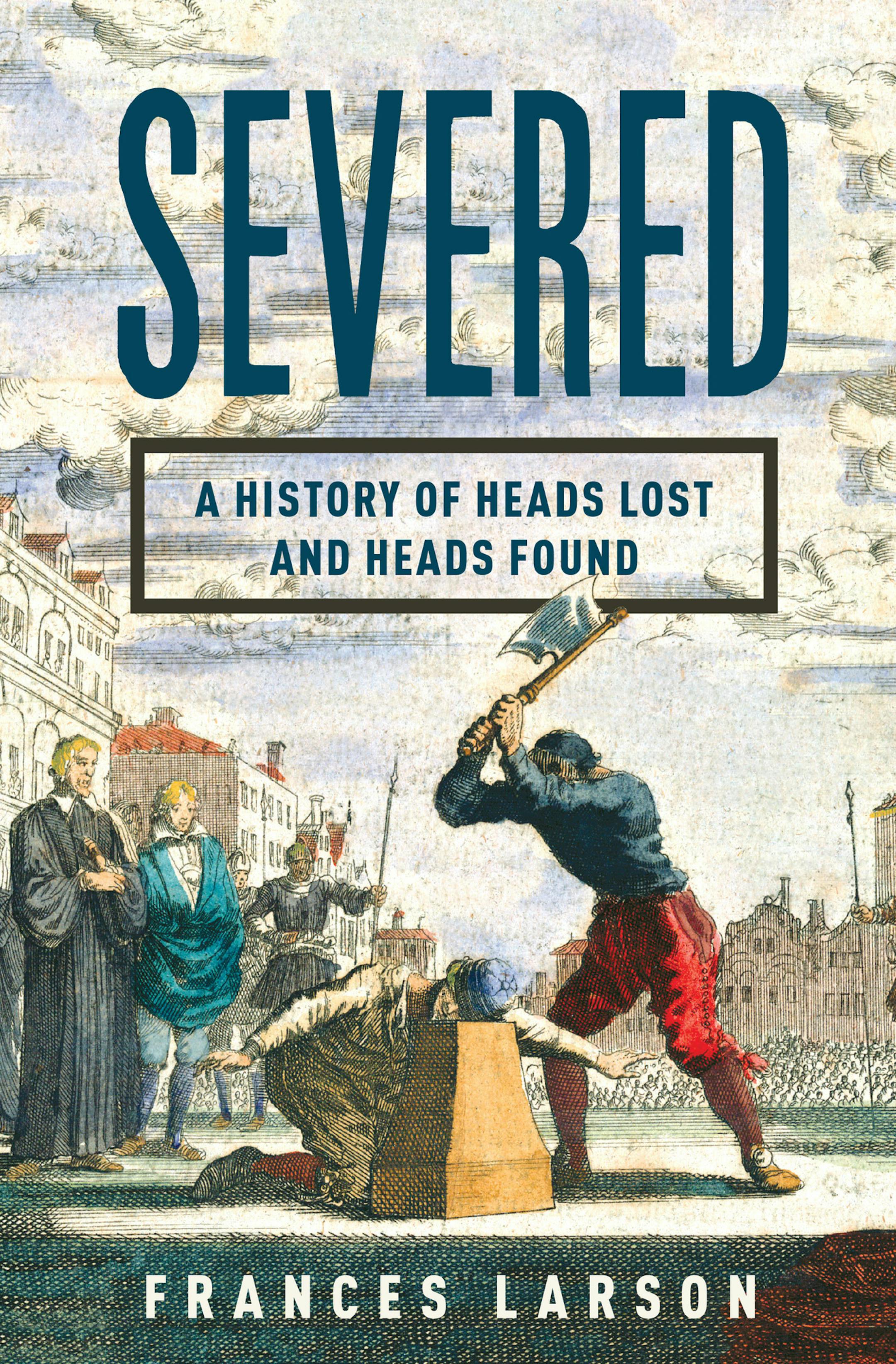
At the conclusion of this grimly fascinating examination of human heads and the reasons for cutting them off, Frances Larson tells us, "We may not like what we see, but that in itself is no reason to turn away." Indeed, Larson's history is extremely hard to turn away from. As she offers one riveting story after another, drawn from a range of historical periods (including our own), she scrutinizes the bleeding remains with an anthropologist's eye: What does decapitation tell us about the people responsible for it?
Larson writes about the shock and power of a beheading. Despite its brutality (or perhaps because of it), a beheading has the power to captivate an audience, to compel others to witness it. As a head is the locale of our expressiveness, removing it transforms a living human into a puppet — an object for entertainment, for ritual, for reverence. A head is both a person and a thing: Witness Hamlet's cheerless speech to Yorick.
"Severed" is especially good at adding complexity to the myths of savagery. During the 1800s, stories of headhunters in South America and the South Pacific titillated Europeans and North Americans. "Scientific" collecting expeditions sought examples of "primitive" heads, especially shrunken ones, and thousands found homes in Western museums, purporting to illustrate white racial superiority.
Yet Larson demonstrates how demand for heads created a lively market. White traders offered natives incentives to slaughter: one gun for one head. Who were the savages, Larson asks: the "wild" people who wielded the blades or the "more refined" collectors and the viewing public back home?
Larson's section on the guillotine is likewise surprising. A technological solution to a logistical problem, the guillotine at first disappointed the Revolutionary-era Parisian crowds who turned out for the spectacle. "Brutal and effective," it mechanized the outcome and removed any feel of uncertainty or chance. It also diminished the need for a skilled professional who "performed" the ceremony.
Most shocking to me was the discussion of head-taking in the Pacific during World War II. Larson explains how U.S. soldiers displayed the heads of Japanese soldiers as an affirmation of masculine virility and hunting prowess, a gruesome sign of status. According to Larson, this practice also helped soldiers "regain a sense of empowerment, because the trophy head, held aloft, is an assertion of control in the chaos in battle." The pictures that accompany this section are more than a little disturbing.
Not all of Larson's material is so horrific. She gives ample attention to collectors of relics, both religious and secular (Beethoven, Mozart and Schubert were all buried without their skulls). And her section on medical students gently explores the sensibilities of dissectors. Much of this well-researched and gracefully written book, though, will be a walk on the dark side.
Tom Zelman teaches English at the College of St. Scholastica in Duluth.


