

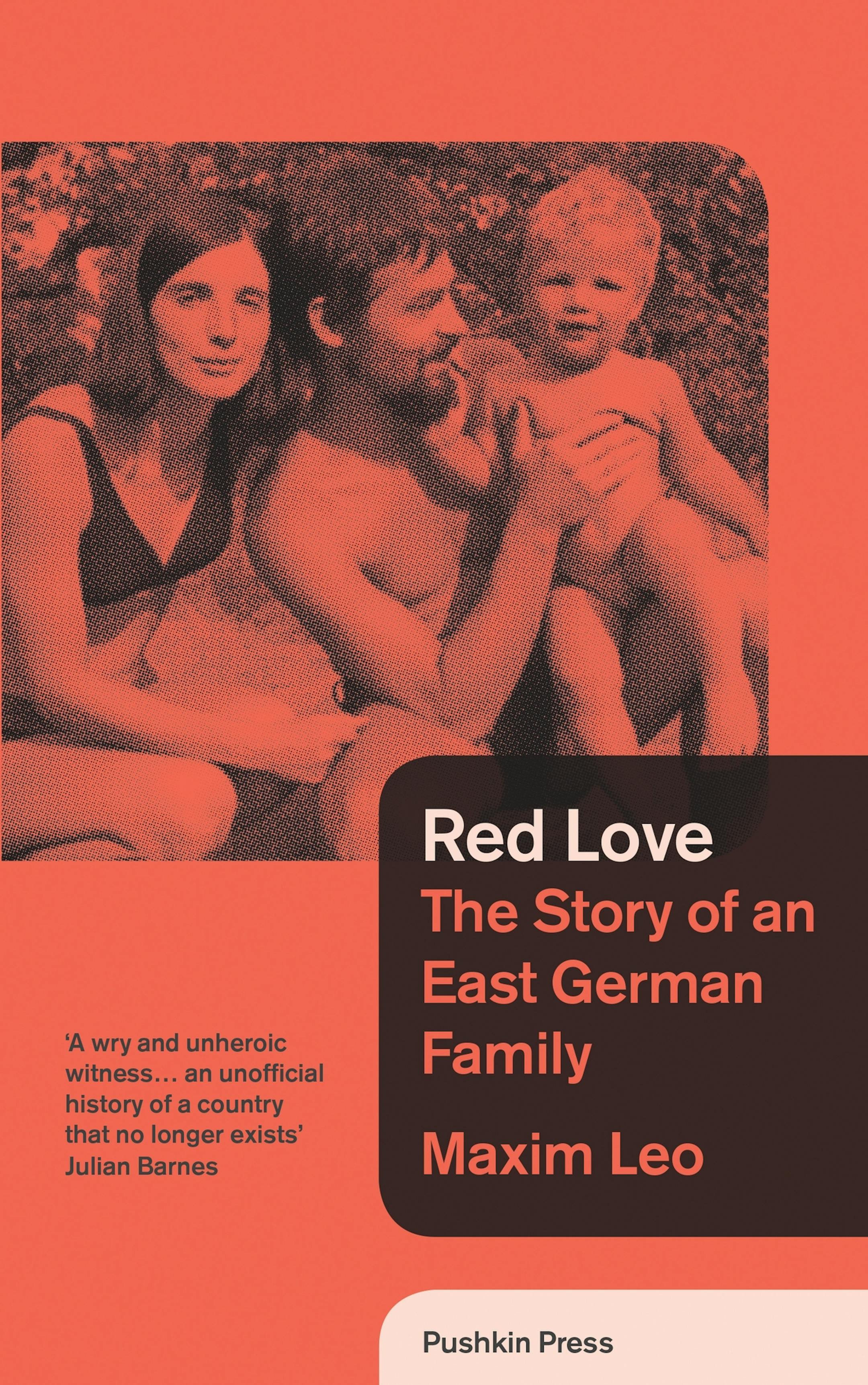
The German Democratic Republic may have officially ceased to exist in 1990, but in books it appears to be alive and kicking. Last year saw the publication of two notable novels by former East German writers: "In Times of Fading Light," by Eugen Ruge, and "City of Angels," by Christa Wolf. Now, with Maxim Leo's "Red Love," we are afforded another glimpse into that shut-off land, one branded a Socialist paradise by its leaders but a gray prison by many of its citizens.
This ambivalence is at the heart of Leo's book. Like Ruge's novel, "Red Love" follows several generations of one family through Germany's turbulent 20th century. But Leo's story is fact, a searching memoir about real people, some of whom wrestle with totalitarian brutality, others with their own consciences for toeing the party line.
Leo, an editor at the Berliner Zeitung, approaches his family members for personal recollections not as a journalist but a genealogist. His bohemian parents, Anne and Wolf, tried to instill good socialist values while encouraging their son to keep an open mind. Anne starts out as a journalist but soon grows frustrated at being unable to produce incorruptible articles. Wolf's art is also subject to state censorship, and his disillusion sours into anger at learning how his young son is being indoctrinated at school.
A different kind of trajectory emerges when Leo traces his grandfathers' lives. Paternal grandfather Werner is a "little Nazi who became a little Stalinist"; Anne's father, Gerhard, on the other hand, from his time as a partisan fighter with the French Resistance to the set-up and consolidation of East Germany, remains true to only one ideology.
For the young Leo, opposites attract: "My Communist grandfather could not have given me a stronger argument for the superiority of capitalism." Leo weaves in his own tale, beginning with a childhood filled with bad jeans, a game called Escape to the West, and teachers preaching about the necessity of the "Anti-Fascist Protection Rampart," aka the Berlin Wall. "Red Love" ends with the breach of that rampart, the fall of the wall, and a last look at a country economically and morally bankrupt.
Leo draws upon family interviews, diaries, letters, poems and even declassified Stasi files. He rigorously reflects mirror images — World War and Cold War, fascism and communism, east and west, conformity and rebellion — to obtain that objective picture. His portrait could have been overtly damning, for his younger self frequently bewails "the poverty, the lies, the claustrophobia, the suspicion" of everyday life. However, the book's brilliance stems from Leo's prioritizing of personal drama over national tragedy. Gerhard's war years are thrilling, Anne's agony of living for the right cause but in the wrong country is poignant, and Wolf's tiny acts of subversion — dyeing his hair, dancing to contraband Elvis tapes — bring smiles.
"Red Love," excellently translated by Shaun Whiteside, won the European Book Prize. It deserves its plaudits for its exposure of the inner workings of East German life and its depiction of ardent devotion and shattered ideals.
Malcolm Forbes has written for the Times Literary Supplement, the Economist and the Daily Beast. Born in Edinburgh, he lives in Berlin.


