

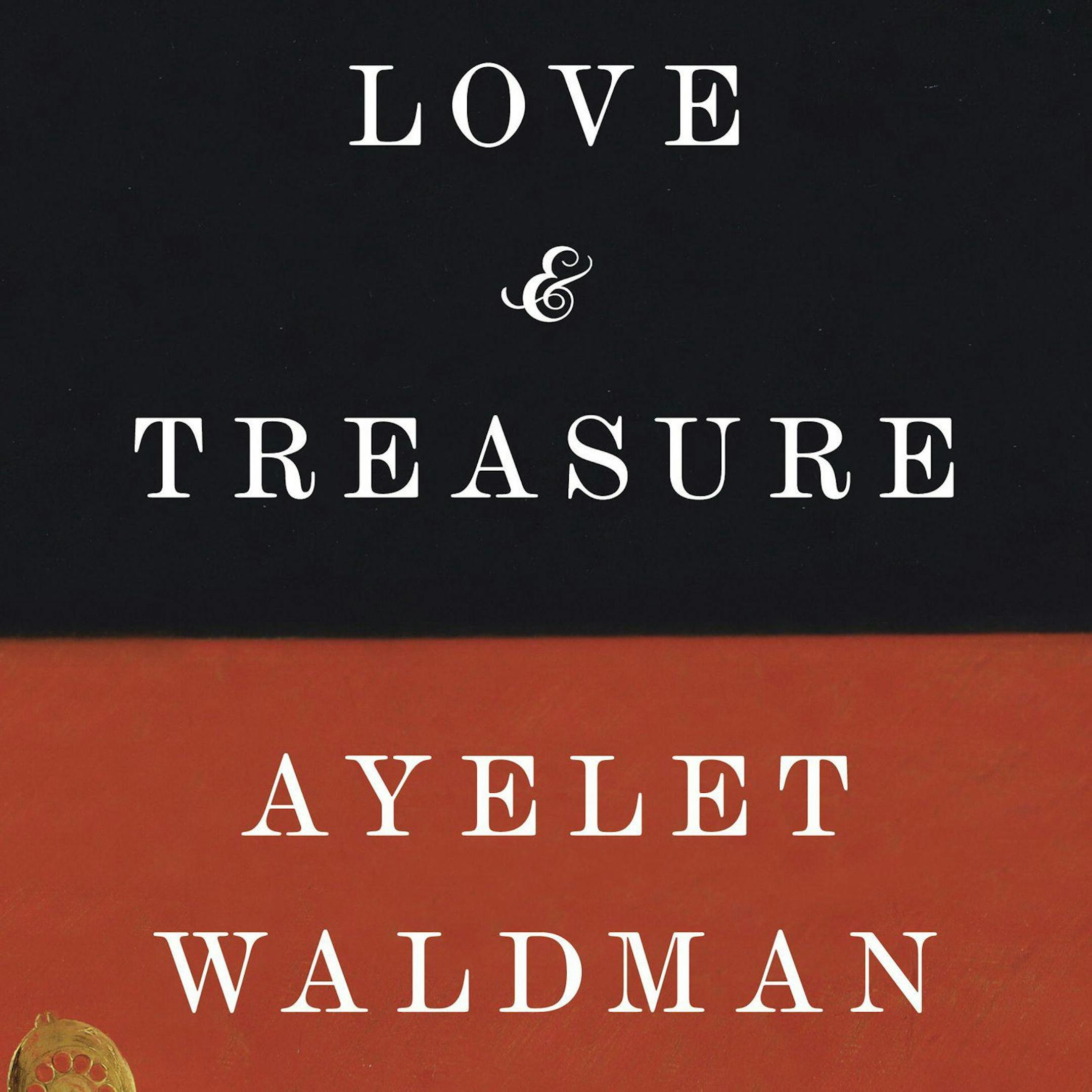
In this heartfelt if somewhat languid novel ("Love and Treasure," by Ayelet Waldman, Alfred A. Knopf, 334 pages, $26.95), two of the most intriguing characters are not human.
The first is the so-called "Gold Train" bearing the belongings of Hungarian Jews, which came to a halt in Salzburg. The second is a pendant with a brilliant peacock.
In 1946, Capt. Jack Wiseman is ordered to guard the train, though its gold has been looted along the way. What remains are dishes, glasses, silverware, fur stoles and other not-so-precious objects. Wiseman, a righteous man, hopes the contents will be restored to Hungarian Jews, although identifying owners, if any are still alive, would be a herculean task. He finally realizes that's not going to happen. Army brass start requisitioning a set of dishes here, some silverware there; Jack's soldiers also have sticky fingers.
Jack feels some guilt too, because he pocketed an unusual pendant, "decorated with an enamel painting of a peacock in vivid purple and green, with white accents. The metal was intricately filigreed … and the tip of each peacock feather was inset with a gem."
The mystery then jumps to the present day. On his deathbed, Jack charges his granddaughter Natalie with finding the pendant's provenance and perhaps, with great perseverance and luck, the owner or a relative to whom she can return it.
In Budapest, Natalie meets Amitai, a Syrian Jew now living in New York. His work involves the reclamation and sale of Holocaust art, a profitable enterprise. He is looking for a painting by undervalued Hungarian painter Victor Komlos — the painting is of a seductive woman wearing the pendant. Natalie and Amitai join forces, discovering that the pendant is actually a locket that contains a faded photograph of two women (one a dwarf) flanked by banners celebrating the 1913 International Woman Suffrage Congress.
They then find one Nina Einhorn, perhaps the "Frau E." of the painting. She appears to be the pendant's owner.
The last and best section is set in 1913, narrated by a fatuous psychiatrist. He tells the story of a young patient named Nina who was forced into treatment by her father for "neurasthenia complicated by chronically recurrent dyspepsia of a hysterical origin." He keeps probing for the sexual trauma he's sure is at the root of her behavior, dismissing her angry explanation that she wants to become a doctor.


