

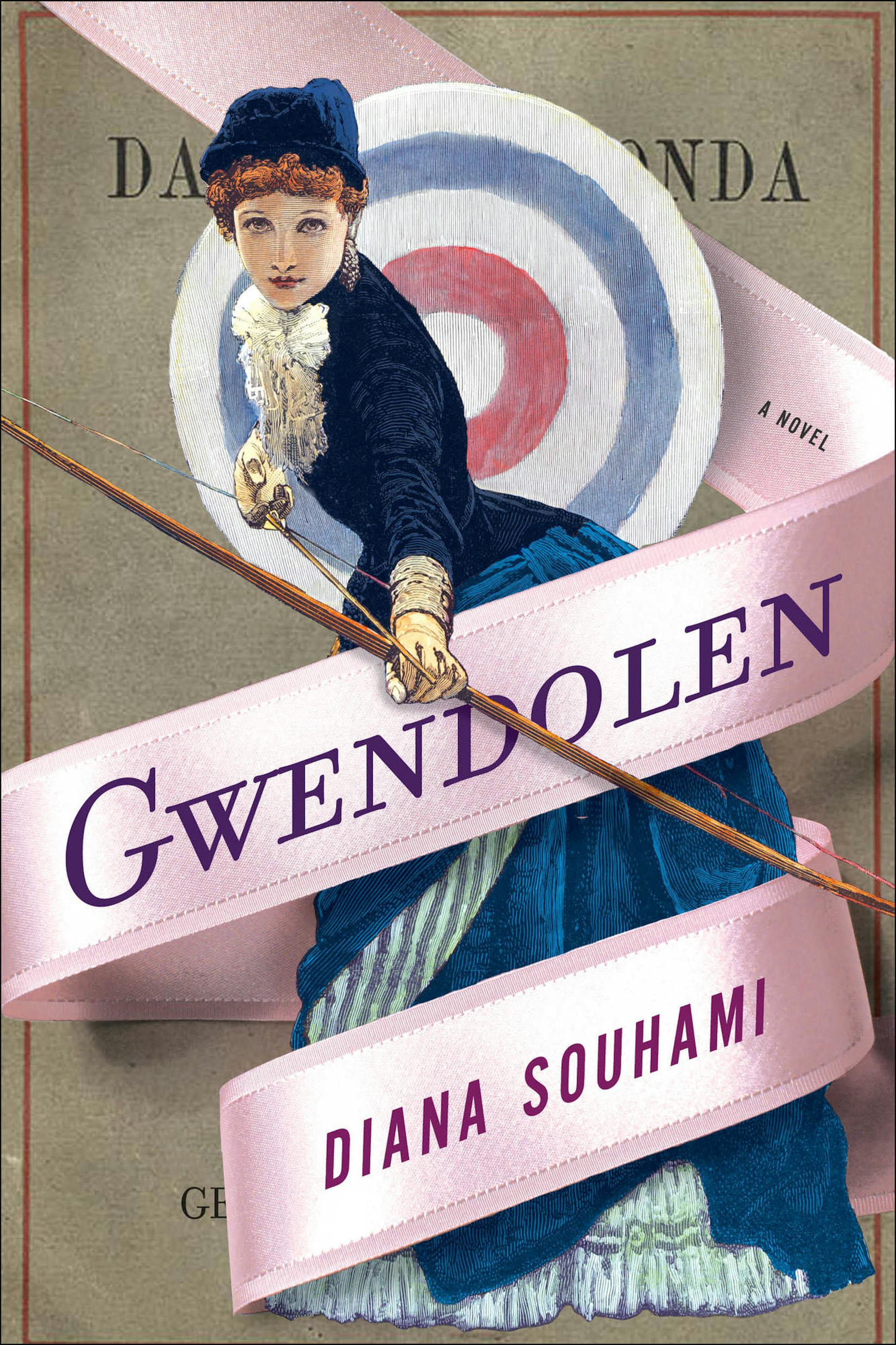
In applying her colorful imagination to George Eliot's 1876 classic, "Daniel Deronda," British writer Diana Souhami moves the spotlight from the character of Deronda to that of Gwendolen Harleth, the alluring young woman who loves him intensely. Written as Gwendolen's unsent letter to Deronda, Souhami's work portrays Gwendolen as a beautiful, vain and complex woman caught in the shackles of fate.
Not only is "Gwendolen" replete with unexpected plot twists and turns, it also is an exhaustive and credible character sketch of an upper-class Victorian woman trying to find happiness for herself and her family.
"I wanted … that my life should be pleasant, that I should star at parties, be victorious at the Archery Club, applauded at the piano, and admired on horseback."
As the novel opens, Gwendolen and Deronda have already met for the first time: He catches her eye disapprovingly as she plays roulette at the Kursal in Germany. Back in rural England, a financial calamity befalls Gwendolen's family, leaving her, her widowed mother and four half-sisters virtually penniless. As the eldest, she feels responsible for providing a roof over their heads.
Souhami cleverly allows Gwendolen to bare her soul in the course of the long letter to Deronda, a tactic that endears Gwendolen to the reader. For example: "I have always been afraid to hear about the indifference of the universe, my own insignificance, the casual inevitability of death, and the caprice of chance."
Thanks to her connection to an aristocratic uncle, Gwendolen continues to move in high social circles. Riding and archery shape her days. She is clearly full of herself. "Being so much admired and so often told I was beautiful set me apart. I liked to be the center of attention, in control, and to have the last word. I came to see my beauty as a kind of genius, an accomplishment of my own doing."
Along with the notion of life's unfairness, a prominent theme in Souhami's book is "women as chattel." Gwendolen believes that for survival, marriage is her only choice. "My natural gifts were the length of my legs, the curve of my breasts, the whiteness of my teeth, the wave of my hair and the slant of my eyes."
Knowing she has no other option, she accepts the marriage proposal of one Henleigh Mallinger Grandcourt, an immensely wealthy aristocrat, a man "who said little and exuded self-importance." She knows of the criminality in his past and the disagreeable rumors about his mistreatment of women. Soon after the wedding Gwendolen is writing: "Every bit of him is hideous to me. I hate him with a force stronger than my love for you [Deronda]."


