

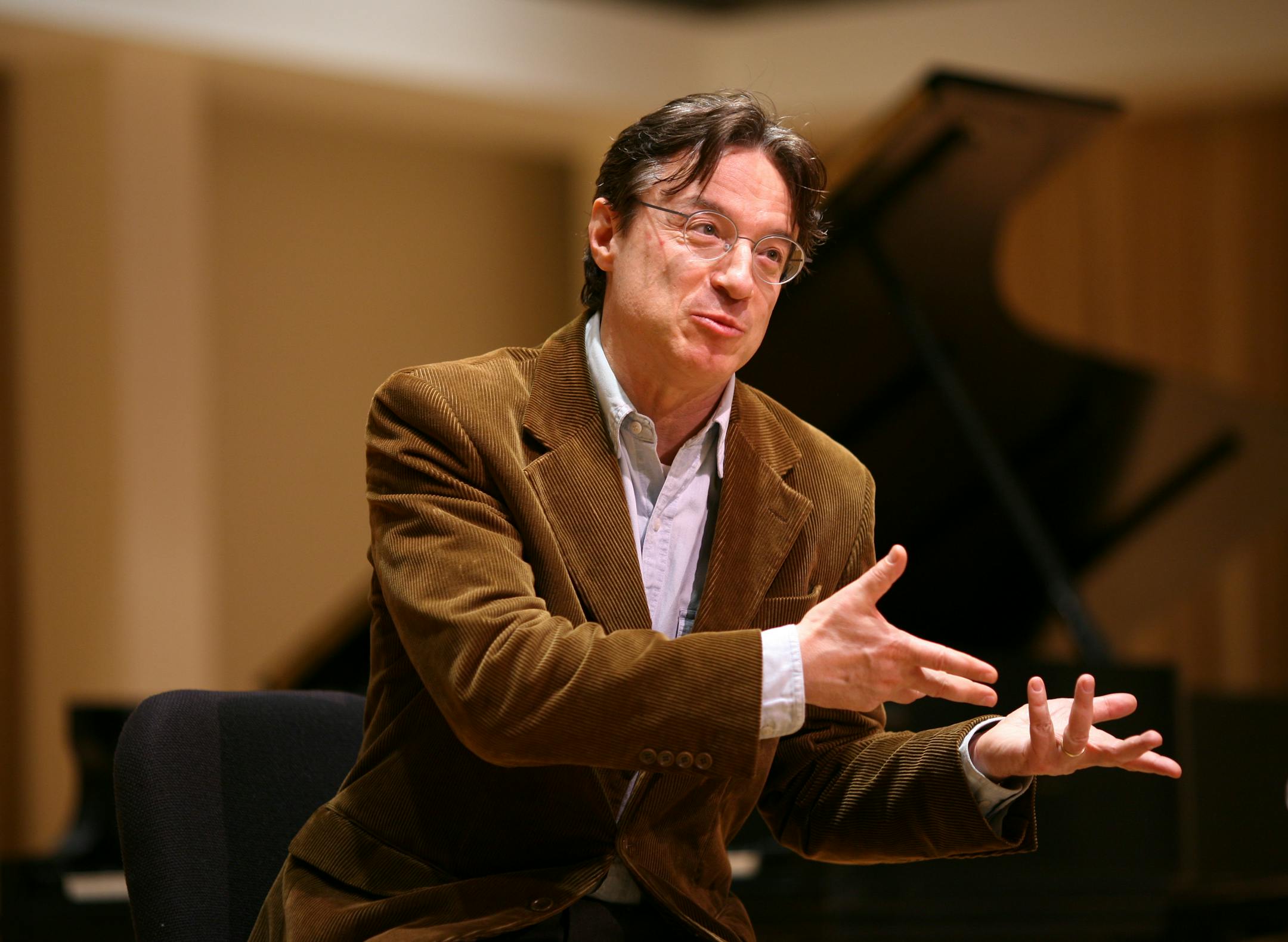
A faint haze wrapped the Ordway Center on Friday morning, but inside the hall clarity reigned as the St. Paul Chamber Orchestra, superbly led by Roberto Abbado, offered a model program: a recent work by a living composer (Charles Wuorinen, who turned 70 in June), two lesser-known scores by a 20th-century giant (Stravinsky) and an 18th century treasure (Haydn's "Drum Roll" Symphony).
The formidable Peter Serkin was at the keyboard in both Wuorinen's "Flying to Kahani" (which he and Abbado premiered in New York in 2006) and Stravinsky's "Movements for Piano and Orchestra."
"Flying to Kahani" is an offshoot of Wuorinen's opera "Haroun and the Sea of Stories," based on the eponymous children's book by Salman Rushdie (written when the author was in hiding, thanks to Ayatollah Khomeini's fatwa). Kahani is Earth's unknown second moon, on which the opera's 11-year-old protagonist discovers the source of all stories.
Despite its intricacy, Wuorinen's music, more phantasmagorical than descriptive, proved absorbing. Much of the credit for this goes to Serkin, who, his 61 years and three-piece suit notwithstanding, continues to champion new scores (and remains strikingly boyish in demeanor).
Though Stravinsky's "Movements" is as old as the SPCO, this week's performances are the orchestra's first. Concentrated and spare, the piece dates from the composer's last period, in which he recast his reputation (and confounded both friend and foe) by embracing the 12-tone technique of Arnold Schoenberg. In timbre and rhythm, "Movements" is reminiscent of Stravinsky, yet its ethos is close to that of Schoenberg's pupil Anton Webern. Abbado and Serkin, to my ear, made more sense of the piece than Stravinsky's 1961 recording (with pianist Charles Rosen) managed to do.
In this company, Stravinsky's neo-classic Concerto in D (1946) might seem brittle -- a driven divertissement, full of calculated surprises, with an unconvincingly lush waltz at its center. But Abbado -- undeterred by the composer's endless sniping at conductors, whom he called "tremendous obstacles to musicmaking" -- pumped more life into the piece than I thought possible. The SPCO strings played brilliantly.
And so to Haydn, whose penultimate symphony, classic without the "neo," marries play and sublimity to dazzling effect. There wasn't one routine bar in Friday's marvelous performance. More, please!
Larry Fuchsberg writes frequently about music.


