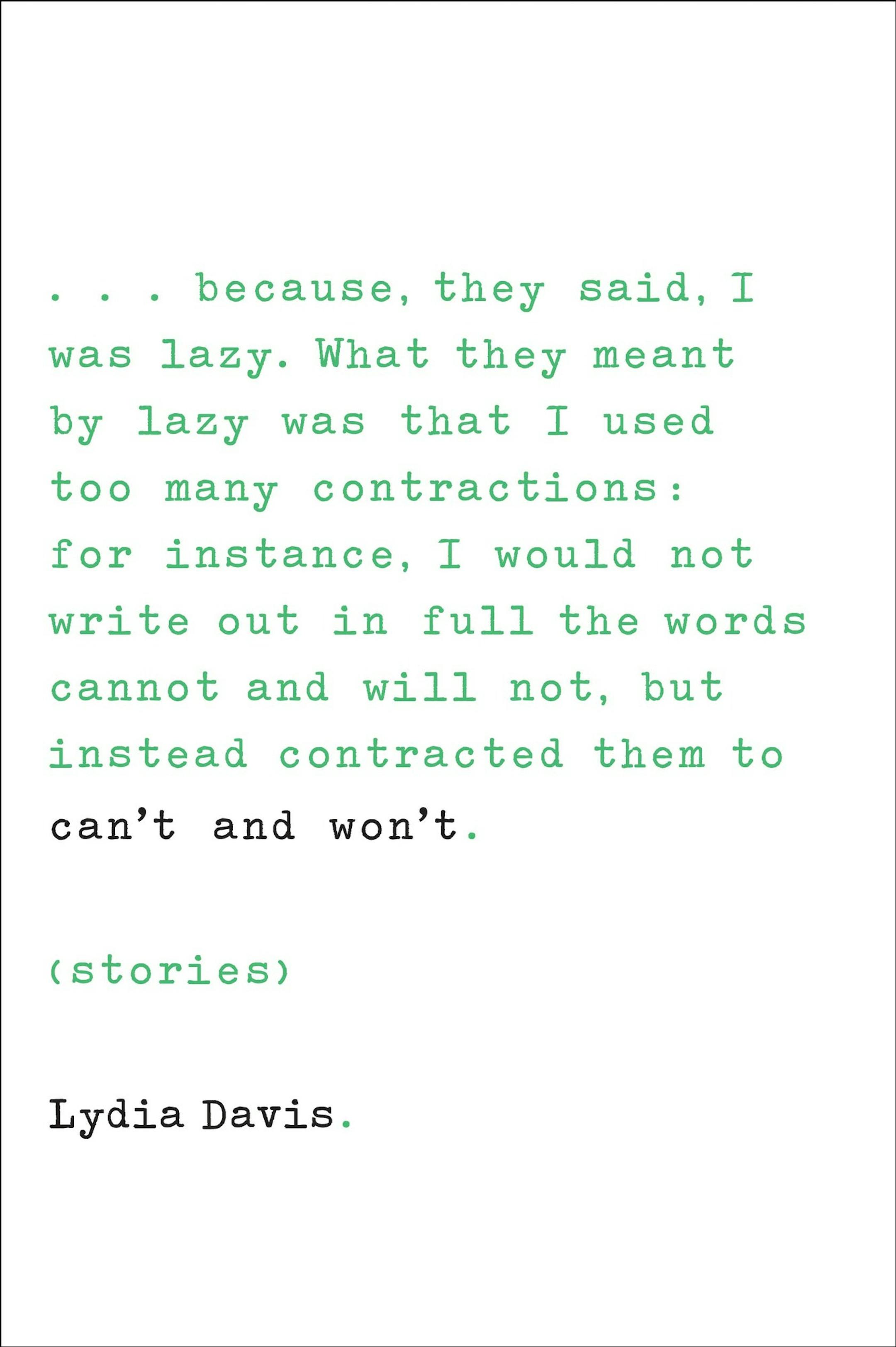
Lydia Davis is a master of, among other things, evocative nonspecificity. She often withholds the names of her characters and the cities and towns they live in, and although she might describe their clothes or cars, she won't stoop to note who manufactured them. Through these somehow vivid omissions and her careful, unflashy prose, she has found a tone that seems at once contemporary and timeless, folkloric and urbane, dreamlike and quotidian.
"Can't and Won't," Davis' fifth story collection and sixth book (she is also a celebrated translator of Proust, Flaubert and other French writers), is less consistently brilliant than her previous books, but it again shows her to be one of contemporary literature's most approachably idiosyncratic and dryly comic writers.
Particularly influenced by Kafka's very short prose works, Davis has for decades been the leading practitioner of what is sometimes called micro-fiction, stories that take up only a page or two, or even a paragraph or one terse sentence. The stories aren't always narrative; if the idea were to sell fewer books, her publisher might package them as miniature essays or prose poems. Sometimes they're rather like jokes. Here is one, "I Ask Mary about Her Friend, the Depressive, and His Vacation," quoted in full:
One year, she says
"He's away in the Badlands."
The next year, she says
"He's away in the Black Hills."
Whether her subjects are undeniably grave or amusingly trivial — one character agonizes over whether to sell a rug — Davis has the rare ability to write calmly about anxiety, capturing all the circularity of a mind in agitation without resorting to run-on sentences or other staples of breathlessness.