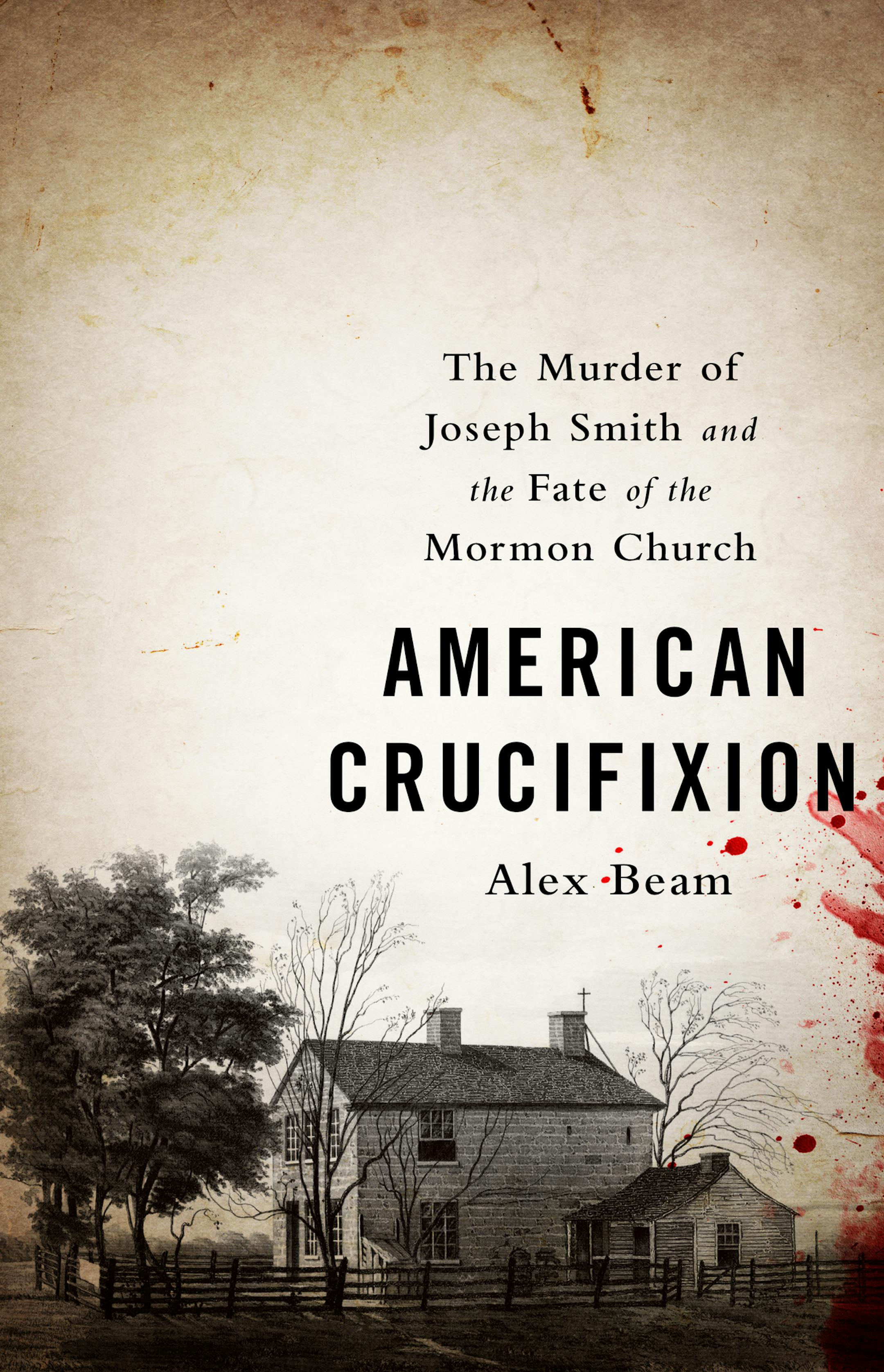
History books often leave no doubt as to winners and losers. Yet there are countless past occurrences in which no one escapes entirely unscathed. Such is the case with the 1844 murder of Mormon leader Joseph Smith and others at the hands of an angry mob in Carthage, Ill., which is recounted in chilling detail by Alex Beam in "American Crucifixion."
Smith's demise brought to an end the Mormons' tragic history in the Midwest, a history that included religious persecution and attacks in their Illinois settlement of Nauvoo and also earlier across the Mississippi River in Missouri, where an "Extermination Order" was directed by the governor, although Beam writes that extermination meant "drive away," not cleanse.
Beam presents Smith as an unsympathetic visionary, a self-professed prophet and a bully who overstepped his vast power in Nauvoo. Division of church and state was nonexistent in what was once the largest city in Illinois and Smith ruled with an iron fist. He destroyed the printing presses of hostile newspapers, slandered his critics and women who spurned his advances, purloined the secret rituals of the Freemasons and, most controversially, practiced polygamy.
"Smith eventually married dozens of wives, including five pairs of sisters and two pairs of mothers and daughters, of whom fourteen were already married."
Smith's biggest nemesis was 22-year-old newspaper editor Thomas Sharp, whose bigotry toward Mormonism and animus toward its spiritual leader knew no bounds as he raged against Smith in the pages of the Warsaw Signal. Sharp was threatened by the wave of Mormons flooding into Illinois, an increasing militarism among the inhabitants of Nauvoo and their potential for creating a powerful voting bloc.
"If Joe Smith is to control the majority of votes on our county, are we not, in effect, the subject of a despot? Might we not as well be serfs to the Autocrat of Russia?" Sharp wrote.
Sharp's columns became more inflammatory, and along with weak protection at the state level by one of Illinois' worst governors (there is no shortage of candidates for that title) created the atmosphere that led to Smith's eventual murder and a trial that was rigged against justice from the sound of the opening gavel.
Beam's evenhandedness in "American Crucifixion" allows readers to appreciate the ongoing evolution of a young frontier nation grappling with issues of diversity and religious freedom. And, in this brutal instance, America and its great promise of exceptionalism failed not only the Mormon Church, but failed all of us as well.