

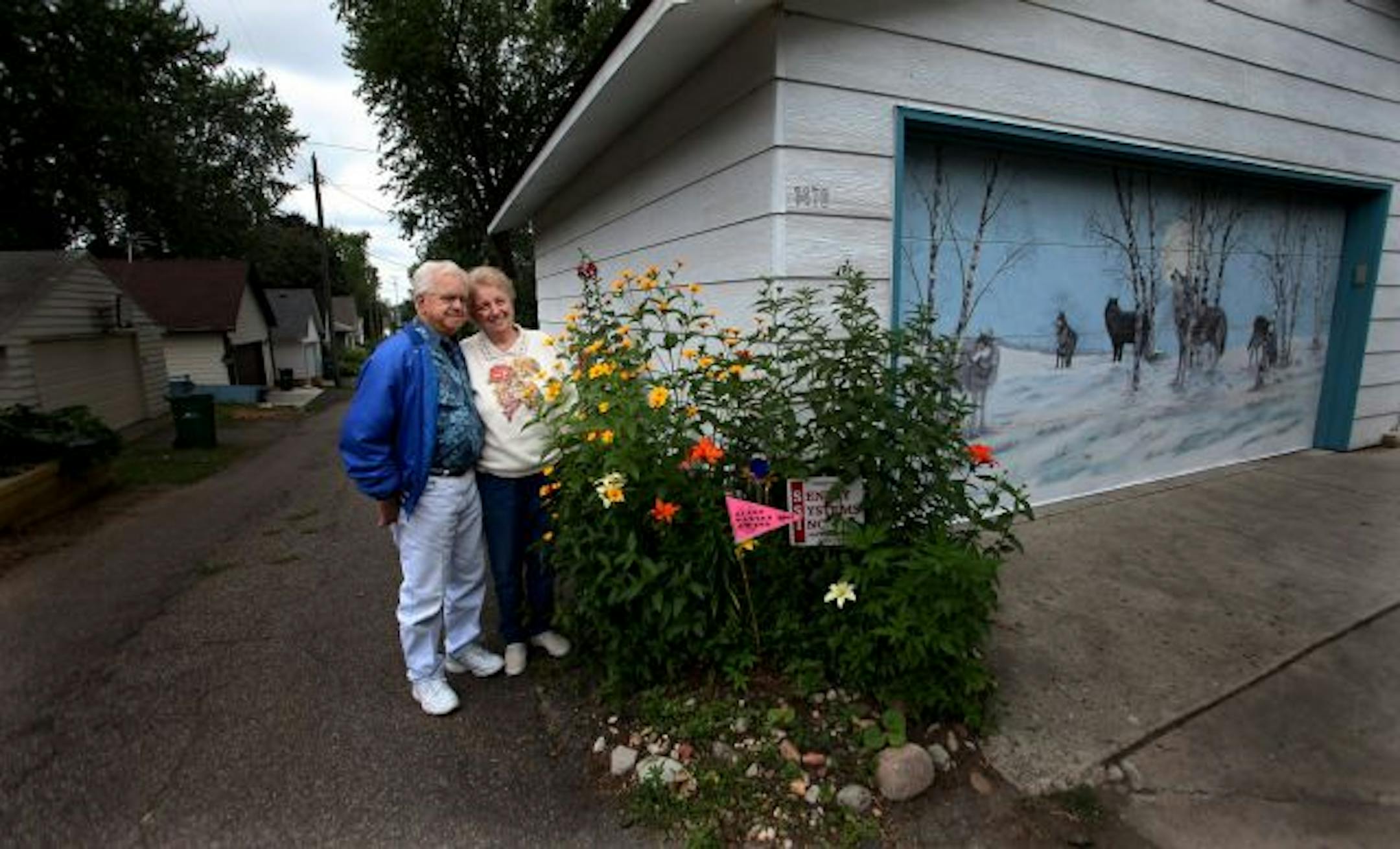
Most homeowners want to present a comely face to the public, but one St. Paul neighborhood boasts a number of lots about which one might say, with the utmost respect, "Nice rear."
The reverse curb appeal is a consequence of the Alley Garden Awards, a program begun by the Macalester-Groveland Community Council in 1992 with the premise that community beautification is a crime deterrent. Over the years, the program has also turned neighbors into friends, inspired a good-natured competition and improved city services.
Yet its chief benefit might be the most intangible. Backing a car out onto a narrow lane lined with spires of lilies and profusions of petunias "makes me happy," said Marianne Paulos, who lives on Fairmount Avenue. "And it's just so nice to come home to."
Paulos has been spiffing up her stretch of alley for years, calling it a work in progress. "I can hardly remember what used to be there," she said. "Grass and weeds, and an old retaining wall on one side with a scrappy tree." Her neighbor to the west, Joe Schwarz, encouraged her -- indeed, everyone on the block -- to nurture this overlooked thoroughfare. Today, their alley that serves Fairmount and Osceola Avenues (between Pascal and Saratoga Streets) is among the most lauded in the community.
"It used to be, you'd plant lilacs to hide the alley," said Schwarz, whose alley features barrel plants of calibracoa, or million bells, nestling against fountain grass. Salvia makes a long-blooming border for the ladies mantle, bearded iris and bee balm.
To the east are Paulos' petunias, lilies and moss roses. Across the alley, an Osceola neighbor's spectacular Asiatic lilies resemble miniature fireworks caught in flight.
However, it's not all about the flowers, said judge Sharon Toscano. In fact, the bloomability factor takes a distant fifth to how a homeowner fulfills these requirements: They've planted some sort of garden, even vegetables. The garden is weed-free and maintained. The alleyside property is litter-free, weed-free and neat. And perhaps most important -- and the factor that most often knocks residents out of the running -- there's an easily read house number visible from the alley.
"The goal of the program is to be community-building, but also increase city services, and having a clear house number is key," Toscano said, eyeballing a beautiful, but numerically anonymous, garden. She's been a judge for five years and has strict standards. For instance, an otherwise worthy effort is marred by a feathery eruption of weeds along a concrete seam.


