

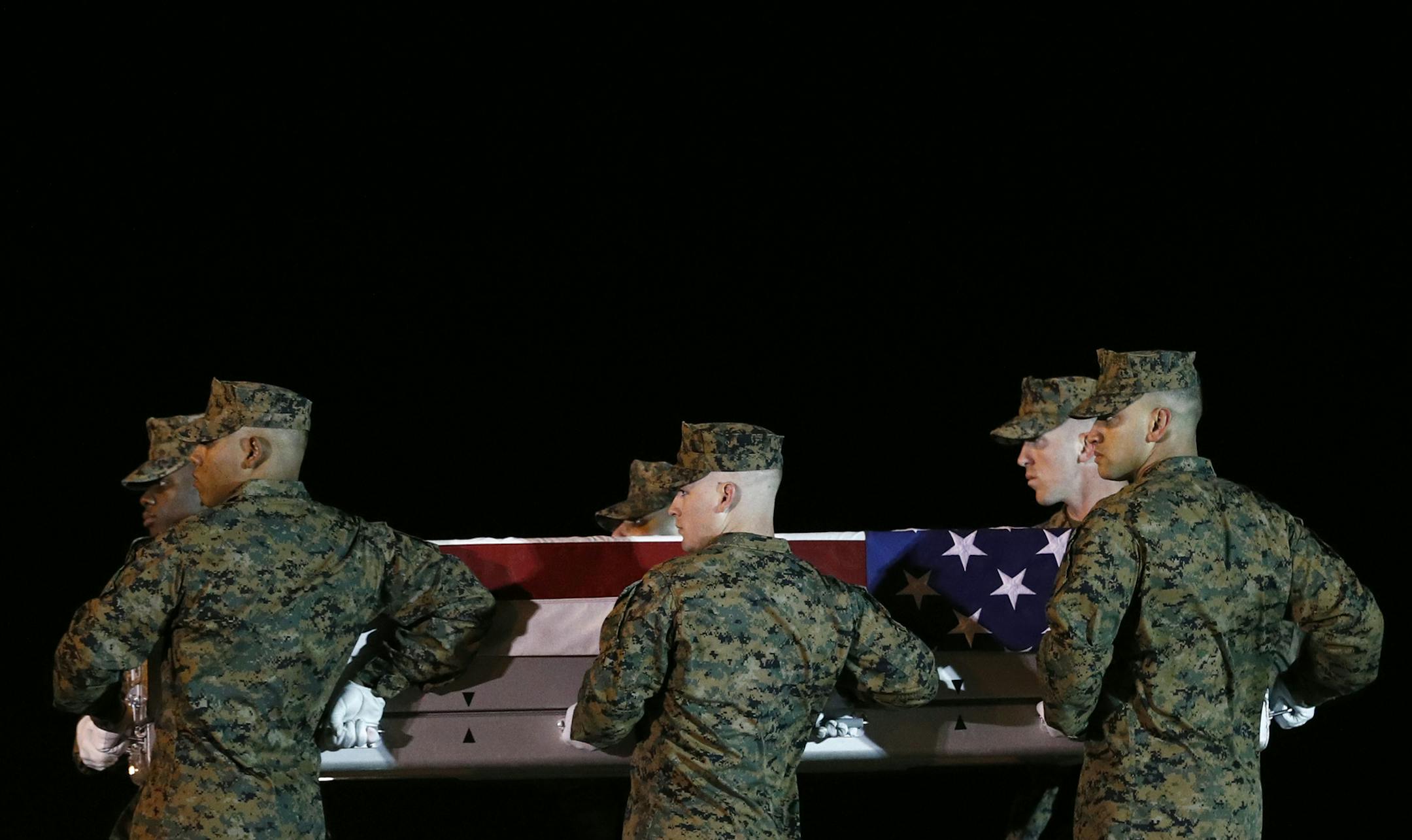
WASHINGTON – With a burst of light and dust, an armored vehicle carrying Marines outside a major U.S. air base in Afghanistan erupted into flames, killing three men inside and plunging their unit into chaos.
The April 2019 car bombing about a mile from Bagram Air Base had the hallmark of a coordinated ambush, said two defense officials familiar with the details. A sedan packed with explosives blew up as the Marines' vehicle drew alongside it, mangling the mine-resistant vehicle so badly that U.S. troops had to take the wreckage back to Bagram to extract the remains.
The Taliban released a photo of the explosion afterward, asserting responsibility for it and saying that "multiple invaders" were killed and wounded.
The attack quickly faded from public attention as one of many violent incidents in a war that has killed nearly 2,400 Americans in combat over more than 18 years. But it has been thrust into the spotlight in recent days amid revelations that intelligence analysts believe those who planned it may have been paid a bounty by a Russian military intelligence unit to kill Americans.
President Donald Trump has dismissed the story as a "hoax" amid reports that information about the threat circulated through the American intelligence community and first reached the White House early in 2019, before the attack outside Bagram.
Other Trump administration officials, meanwhile, have cast the information as a concern that merited attention, even if defense officials did not see the intelligence — originally gathered in interviews with Taliban members detained in Afghanistan — as verified.
Caught in the firestorm are the families and friends of the three Marines — Staff Sgt. Christopher Slutman, Staff Sgt. Benjamin Hines and Sgt. Robert Hendriks — who were just a few weeks from returning home to the United States when they were killed.
Kyle Moyer, a Marine veteran who deployed with Hines and Slutman to Iraq in 2008, said that the death of his friends was "heartbreaking" and that the revival of the attack in the news has brought more pain.


