

Rembrandt was such an operator that everything about him seems larger-than-life -- his busy studio, his outsized reputation, his nasty bankruptcy, his unconventional affairs. His paintings, as smartly presented in "Rembrandt in America" at the Minneapolis Institute of Arts, seem an extension of that ambitious, wide-ranging and competitive talent.
But there was another Rembrandt, too, a small-scale guy who loved to experiment, play around, make visual jokes. A guy who studied the neighborhood beggars and merchants, a free-thinker regarding religion, a wanderer who delighted in ducking out of the shop and escaping to the country on a sunny summer afternoon. A guy who brooded about death, knew pain, accepted the inevitability of aging.
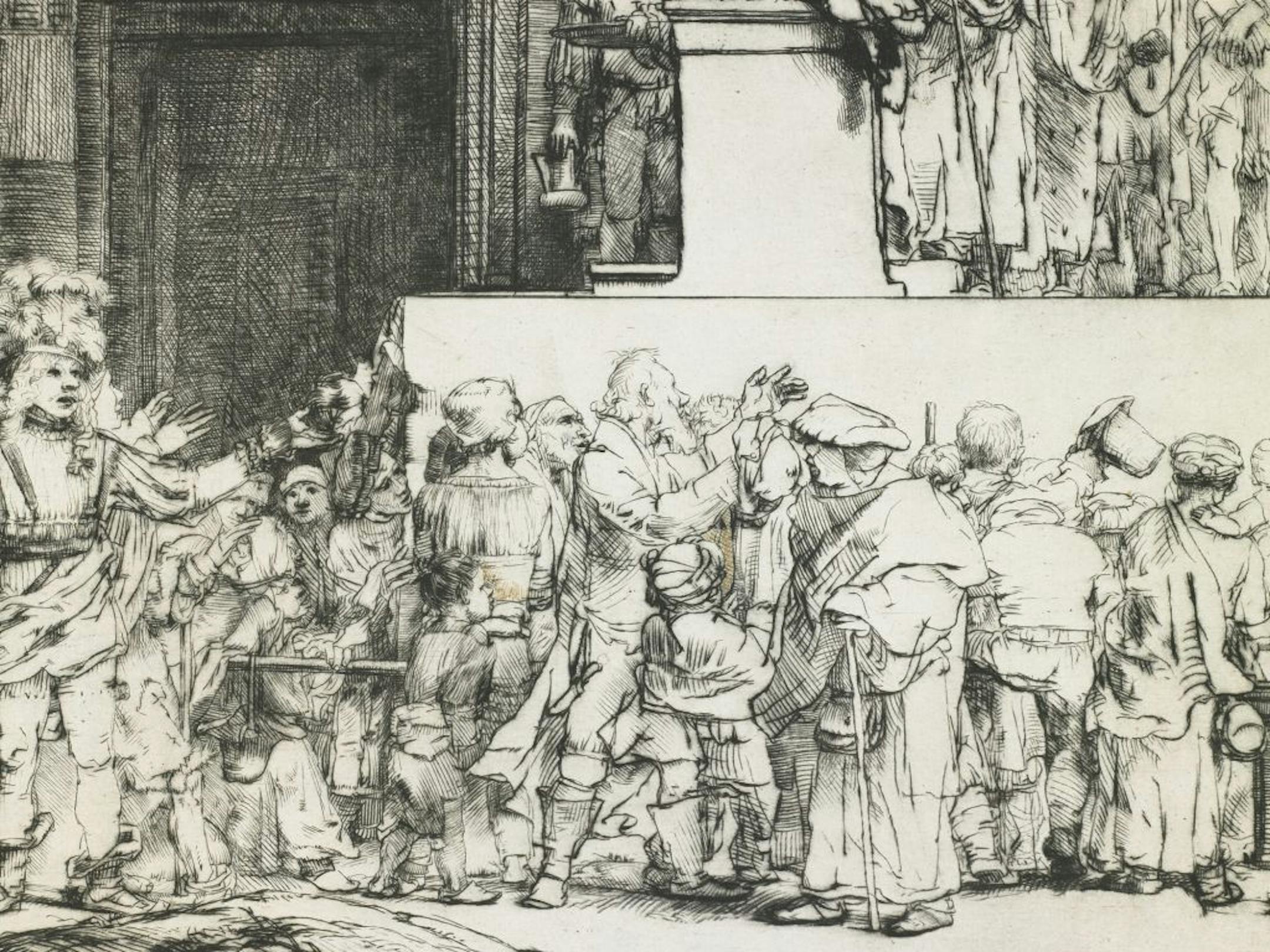
This is the man whose work can be seen in "Rembrandt's Miniature World," also at the Institute through Sept. 16. Although billed as a separate show, "World" is actually the exit gallery of the painting exhibit, the room where visitors drop audio guides and shake off their reverent awe. It's a fabulous display of 39 etchings, almost all from the institute's collection. They deserve full attention and shouldn't be blinked past as mere wallpaper, even though many visitors will be justifiably recovering from visual overload.
Small scale, big impact
The word "miniature" is grating, with its precious hint of the doll house and the tea party. There's nothing in the least twee about Rembrandt's prints. True, the etchings are small, some as tiny as postage stamps and many the size of postcards, magazine or newspaper images. But modest size does not diminish their emotional impact, psychological weight or conceptual ambition.
Consider five self-portraits, each less than 2 inches tall and wide. In them he variously wears a silly fur hat, gives a feral snarl, appears to be shouting, or angry, or surprised, or just plain goofy, with pursed lips and comically worried brows. All made in about 1630, when Rembrandt was just 24, they seem as spontaneous as doodles even though they're richly textured, with an animation that belies their size. This is Rembrandt at play, testing his skill at conveying emotions and figuring out how to use shadowy scribbles to make an image pop off the page without going muddy.
A few years later, in 1636, he etched six heads onto a plate, among them that of his wife, Saskia, surrounded by women whose faces are shadowed by hoods, bonnets, wide-brimmed hats, a hand-to-mouth as if lost in thought. And from that same year there's another intense "Self-Portrait With Saskia," in which Rembrandt appears as a dandy with floppy hat, fluffy collar and fur-lined coat peering intently as if reflected in our eyes. No mere flabby likenesses, these are penetrating images that subtly convey the look of thought as manifest in the very slightest arch of brow, line of mouth, narrowing of eye. While he often caricatured himself to amusing effect, he's at his unbeatable best in these incisive little portraits.
Fat ladies and darkness at midday


