3:55
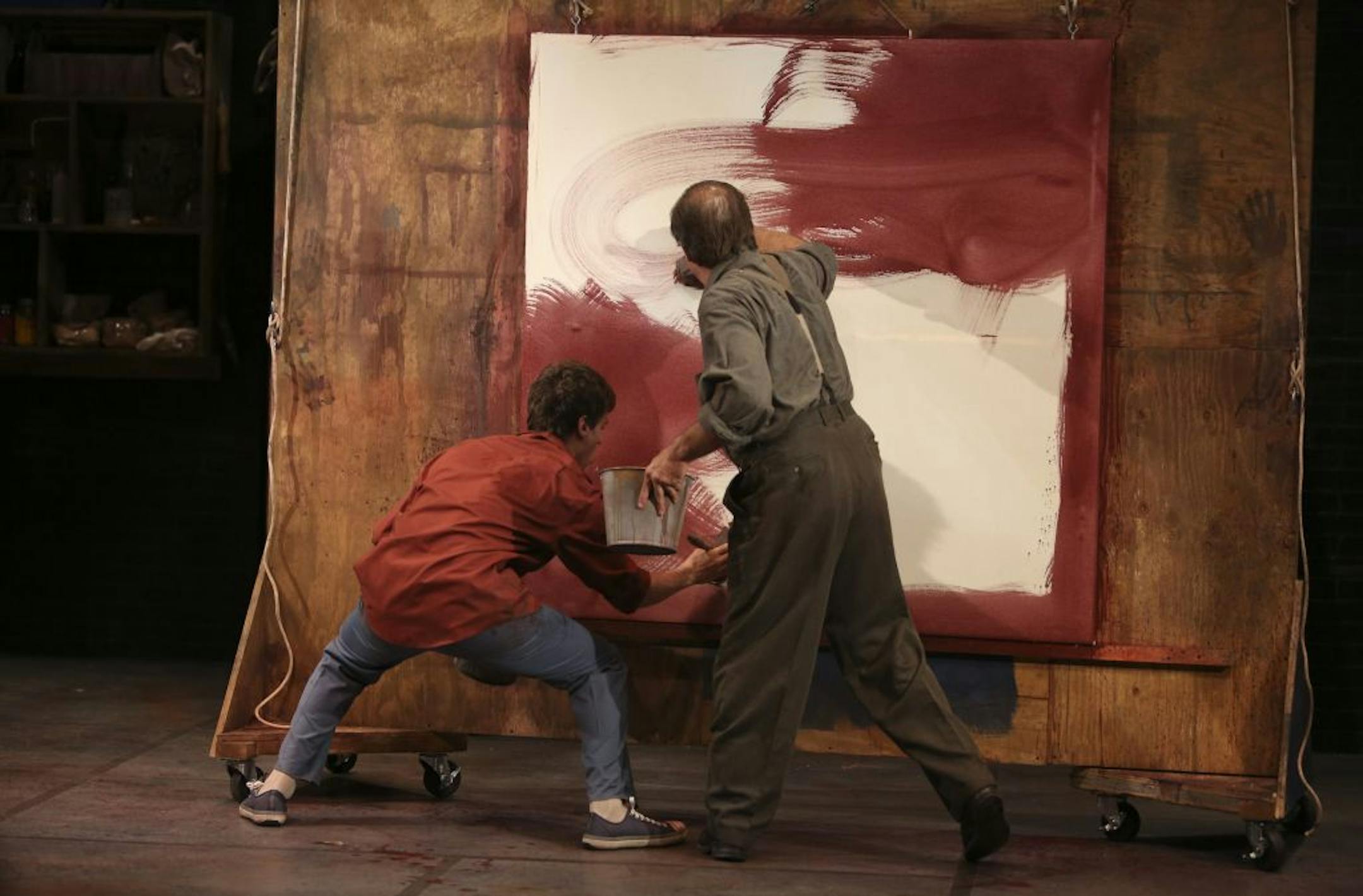
3:55The assignment was straightforward, yet the responsibility felt heavy on the shoulders of Anne Henly. A graduate student in scenic design at the University of Minnesota, Henly was tasked with creating four or five replicas of Mark Rothko murals for Park Square Theatre's production of "Red," which has its Minnesota premiere Friday in St. Paul.
"It was a little overwhelming," Henly said last week as she appraised her work, stacked on the Park Square stage. "His work seemed so simple but there are so many layers."
Indeed, just as complexity defined the man. Rothko, who killed himself in 1970, was solemn and hard-working -- when he wasn't raging about the pop-art philistines who threatened his abstract aesthetic in 1959. He disdained commercialism and yet accepted a $35,000 commission to paint murals for the Seagram Building in New York. He carried a hard-edged social cynicism, yet allowed himself to be emotionally captive to his work.
"Rothko is very much trying to not perish from what's coming and what's happening in his life," said actor J.C. Cutler, who plays the artist. "His paintings spoke to him. They were living things."
John Logan's play originated in London in 2009, and then moved to Broadway. Alfred Molina, as Rothko, and Eddie Redmayne as the young assistant, Kent, were nominated for Tony Awards. Redmayne's victory was one of six Tonys -- including for Best Play.
As soon as artistic director Richard Cook secured the rights for Park Square, he talked to Cutler, and then chose Steven Johnson (Latté Da's "Beautiful Thing") to play Kent. A young artist hired as an assistant to Rothko, Kent is both a punching bag for Rothko's fulminations, and a menacing avatar of the generation that certainly will overtake the older man.
Struggle to survive
Rothko's reputation was well established by the time of the Seagram commission in 1959. A Russian émigré at age 10, he grew up in Portland, Ore., and attended Yale on scholarship. He drifted to New York to savor the life of a starving artist. His first exhibit, with other youngsters in 1928, bore the influence of German Expressionists and of surrealists such as Paul Klee.