

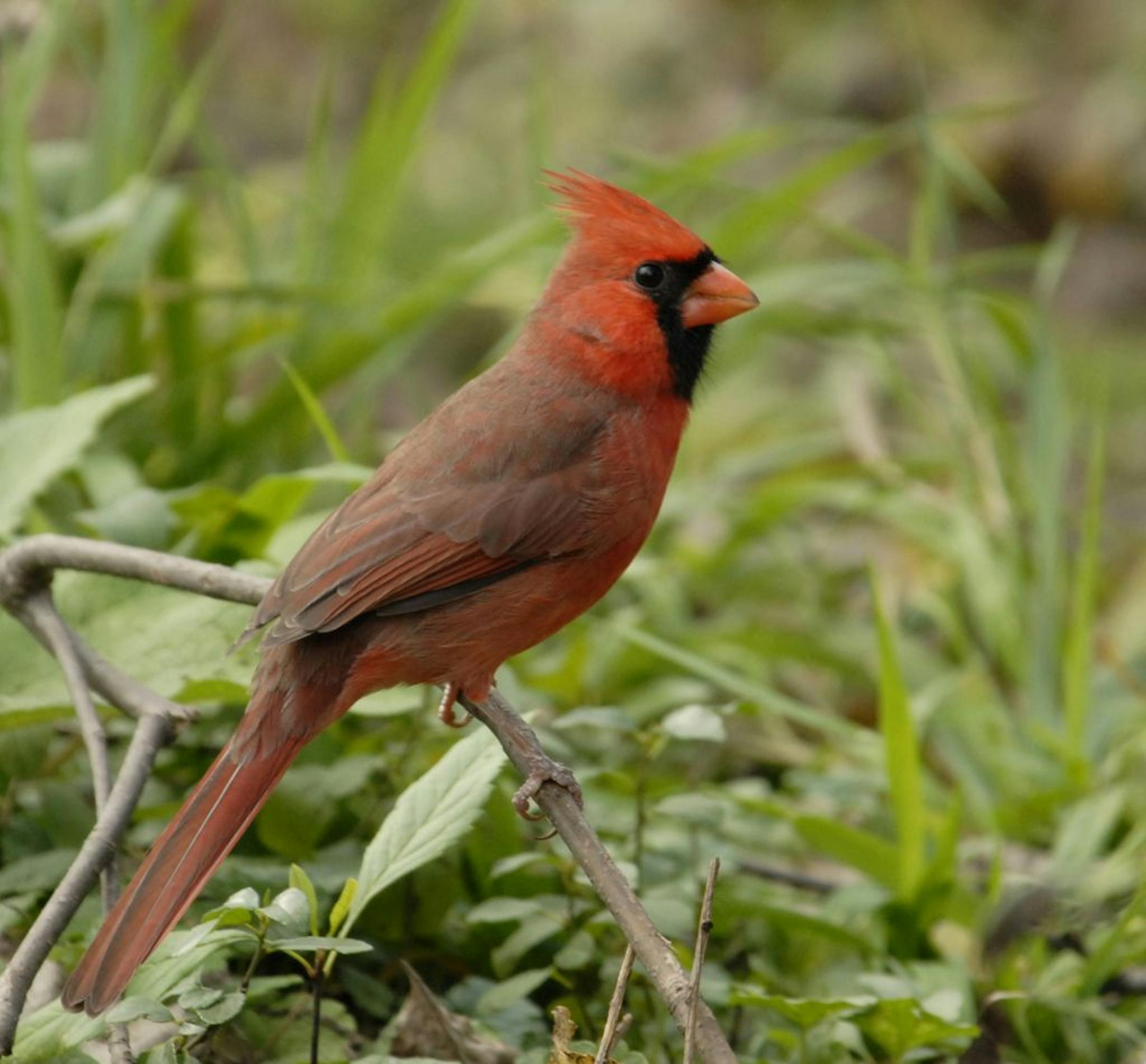
Q Is it just my imagination, or are the cardinals extra bright this spring?
A You may have some particularly bright males in your neighborhood. Although we tend to think of all cardinal males as being knockout red, there actually is some variation in their brightness. And some of what you're noticing may be due to location: At this time of year, males are sitting at the top of trees, often facing the sun, to appear as red as possible. Studies have shown that redder males earn better mates and higher quality territories.
Cardinal songs filled with meaning Q Why do cardinals sing so much? I hear them when I go out for the newspaper in the early morning, and they keep it up for hours.
A At this time of year, cardinals are using their songs to accomplish two things: attract a mate and establish a territory. Like many other birds, cardinals are homesteaders and their songs tell other red birds, "This territory is occupied, go find your own!"
With nesting season approaching, they know they're going to need hundreds of insects a day to feed their offspring. Their songs "fence in" enough room to ensure a good supply of this high-energy food for their nestlings. When cardinals sing "Hey, sweetie, sweetie, sweetie," over and over, the opposite sex reads that as an invitation. For other males it means, "Buzz off, or be ready for a fight."
Cardinal attacks reflection Q How long do cardinals live? For eight years a male cardinal has been throwing himself into our windows, mostly in the morning. He does this repeatedly for hours, first at one window, then the others. Could this be the same bird, or is it learned behavior by one of his offspring?
A You certainly have a persistent bird on your hands. This behavior is not uncommon -- many people are perplexed by a cardinal attacking its reflection in a window, car mirror or shiny bumper. Both males and females do this, and most often in spring and early summer when they are obsessed with fighting off competitors. They're confused by their own reflection, thinking another bird is trying to take over their territory. A few weeks from now, as levels of aggressive hormones subside, the attacks should end.
The average lifespan for wild cardinals is about three years, so chances are your windows have been attacked over time by cardinals from several different generations. This behavior tends to be an innate response to a perceived threat. It would be a kindness to put a piece of cardboard over the outside of the window that the bird is attacking. If he moves to another window, move the cardboard. Some birds will harm themselves with this persistent, hormone-driven behavior.


