
Readers Write: Charlie Kirk’s memorial, public debate, Palestinian statehood

Christianity vs. Trumpism, distilled.

The Minnesota Star Tribune
September 24, 2025 at 12:00AM
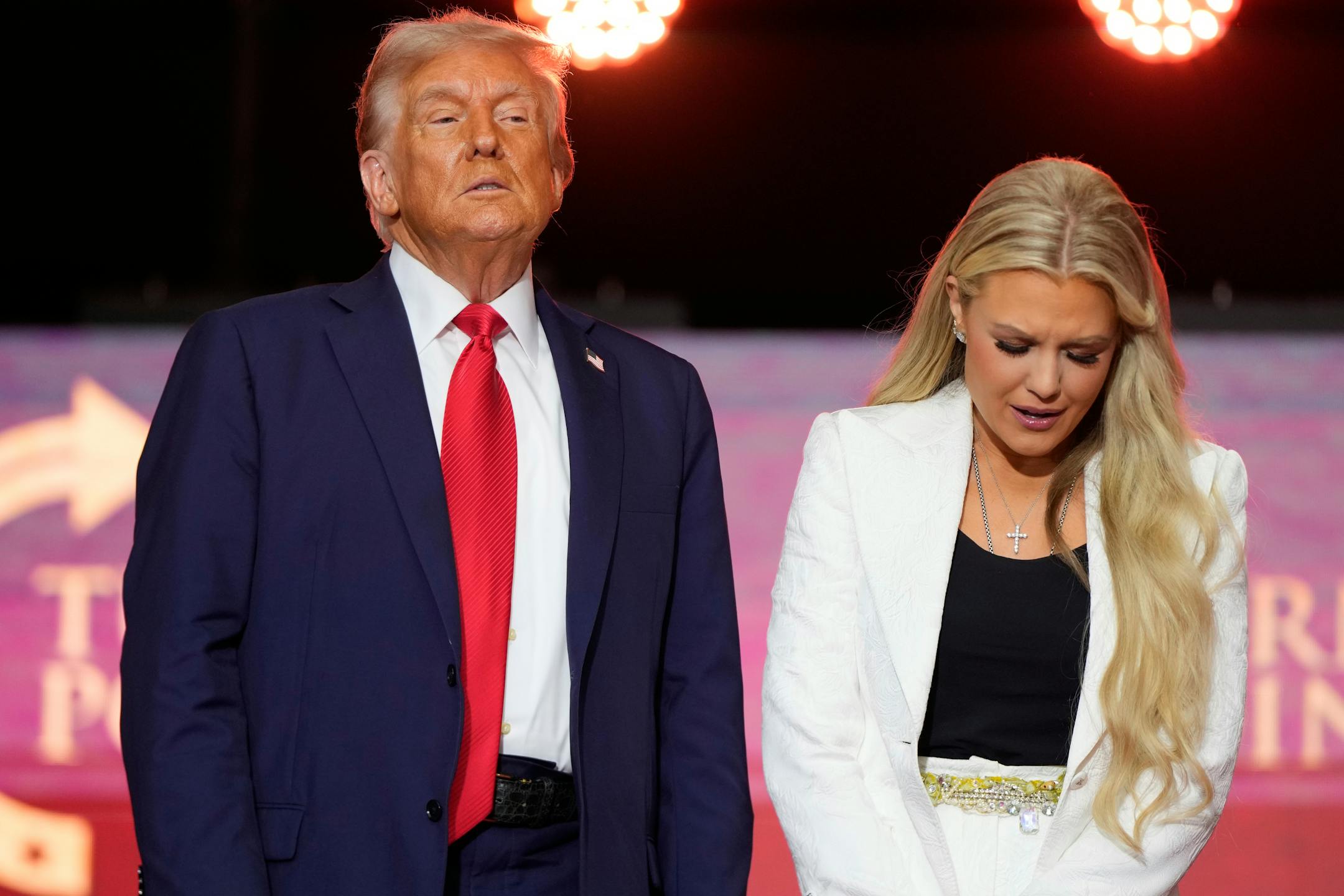
President Donald Trump, left, stands with Erika Kirk at the conclusion of a memorial for her husband, conservative activist Charlie Kirk, in Glendale, Ariz., on Sept. 21. (Julia Demaree Nikhinson/The Associated Press)

Opinion editor’s note: Strib Voices publishes letters from readers online and in print each day. To contribute, click here.

•••

Erika Kirk began the memorial service for her husband by saying she forgave the person who killed Charlie Kirk because it was what Christ did. She went on to say, “The answer to hate is not hate. The answer, we know from the Gospel, is love.”

President Donald Trump was the last speaker, and he said that Charlie was “did not hate his opponents. He wanted the best for them.” Trump then went on to say, “That’s where I disagreed with Charlie. I hate my opponent and I don’t want the best for them. I’m sorry. I am sorry, Erika.”

Those who are part of Turning Point USA have a choice, will they follow the vision of Erika Kirk or Trump? Will they choose forgiveness or revenge? Will they choose love or hate? And I would ask those who identify as Christians, if you choose hate, how do you justify that choice?

Roland Hayes, Shoreview

•••

I fully agree with Nekima Levy Armstrong that in America, disagreement is part of democracy, and Kirk should not have been killed (“The truth about Charlie Kirk’s legacy,” Strib Voices, Sept. 20). While many progressives objected to his views and many conservatives supported them, that is not the point. Kirk’s positions were not unique; what set him apart was the way he engaged those who disagreed with him.

I knew little about him until recently. The first time I watched one of his campus appearances, three things stood out: his willingness to face hostile audiences, his discipline in critiquing arguments rather than people and his ability to debate without notes when many opponents relied on them.

I did not agree with all of Kirk’s views. What made him distinct was not the content of his positions but his openness to debate them publicly and unscripted, while hearing opposing perspectives in real time.

At a time when many public figures avoid difficult conversations, Kirk sought them out. On college campuses, he invited tough questions, responded directly and often began by finding areas of agreement before turning to disagreement — a refreshing contrast to today’s all-or-nothing politics, where genuine public debate is rare. Even when his conclusions proved unpopular, his process modeled a more respectful way to disagree.

That emphasis on engagement is what made him stand out. In an era of increased and insular polarization, Kirk showed that civil discourse remains essential. His style of engagement may in fact be a practice capable of keeping our country from drifting further toward polarized extremes. He reminded us that diversity is not only about background or identity, but also about ideas — and that in a democracy, we will always encounter views we strongly disagree with.

The best way for us to remember Kirk is not to canonize his beliefs, nor to demonize them. It is to recognize that his true contribution lay in his approach: engaging directly, respectfully and publicly with those who opposed him. That commitment to public discourse, more than any single opinion he held, is the part of his legacy worth remembering.

Mark Stockhowe, Glenwood, Minn.

•••

Is speech violence?

Everyone has received a critical comment about themselves. We all know what that feels like. It is uncomfortable. It hurts. It can raise your blood pressure. If you hear critical comments everyday that raise your blood pressure, that can have life-altering consequences.

The physical reaction we can have to some words is the reasoning used that speech can in fact be violence.

This is a dangerous premise to hold.

We have a way to seek justice through the state when someone commits physical violence. The state is the only organization allowed to hold someone against their will (physical violence) in jail. Jail is violence. But it is violence mediated by the state after a legal process that we all have agreed to participate in by being citizens of the state.

There is no such mechanism for speech as violence. The First Amendment protects our freedom of speech. You can’t be prosecuted by the state for saying something that raises someone else’s blood pressure.

The person who believes speech is violence may still want justice, however. But they have no legal mechanism through the state to seek justice. People who seek justice outside the legal system are called vigilantes. If vigilantes group together, that is mob justice.

Growing up I was indoctrinated — yes, indoctrinated — that “sticks and stones can break my bones, but words will never hurt me.” This is not technically true. Words can and do hurt. But believing words are violence leads down a dangerous path of which words are violence and who decides.

Speech is not violence. This premise is central to our way of life.

Spencer Kubo, Minneapolis

ISRAEL AND PALESTINE

Statehood requires Palestinian support

No doubt the countries lining up in support of a Palestinian state believe they are handing the Palestinian people something they seek to achieve (“U.K., allies affirm Palestinian state,” Sept. 22). History makes it clear, however, that they do not seek a state that exists alongside the Jewish state of Israel. Witnessed their refusal to accept statehood when offered by the United Nations in 1947, and in the years that followed when offered by Israeli Prime Ministers Ehud Barak and Ehud Olmert. The Palestinians refused the idea of two states west of the Jordan on those occasions, and have indicated they would do the same today, in spite of the hope of many who support a Palestinian state, for one reason: It requires acknowledging Israel’s legitimacy and acceptance of its right to exist in peace as a Jewish state west of the Jordan River. Neither the Palestinian people nor their governing bodies have shown any inclination to accept those principles.

This conclusion is supported by polling data done shortly before the war in Gaza began, which consistently shows that a majority of Palestinians do not support the so-called “two-state solution,“ with some surveys indicating opposition as high as 65%. So while these countries are virtue-signaling their support of an independent Palestinian state west of the Jordan River, it can never be accomplished without the support of the Palestinians who live there.

Ronald Haskvitz, Minnetonka

•••

Thousands of Minnesotans have family in Palestine, yet in just two days after the killing of Charlie Kirk I heard our state’s leaders speak more about the violent killing of a single political activist then they have said over the past two years about the systematic, U.S.-funded genocidal violence that has claimed tens of thousands of innocent Palestinian lives.

We are grappling with a cascade of crises: gun violence, the gutting of health care and science, a federal government that is kidnapping and trafficking our neighbors, attacks on trans friends and family, and the marginalization of individuals with disabilities.

Yet so much of our civic energy must be spent urging officials to recognize the atrocities happening in Palestine and do something to stop our complicity in it.

Imagine the collective change we could find if we had leaders with consistent principles. If our elected officials and faith leaders devoted as much of their influence and platform to ending a genocide abroad as they do to whitewashing Kirk’s death.

I am weary. I hold on to hope. I just wish we had leaders that actually inspired it.

Nathan Chomilo, Minneapolis

about the writer

about the writer