
Readers Write: Charlie Kirk and the freedom of speech

The shooter chose bullets over persuasion.

The Minnesota Star Tribune
September 14, 2025 at 8:58PM
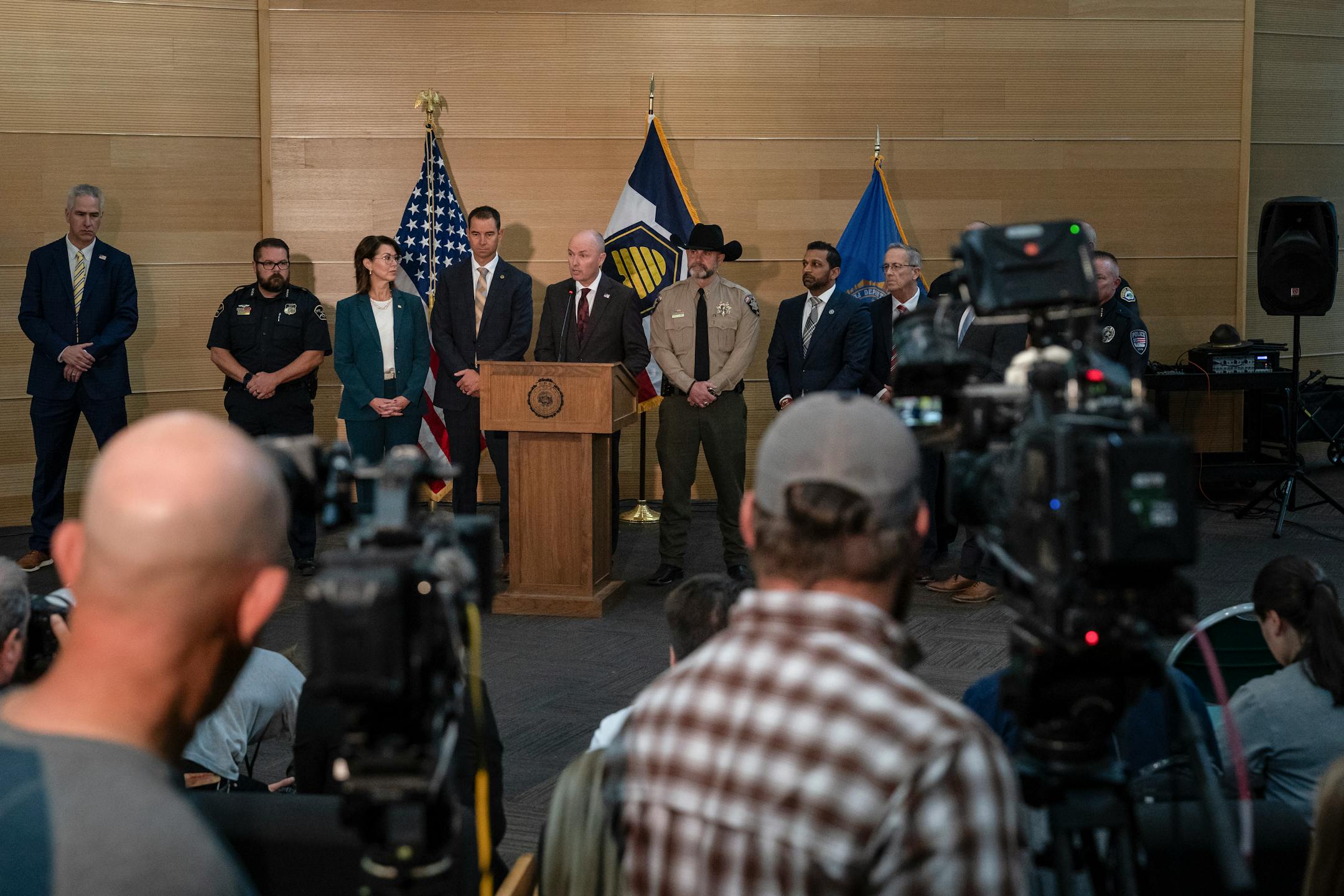
Utah Gov. Spencer Cox speaks at a news conference on Sept. 12 announcing the arrest of a suspect in connection with the fatal shooting of Charlie Kirk at Utah Valley University in Orem, Utah. (LOREN ELLIOTT/The New York Times)

Opinion editor’s note: Strib Voices publishes letters from readers online and in print each day. To contribute, click here.

•••

The commentary from the New York Times’ Ezra Klein in Friday’s Minnesota Star Tribune should be read by the many who have used the killing of Charlie Kirk as an excuse to attack him for his political views, and to suggest it is those views that are the reason he was killed (“Kirk was practicing politics the right way,” Strib Voices). I have heard some making such a claim on cable, and read of others. Klein, a liberal whose views are diametrically opposite those of Kirk, writes: “American politics has sides. There is no use pretending it doesn’t. But both sides are meant to be on the same side of a larger project — we are all, or most of us, anyway, trying to maintain the viability of the American experiment.”

James Madison could not have said better. We should all recognize that this is a time to mourn the death of someone assassinated because of his political views. And to understand that the “threat to democracy” many see in Kirk and his followers is really to be seen in the silencing of one whose only “crime” was expressing political views that some disagreed with.

Ronald Haskvitz, Minnetonka

•••

President Donald Trump. Charlie Kirk. They are not political props, but Americans whose lives were shattered — or nearly so — by a rising tide of radical left-wing violence.

These atrocities are not random; they are the result of a political climate that casually equates conservative conviction with moral evil. When influential state leaders like Gov. Tim Walz casually label Trump as a fascist, they light a social fuse that explodes into depraved political bloodshed. Words matter. This reckless rhetoric grants the unhinged in our society a moral permission slip, persuading them that gunning down a talk-show host with a wife and two kids or trying to assassinate a president are not crimes at all, but a righteous purge paraded as virtue.

Minnesotans and Americans cannot stand for this incivility. Our republic cannot survive a partisan caste system that shrugs at violence against the right as collateral damage for political disagreement. Let’s make one thing clear: Political violence is treason against self-government. However, the remedy is explicit: Denounce every progressive politician, professor and pundit whose incendiary words light the fuse of hatred, defund campuses that refuse to shield invited speakers and shame the media figures who cloak bloodshed in euphemism. Silence today is complicity tomorrow.

Our country can, and must, rise above this. The ultimate question is, will we?

Jimmy Murphy, Golden Valley

•••

Klein completely loses the thread when he decries political violence such as the Jan. 6, 2021, insurrection in one breath and says “Kirk was practicing politics in exactly the right way” in the other.

Kirk helped send buses to D.C. on Jan. 6, and he pleaded the fifth when he appeared before the United States House Select Committee on the Jan. 6 attack.

Kirk should not have been assassinated. Political violence has no place in a functioning democracy. But let’s be honest about Kirk’s life work as harbinger of the era of political violence we now live in.

Matthew Byrnes, Hopkins

•••

I am deeply saddened by the killing of right-wing political activist Kirk and want to affirm my strong commitment to peaceful protest. I see no value in such violence.

I am also saddened to hear the right wing accuse the left of inspiring this murder through language, for example, identifying right-wing leaders as “Hitler” and their supporters as “fascists.”

Such accusation neglects to acknowledge how their own leader, the president of our country, has signature behaviors of gleefully creating nasty names for his opponents, as well as labeling them “a horrible man,” “disgusting,” “weak, little,” “lying,” “dumb as a rock,” even simply “ugly,” and he calls the left Marxists, communists and fascists. As such verified name-calling isn’t sufficient for his purposes, this president’s inflammatory rhetoric includes almost countless threats of litigation against anyone who crosses him and assurance he will cover legal costs if others physically assault his opponents.

Yes, the left has been insolently at fault as well. I myself try to make my points more thoughtfully, but I assume I too have slipped into rudeness. I am still allowing myself to use the phrase “dear leader,” out of both accurate description and lack of respect. But violence? Absolutely no.

Sadly, human history shows us how political situations like the one we’re in now have often evolved into violent takeover of governments. I have to trust that in our attempt to build an honorable democracy we have enough strength in the accumulation of ethical behavior to guide us through today’s challenges without needing to relive history’s examples.

Shawn O’Rourke Gilbert, Edina

•••

I appreciate the call for thoughtful discourse after Kirk’s passing but reject a recent letter writer labeling Kirk’s 2024 podcast remark on Black pilots as “white supremacist.” It misrepresents his critique of DEI policies in aviation: “If I see a Black pilot, I’m going to be like, ‘Boy, I hope he’s qualified.’” He later explained this was “because of their massive insistence to try to hit these ridiculous racial hiring quotas.” This highlights concerns over quotas prioritizing identity over merit, not racial bias. Kirk clarified that DEI fosters a “hyper-racialized” view of hires.

This view isn’t fringe; it’s echoed in Trump’s Jan. 21 executive order ending federal DEI programs to restore merit-based hiring. Calling such skepticism supremacism dilutes the term and hinders debate. Kirk’s followers admire his challenges to overreach, not hate. Let’s debate his ideas fairly.

The letter writer’s use of that label is part of the problem.

Don McConnell, Mendota Heights

•••

I was troubled to hear of Kirk’s killing. On the radio, mixed in with the news, though, I could hear Trump and other prominent conservatives trying to recast him, in real time, as some sort of nationally beloved figure who believed in discussion and connection with others. Kirk made a lucrative career out of stoking the nation’s political divides. All you need is a quick look at his most popular videos online. His “debates” with college students were never meant to try and convince them of anything, or to discuss issues on the merits — instead they are about teeing up people who are overconfident, naive or poor public speakers to be knocked down. His modus operandi was to find the weakest version of any argument and ruthlessly pick it apart. The humiliation was the point, and you can see this from comment sections where, without fail, his audience mocks these people for the same smug overconfidence that he was cultivating in them.

He did not deserve to be killed — nobody does, and I hope the killer faces justice — but I reject the idea that I suddenly have to be grateful for his career; he did more than his fair share to poison the well of political discourse. Am I now expected to cry? Send flowers? Write a poem in his honor?

Rory Cole, Excelsior

•••

In these troubling times fraught with great emotion, uncertainty and justifiable concern, we might be wise to heed the words of Friedrich Nietzsche: “Whoever fights monsters should see to it that in the process he does not become a monster.”

Stewart Hanson, Excelsior

about the writer

about the writer