
Readers Write: Assassination of Charlie Kirk

If violence wins, we will cease to be free.

The Minnesota Star Tribune
September 12, 2025 at 12:00AM
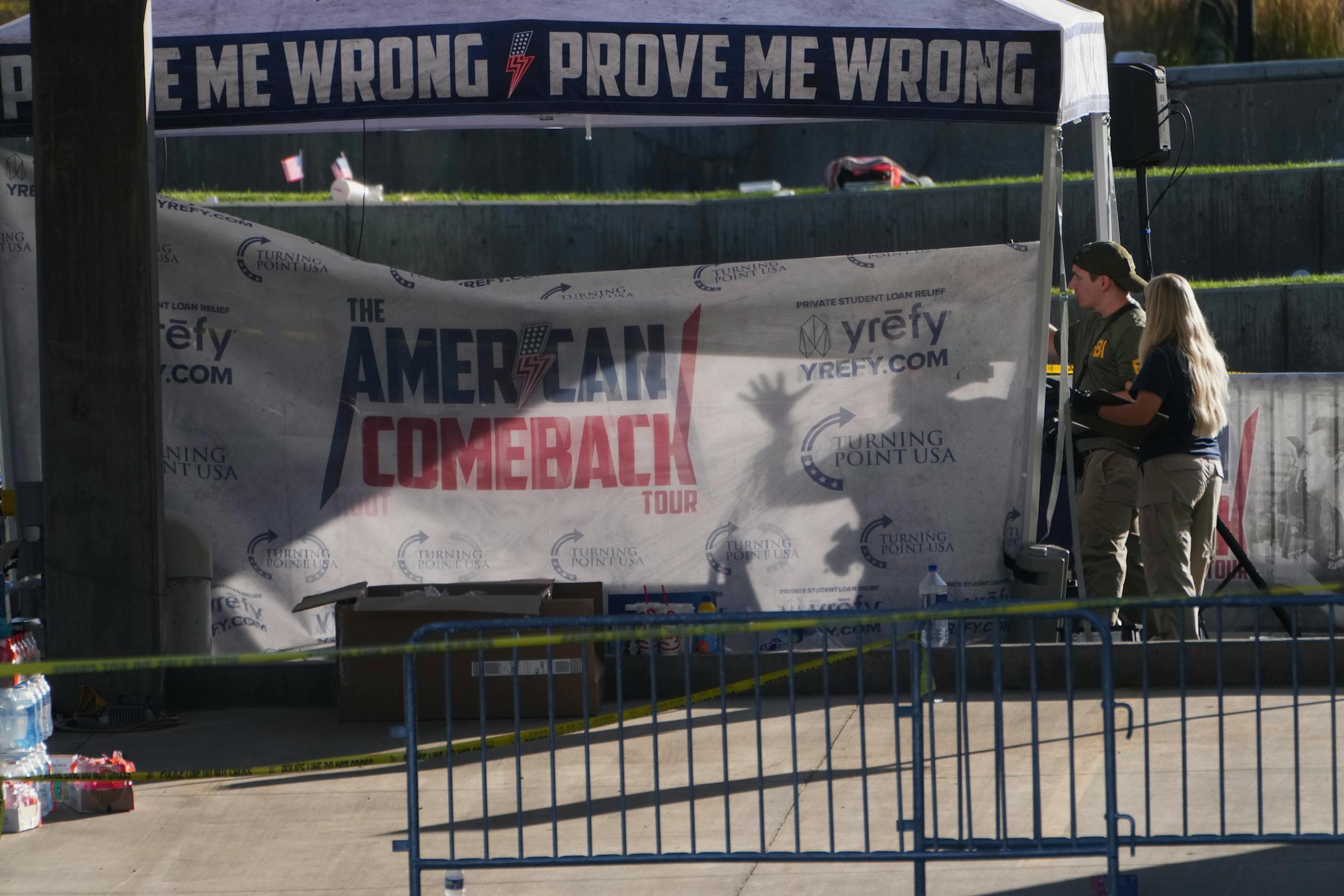
FBI agents investigate the area at Utah Valley University in Orem, Utah, a day after Charlie Kirk was shot and killed there. (Lindsey Wasson/The Associated Press)

Opinion editor’s note: Strib Voices publishes letters from readers online and in print each day. To contribute, click here.

•••

I had profound disagreements with Charlie Kirk. Yet when I learned of his assassination, I felt heartbreak. Not because I shared his vision, but because I believe in the American experiment — and that experiment cannot survive if bullets replace ballots.

I come to this moment as someone who spent years organizing around gun reform in Minnesota. I advocated for universal background checks, red-flag laws and limits on assault weapons. In 2018, I helped organize the March For Our Lives in St. Paul, where thousands of youth marched for change on this issue. In 2020, I even ran for the state Legislature to carry that fight into the halls of government. Along the way, I crossed paths with leaders like state Sen. John Hoffman — who I last saw at a doorknock for Mandy Meisner in 2024 — and Speaker Melissa Hortman, whose home fundraisers I attended twice before her tragic assassination.

Despite the marches, the petitions and the countless testimonies, America has not enacted the reforms that could reduce this violence. Instead, gun violence now feels less like a series of isolated tragedies and more like a virus creeping into the DNA of our democracy.

If assassination becomes a commonplace tool of politics, it will not matter whether you are conservative, progressive or somewhere in between. America will cease to be a place where the free can act free. Who will risk running for office? Who will knock on doors for a candidate? Who will stand up at a town hall to voice dissent — if doing so could make them a target?

My grandfather believed deeply in the light of America’s promise. He carried that belief until his last days, convinced that his “sweet America” could still become something better. I still hold that hope as well, captured in the words carved into our national conscience by Emma Lazarus: “Give me your tired, your poor, your huddled masses yearning to breathe free.”

That lamp of freedom dims each time a political leader falls to violence. Whether it is someone I opposed, like Kirk, or someone I admired, like Hortman, the result is the same: America is diminished.

We can argue policy forever. But first we must agree on this: Political violence cannot become normal. If we let that happen, the American experiment will fail, not with a bang, but with silence, as free people grow too afraid to speak.

Austin Berger, St. Louis Park

•••

Just as we denounced what happened to the Hortmans and the Hoffmans here in Minnesota, we must denounce the murder of Charlie Kirk in Utah. This political violence is never the answer. Only love can expel the darkness. Those who live by the sword die by the sword, as Jesus said.

As we go through this crucible as a nation, we must renew our commitment to adhere to nonviolent civil disobedience. Martin Luther King Jr. and Mahatma Gandhi are still models of the most effective way to transform the injustices in our society.

God bless the better angels of our nature. Our nation desperately needs them this very hour.

Howard Dotson, Minneapolis

•••

As a candidate who ran five times for governor with the marijuana parties, I was often confronted by people at our Minnesota State Fair booth who said to me, “You should be shot.”

Our nation was founded on classical liberalism’s belief in free speech. If you cannot say something that is unpopular, then you don’t have free speech.

The assassination of Charlie Kirk is an attack upon the principles upon which this nation was founded.

The assassination of Rep. Melissa Hortman is another shocking example of a trend toward political violence.

America needs to be working toward reason and a sane society. There cannot be patriotism without love of country. There cannot be love without care, respect and oneness with our people.

Please support the politics of oneness and reject all those who spout the politics of division.

Divided we fall. Don’t surrender the principles of America. E pluribus unum.

Chris Wright, Minneapolis

•••

The nearly universal expressions of condemnation and grief on a bipartisan, or nonpartisan, basis following the assassination Wednesday of right-wing influencer were appropriate and understandable.

But the lamentations focusing on Kirk’s role as a pied piper for youthful MAGAites tended to overlook a couple of his most telling remarks illustrating his white supremacist leaning and his views of gun violence that were embedded in his persona and his youthful followers.

His racist outlook was reflected in his comment that whenever he boards an airplane and sees a Black face in the cockpit, he questions whether the pilot is “qualified” or the beneficiary of affirmative action or diversity, equity and inclusion (DEI), now banned by the Trump administration, a prohibition inspired by influencers like Kirk.

His view on gun violence was highlighted in his observation that “It’s worth to have a cost of, unfortunately, some gun deaths every single year so that we can have the Second Amendment to protect our other God-given rights. That is a prudent deal. It is rational.”

Kirk was certainly entitled to have and express these beliefs safely and influence others to share them, but they do not warrant a type of unofficial sainthood that’s being bestowed upon him.

Marshall H. Tanick, Minneapolis

•••

During a 2023 Turning Point event, Kirk said, “You will never live in a society when you have an armed citizenry and you won’t have a single gun death. ... I think it’s worth it. I think it’s worth to have a cost of, unfortunately, some gun deaths every single year so that we can have the Second Amendment to protect our other God-given rights. That is a prudent deal. It is rational.”

This is not prudent, nor is it rational. How many people have to die in this country unnecessarily before we do something?

Teresa Maki, Minnetonka

•••

There’s money to be made in the venting of political outrage (and the inciting of others to do so) on certain AM radio programs, cable television outlets and social media pages. The more listeners, viewers and eyeballs a medium can attract, the higher it can set its advertising rates. Many of our politicians operate on the same principle, initially to attract contributions and ultimately to win election. This approach to the public degrades political civility and democracy itself in a vicious cycle of outrage, profit, more outrage and more profit. As media consumers and as voters, we should stop rewarding those whose self-serving agenda turns us against each other, even to the point of political violence (“Americans must unite against violent spiral,” Strib Voices, Sept. 10). It may be the challenge of our lifetime, given the power of the primitive part of the human brain, which loves a good fight.

Jim Kaufmann, Burnsville

•••

Following this latest assassination, we would hope that the president would have shouted, “Enough is enough!” That he would have made a major speech, decrying political violence for any reason and calling on Americans to start working with each other in positive ways. He would have followed up by calling leaders of both parties to the White House to announce his decision not to sign any bill sent to his desk without substantial bipartisan support.

Well, we have the president we have, and it is unlikely that any of this will happen. But that doesn’t mean that we can’t follow the lead we should have received. We are free to talk respectfully to those we differ from and to work together to make our communities better. Our representatives are free to drop the hyperbolic rhetoric and work across the aisle.

We choose this better path not because we are nice people, but because we love our country and want to make it a better place to live. We accept the precious responsibility we have to our fellow citizens.

W. Perry Benson, Minneapolis

about the writer

about the writer