

Ramstad: Gift shop, coffee shop in Grand Rapids show full potential of human services programs

Fraud at some human services programs shouldn’t dim the shine of the ones helping people flourish and boosting Minnesota’s economy.

Columnist Icon
The Minnesota Star Tribune
November 29, 2025 at 1:00PM
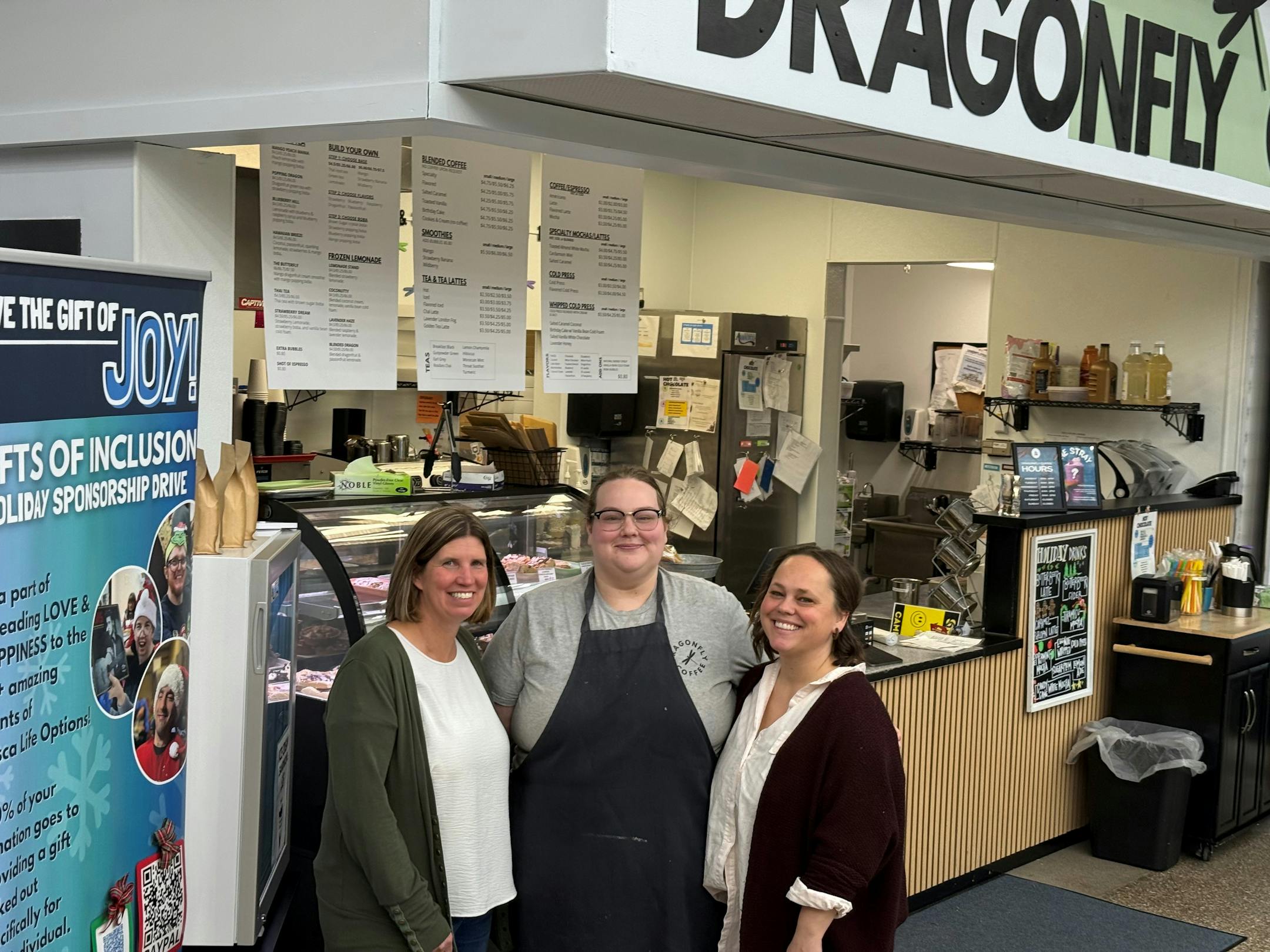
Lisa Lassen, executive director of Itasca Life Options, left, and Sonia Lindgaard, associate director, right, stand with Sara Slaubaugh, manager and chief baker after closing at Dragonfly Coffee in Grand Rapids. Itasca Life Options, a provider of human services and a variety of skilled opportunities for people with mental and physical challenges, started the coffee shop during the pandemic. (Evan Ramstad)

GRAND RAPIDS, Minn. — Human services programs for Minnesotans with disabilities are under new scrutiny amid evidence of fraud in some of the Twin Cities-area organizations that provide housing aid, addiction treatment or help to people with autism and other disabilities.

As happens so often, the problems of the few hurt the work of the many.

One human services organization that blossomed in recent years is Itasca Life Options (ILO) here in Grand Rapids, the Mississippi River town of 12,000 that sits on the divide between the Iron Range and the resort-filled lake country of northern Minnesota.

More precisely, it’s the residents of Grand Rapids that ILO serves who have blossomed. Through ILO’s programs, they are working jobs above minimum wage, even running their own coffee shop, gift store and theater company.

One of them, Hanna Hays, told me to be careful with my words when writing about her and her peers.

“I’m not all that fond of the words ‘disabled’ or ‘handicapped,’” said Hays, who told me she has Asperger’s syndrome and a few other challenging conditions.

“It makes me sound a little less than fully human,” she added. “I like to use the words ‘mentally or physically challenged.’ Challenges can be overcome.”

ILO started 60 years ago in the days when people with mental and physical challenges were sent to state hospitals. The organization played an important role in Grand Rapids and Itasca County during the evolution to move people into communities.

About a decade ago, ILO was only serving about 38 people in a small building. Members of the organization’s board had greater ambitions and hired an executive director, Lisa Lassen, who shared them.

“We had a small little program at our YMCA. It was a tiny room. We had eight clients and they did arts and crafts. People didn’t even know we were there,” Lassen said. “We looked for bigger space that was accessible, and the mall came up.”

The mall is Central Square Mall, just off the main intersection in town. It was revived by an owner who a few years ago decided to concentrate on local businesses rather than regional or national retailers.

Now, Central Square Mall is full and at its center is Dragonfly Coffee, operated by ILO and staffed by rotations of its clients.

Opened shortly after the pandemic, Dragonfly is a full-service coffee shop and bakery, the only one in town. Work begins at 7:30 a.m. for manager and lead baker Sara Slaubaugh and around 8:30 or 9 a.m. for the ILO clients who work to the level of their abilities. They staff the cash register, make drinks, and bake cookies, rolls and bars slathered in caramel.

“We give our workers individual attention. They get to be as autonomous as they like or work in a team,” Slaubaugh said.

Just a few storefronts away, ILO operates Crafted, a workshop and gift store where even more of its clients produce items for sale. There are fireplace starters, scarves and shawls, painted signs for lake cabins and many other handmade gifts. Crafted will also have a featured space in the annual holiday fair at the Itasca County Fairgrounds.

Each creator receives 60% of the revenue when one of their items sells. “We give them the same commission as the local art center,” Lassen said. “We provide all the materials, and they make whatever is unique to them and we have the space to sell it in our store.”

ILO’s programs now attract over 100 clients with a full range of challenges. Minnesota Diversified Industries, one of the state’s best-known providers of working opportunities for people with mental and physical challenges, also has an operation in Grand Rapids. Some ILO clients will spend part of the day at Dragonfly or Crafted, then another part at MDI. ILO helps facilitate work for them at other local businesses, too.

“What I love about this place is the joy of saying yes and figuring it out as we go and seeing the change it makes in, not just the participants’ lives, but the community and our staff,” said Sonia Lindgaard, ILO’s associate director.

Staffers at Blandin Foundation, the Grand Rapids-based philanthropy that is the largest by asset size in Minnesota outside of the Twin Cities, watched ILO’s transformation and became regular customers of its businesses. “Dragonfly brings me joy,” said Tuleah Palmer, Blandin’s chief executive.

Through the years, Blandin routinely provided grants to advance ILO’s services, which are chiefly funded by Medicaid. Recently, Lassen turned to Blandin for a different reason. ILO’s staff has grown to 56 and she and Lindgaard still write out checks by hand. The foundation agreed to provide grants that would let ILO automate its books, hire a human resources director and provide more training for workers.

“We all want organizations to have more growth, more impact, but you also have to build them in a sustainable way,” said Kyle Erickson, Blandin’s director of rural grantmaking.

In the Twin Cities, you can find businesses like Constellation Coffee in Apple Valley or Highland Popcorn in St. Paul that formed to employ people with challenges like autism or other special needs.

By starting businesses and other ventures, ILO pushed the envelope as a provider of home and community services. Blandin executives see ILO as a model for other human services organizations and, while I don’t have their expertise, it appears that way to me, too.

The recent emergence of fraud and fraud allegations in other human services providers threatens the image, and perhaps the funding, of the ones that truly do help the state’s most vulnerable people. Some of those, like ILO, also help Minnesota’s economy.

Sign up at startribune.com/evanalert to receive an e-mail from Evan when his columns publish.

about the writer

about the writer

Evan Ramstad

Columnist

Evan Ramstad is a Star Tribune business columnist.

See Moreicon

More from Business

See More
card image
Shari L. Gross/The Minnesota Star Tribune

The nonprofit grocery store opened in 2017 to serve a neighborhood deemed a food desert.

card image
card image