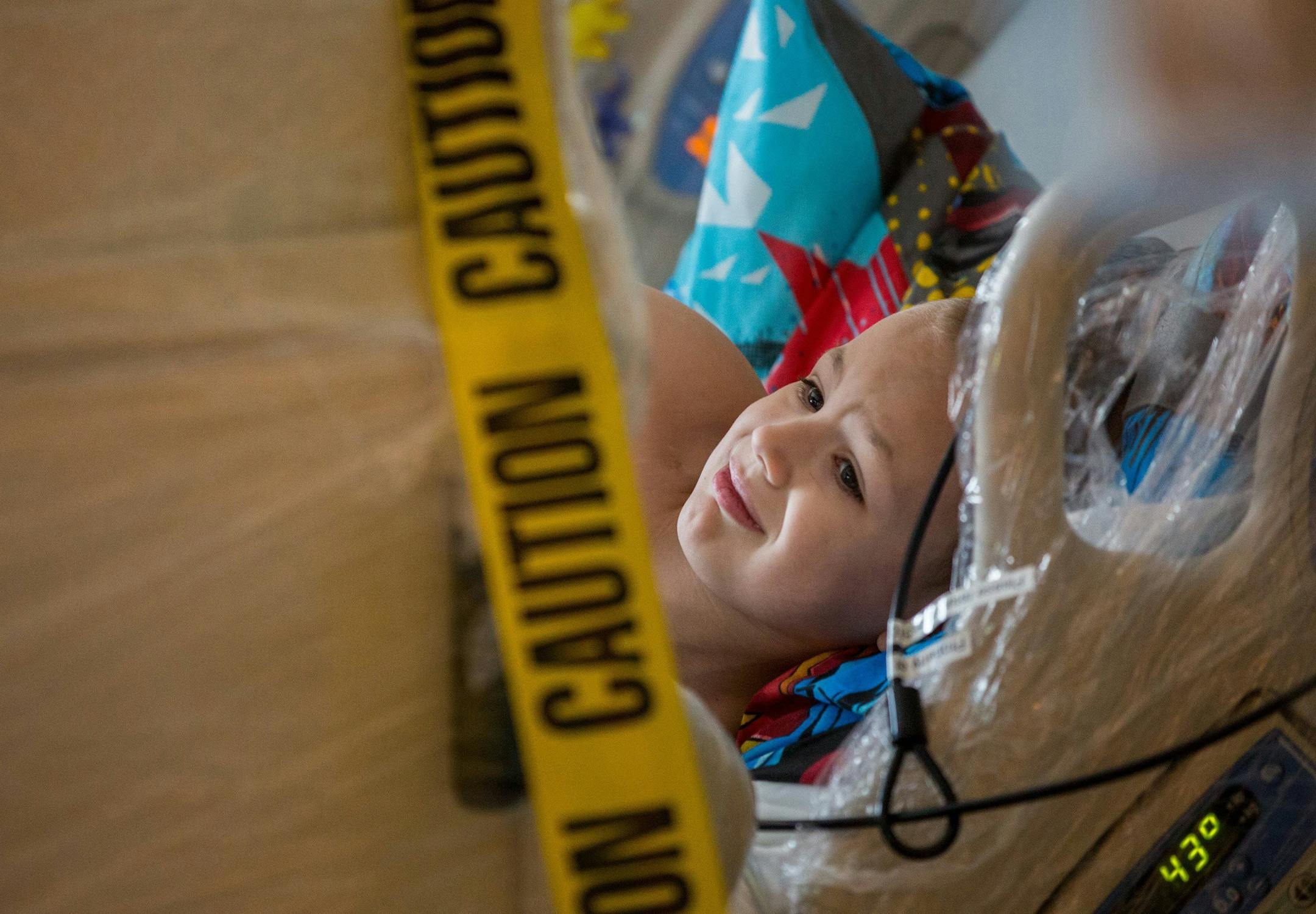
At precisely the time 6-year-old Sammy most needed his parents, they were forced to keep their distance because his cancer treatment made him radioactive. Even his favorite blanket and stuffed animal were off-limits, lest they, too, become contaminated.
Two weeks ago, Sammy Nahorny became the first patient at Comer Children's Hospital to undergo high-dose radiation therapy for neuroblastoma, one of the deadliest pediatric cancers.
The treatment confined him to a room of less than 200 square feet, lined with 450,000 pounds of bricks that contain lead. Every inch was covered in paper or plastic, as well as any object Sammy touched, such as video games and the remote control. For five days, Sammy was mostly alone, waiting for his radioactivity levels to drop closer to normal.
"Not being able to snuggle him completely breaks my heart," said his mother, Erin Nahorny. "It's probably the worst feeling I have experienced. He gives me these puppy dog eyes and just wants me to hold him."
Erin and Chris Nahorny interacted with their son primarily through a closed-circuit TV monitoring system and walkie-talkies. Only one parent at a time was allowed in the room, for a total of about 40 minutes a day between the two of them. "On that first night, he asked if I could please hug him before he went to sleep, and I could not say no," Erin said. "It's too much to expect from a 6-year-old. Yep, I broke the rules."
Despite the hurdles, the Nahornys consider themselves "so fortunate" to be at Comer, one of about a dozen children's hospitals nationwide to offer the treatment and the only site in Illinois.
The family made the 10-hour trip from its home in Columbus, Neb., to the University of Chicago because surgery, chemotherapy and a stem-cell transplant have not slowed the primary tumor and growth of neuroblastoma cancer cells, which have spread to Sammy's bones and bone marrow, physicians said.
And so this is the couple's "Hail Mary." They have put their lives on hold — he's in manufacturing, and she's a social worker — because they have run out of options. The radiation therapy has been shown to have a 30 to 40 percent response rate for patients. "You can read all the statistics you want," his father said. "But all you really care about is how it affects just one."