2:29
2:29If playwright Bruce Norris' recent stratospheric success is at all surprising, it's because he has been so scathing in his indictment of the middle-class urban liberals who are the core of the theatergoing demographic. He pokes the establishment in the eye and gets rewarded with its highest accolades.
Since his drama "Clybourne Park" won theater's triple crown starting in 2011 — the Pulitzer Prize, the Tony Award and London's Olivier — Norris, 53, has been trying to manage the demands of success. Offers have poured in from across the globe for his plays, old and new.
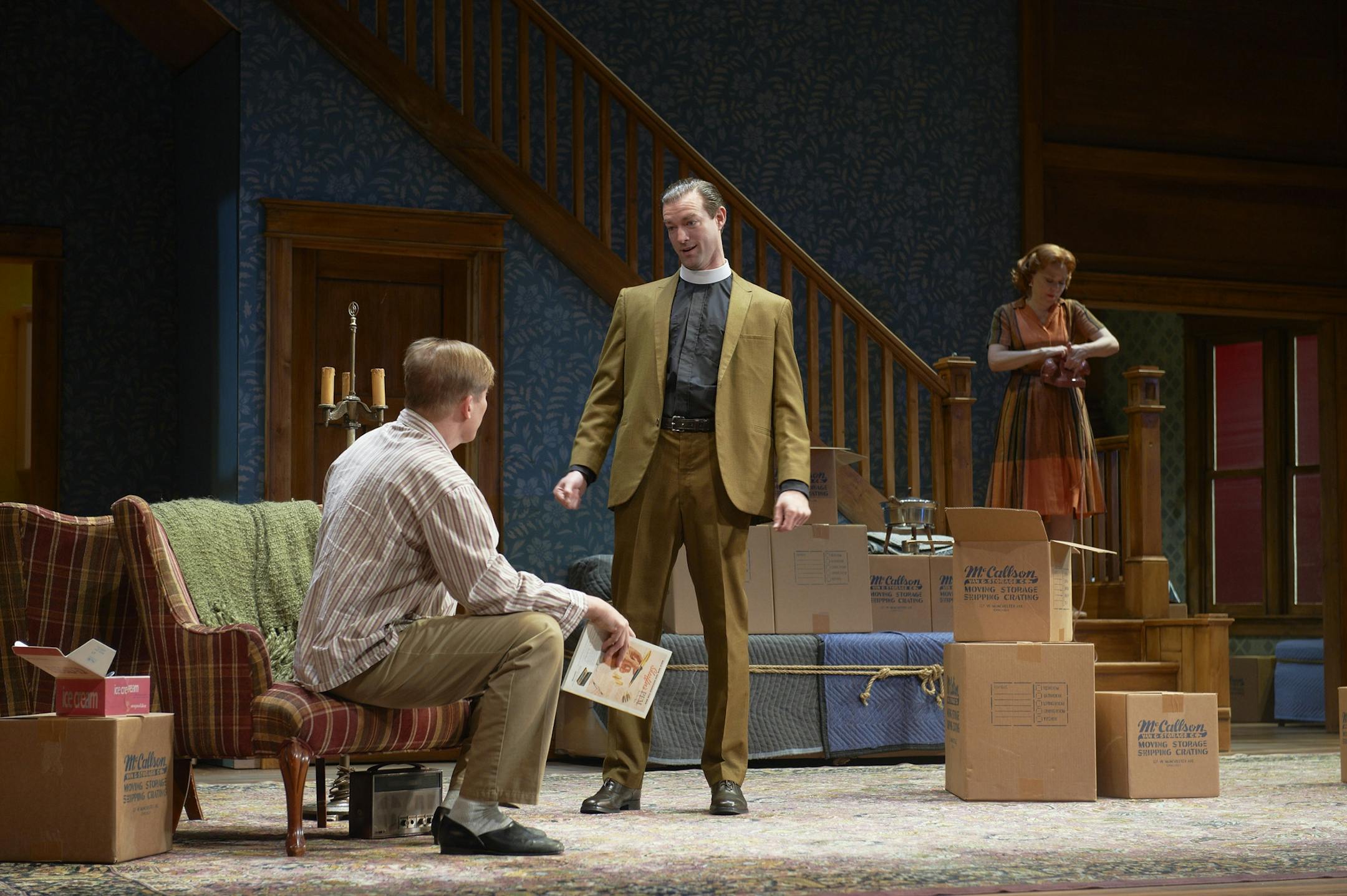
Norris' newest play, a big-cast critique of Western capitalism called "The Low Road," premiered this spring at London's Royal Court Theatre. He is revising another work, "A Parallelogram," for a fall production in Los Angeles. And "Clybourne Park," which opens Friday at the Guthrie Theater in Minneapolis, also is about to bow in Australia.
Norris takes the acclaim in stride.
"The best thing about winning the Pulitzer is that you never have to feel bad about not winning the Pulitzer," he said. "It's liberating, really. Now, I can just do the work."
For that, he has to make time. Norris spoke from a remote island off the coast of Maine in a hideaway owned by Mary Zimmerman, the Tony-winning director and playwright who also is his Northwestern University schoolmate.
Norris embeds a lot of intellectual, moral and political complexity in plays that, on the surface, seem like domestic dramas. He opens the cauterized scars of war in "Purple Heart," his 2002 drama set in the 1970s. He strips away the progressive veneer of comfortable yuppies to reveal xenophobia and hypocrisy in "The Pain and the Itch." And he pricks at bigoted beliefs, class issues and gentrification in "Clybourne Park," whose regional premiere is being directed by his friend Lisa Peterson, a Guthrie regular.
"I love plays that are anchored in big ideas — Shaw, Kushner, Caryl Churchill," said Peterson, who also is a playwright of "An Iliad," which just closed at the Guthrie. "Bruce uses language and character to create these really dramatic, interesting arguments onstage. It's a play that says, 'Listen, we ought to look at how we talk with each other in this alleged post-racial age.' "