

Chances are, you've run across the painting of a woman and her children picking flowers on the prairie, her long apron furling in the incessant wind, echoing the curve of the creek bank. The scene is a fixture of fine-art calendars or collections of blank notecards. Artist Harvey Dunn, who grew up on such grasslands, captured in a yellow coneflower the woman's discovery that the prairie could be a garden.
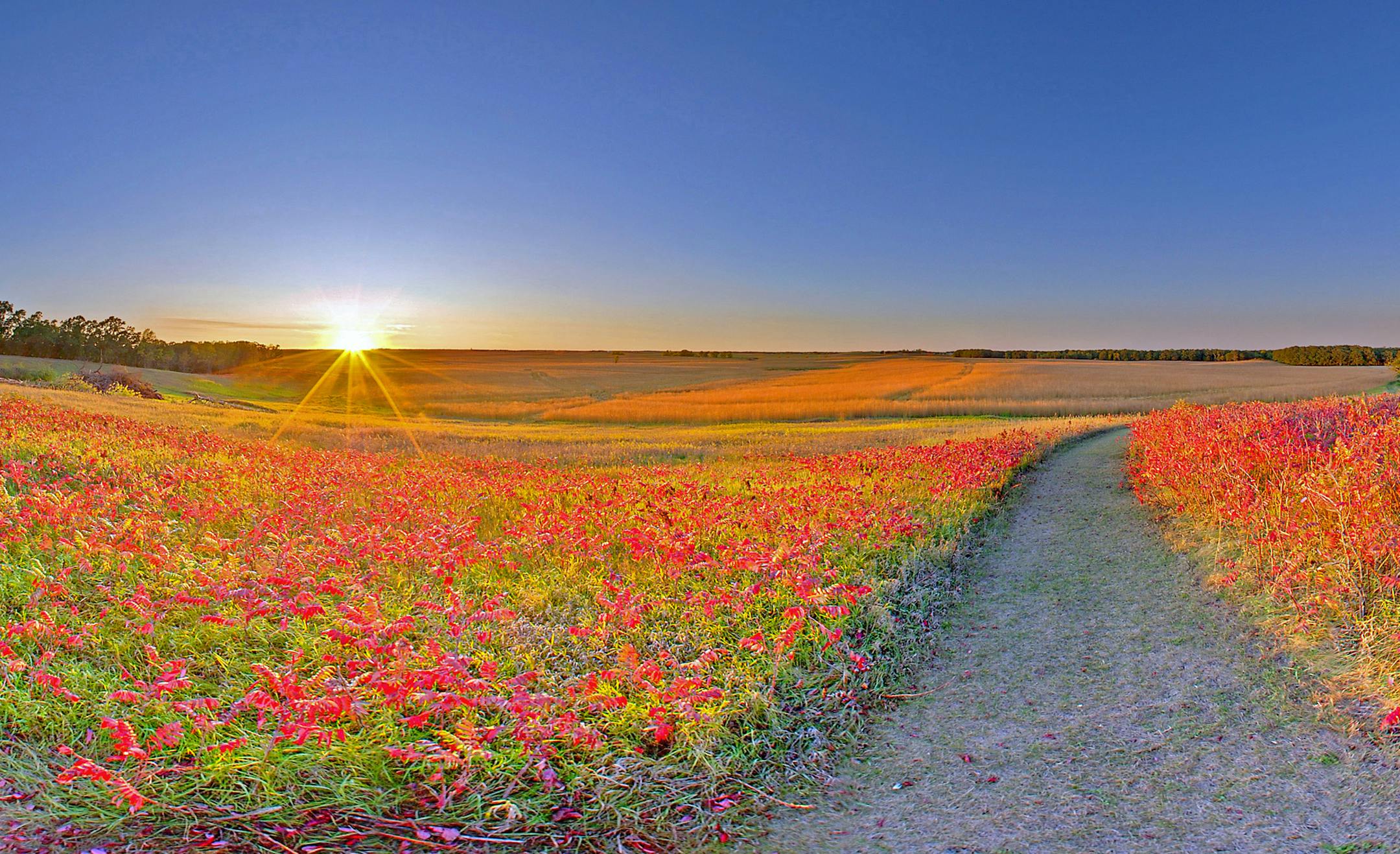
I hadn't thought about that painting in years, but there it was last fall as I topped a rise in Glacial Lakes State Park, hiking a ridge that rose like a gargantuan spine from the rolling prairie near Starbuck, Minn., about 140 miles northwest of the Twin Cities. The grassy slope to my right fluttered with the fading burgundy of spent sumac. Two weeks earlier? That broad swipe must have been a blinding scarlet. Two months earlier? Freckled with smooth blue aster.
Looking west, I swore I could see into South Dakota. And that's when I remembered the woman's gaze — an arresting mix of stoicism and gratitude as she pondered her garden's strange and fleeting beauty within an endless burlap expanse.
The prairies no longer seem so endless. A Morse code of windbreaks and barns breaks up the flat line of a horizon. Today, 90 percent of Minnesota's prairies have been converted to farmland, which makes the several state parks that preserve the ancient landscape so intriguing, and essential.
Glacial Lakes State Park
It requires a bit of squinting to capture a sense of what life must have been like for Dunn's prairie mother. But it can happen, and perhaps most readily in this stunning park.
Geologically, these 1,880 acres are like none other in Minnesota, a swath of steep hills and broad kettles formed by the dregs of ancient glaciers. The park also harbors the transition between the oak savanna forests of the east and the rolling grasslands of the west. One hiking trail literally perches on that line, placing a forest on your left, a prairie on your right as you tramp to the park's highest elevation, 1,352 feet.
Once there, you can look down on the several small lakes filling some of the kettles. Signalness Lake, the largest, is fed by springs that lie entirely within the park. The result is water so clear that, while sitting on one of the docks, I could watch a half-dozen fish swim in and out of the weeds, nosing around for their lunch as I slowly, silently ate mine.


