

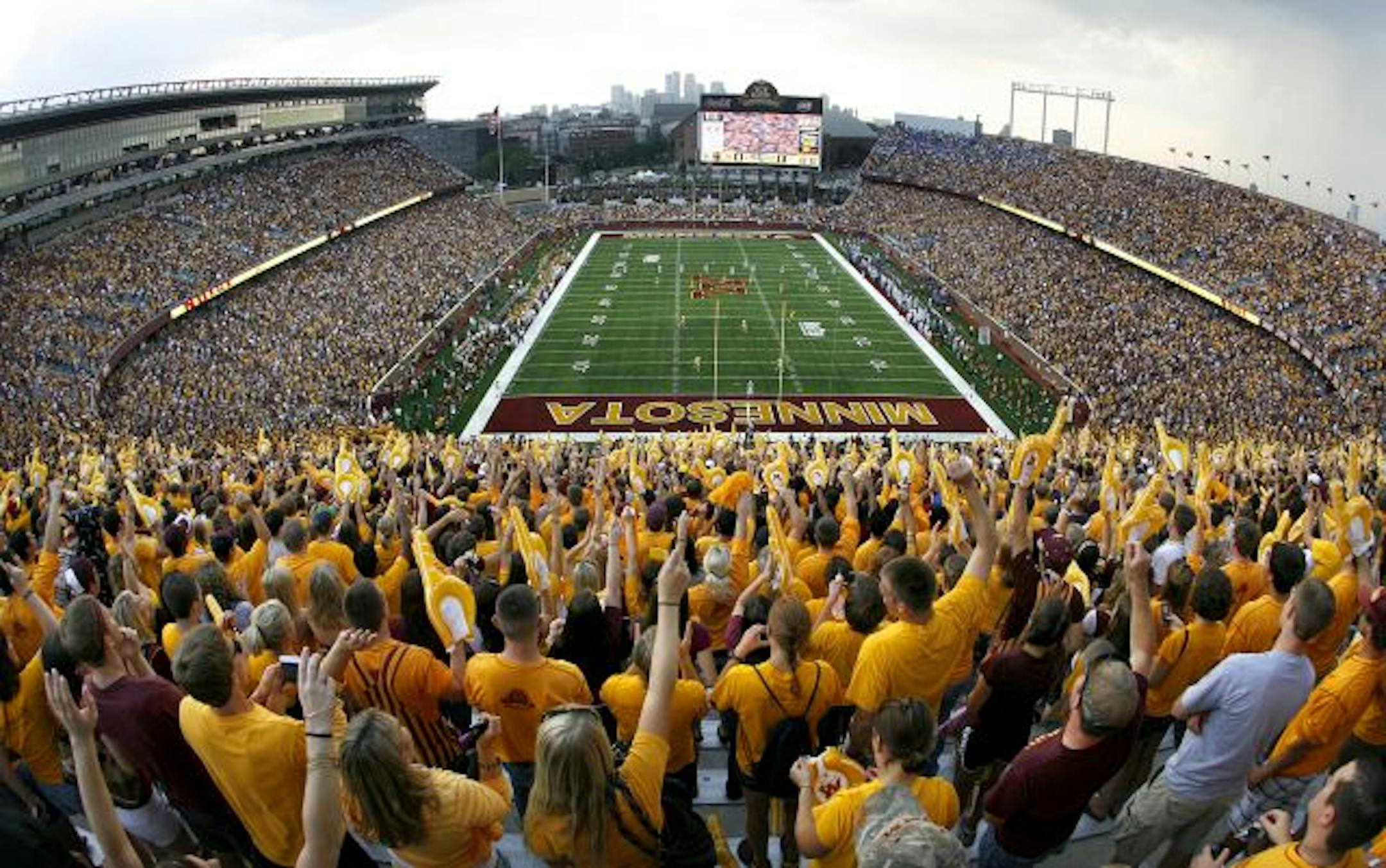
John Williams was a standout tackle for the 1967 Gophers, the last Minnesota football team to gain as much as a share of the Big Ten title. Williams went through TCF Bank Stadium with teammates Jim Carter and Ezell Jones last month and, when finished, offered a concise review: "This is the Taj Mahal."
Twenty-seven years earlier, Gophers coach Joe Salem brought his team to the Metrodome for a precamp media day. He looked around the shiny blue room and said:
"This will be the Taj Mahal of college football."
Salem's euphoria lasted through two home games, both impressive victories before crowds of more than 50,000. The third home game was the Big Ten home opener against Illinois that brought both the CBS cameras and a crowd of 63,684 to the Dome on a Saturday night.
The Gophers were blown out in the second half and lost 42-24. It was the first of 18 losses in Smokey Joe's final 19 games. He was followed by another handful of coaches -- Lou Holtz, John Gutekunst, Jim Wacker, Glen Mason and Tim Brewster -- who were unable to make Minnesota a Big Ten contender while in the Dome.
Mason was the first influential person to promote the idea of an on-campus stadium in December 1999. The idea of building a stand-alone stadium for the Gophers, when the Vikings also had started to make noise about a new home, seemed beyond absurd a decade ago.
Yet, there it was on Saturday -- a 50,000-seat stadium on the east end of the main campus, and certainly a Taj Mahal compared to Memorial Stadium, the brick house in which John Williams competed, and to the Metrodome, which was home to the Gophers for 27 seasons and never propelled them to a Big Ten record better than 5-3.
The Gophers have been absent from the Rose Bowl since 1961 -- six years longer than any of their conference colleagues. They have stood by idly as Midwestern rivals Wisconsin and Iowa made three and two trips, respectively, to the Rose Bowl during Minnesota's Dome years.


