

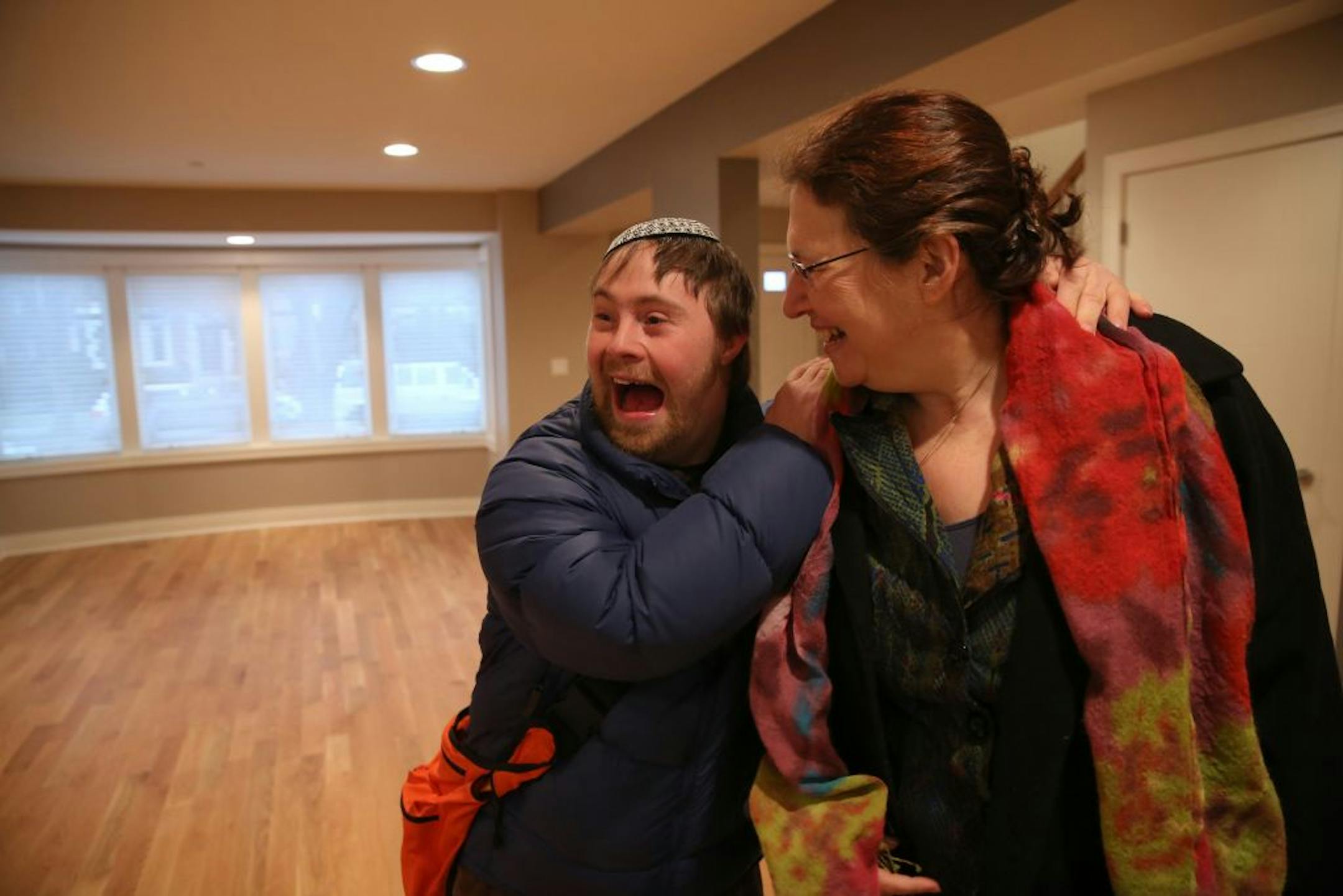
Baruch and Joyce Schur were out of options. They couldn't find anywhere for their physically and intellectually disabled 26-year-old son to live, at least nowhere that met their criteria or didn't have a years-long waiting list. The 55-year-old couple made plans to move out of state. Uprooting themselves from their native Chicago, leaving friends and a family business, was the only way to give Josh a home -- not an institution -- that offered independence, a kosher kitchen and a sense of community before his parents became too elderly to care for him. But then the Schurs took an even bolder step. They joined forces with five other families in similar circumstances to do what government could not: They created something better. They become a nonprofit, raised their own funds, bought their own property, hired a design team and a social services agency to staff a home. Last month, six young men -- with cerebral palsy, autism and Down syndrome -- moved into a red-brick Georgian on a quiet block in the same Chicago neighborhood, Rogers Park, where they grew up.
Other parent-empowered groups are also rolling up their sleeves, joining this quiet crusade. A Glenview, Ill., couple has partnered with Rush University Medical Center to build housing for young adults with autism in Chicago's West Loop. In Wheaton, Ill., another family group collaborated with their church for a similar project.
In a previous era, children such as Josh would have been institutionalized. Today, because of medical advances and sweeping public policy changes, children with disabilities are not just surviving but thriving into adulthood. And no one knows what to do with them all.
'Look at other sustainable models'
There are 1 million to 1.5 million Americans with autism alone, 80 percent of whom are younger than 22, said the Centers for Disease Control and Prevention. "The statistics are frightening," said Tony Paulauski of the Arc of Illinois, an advocacy organization. "What's going to happen to all these folks? We are bracing ourselves for a demographic wave and we are totally unprepared."
These young adults were born into a very different world than earlier generations. Parents started seeing their offspring for what they could do -- not just what they couldn't.
They pushed clinicians for more physical, occupational and speech therapy and pushed lawmakers toward mainstreaming policies. No longer hidden, these youngsters were now woven into society, participating in school plays, soccer and Boy Scouts.
Then, at age 22, most publicly funded services end. As the kids get older, the journey gets lonelier. Some 80 percent of young adults with autism ages 19 to 30 still live at home, said a 2008 Easter Seals study.


