

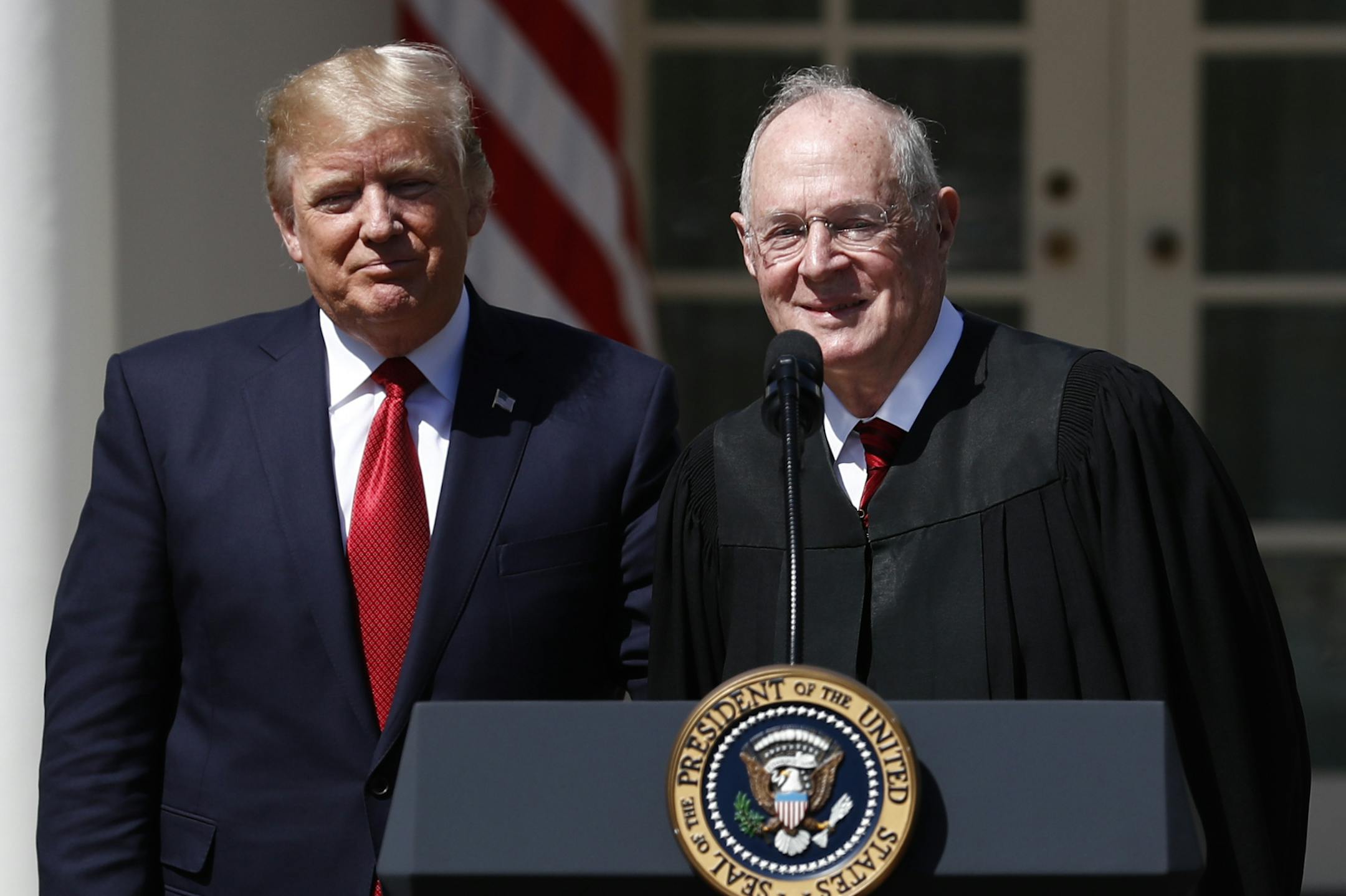
After 30 years of pivotal decisions on the U.S. Supreme Court, Justice Anthony Kennedy is about to make his biggest decision yet.
For the second straight year, Kennedy, 81, is the focus of retirement speculation as the court approaches the late-June end of its term. A retirement by the court's swing justice would give President Donald Trump his second Supreme Court vacancy to fill before Republicans' Senate majority goes on the November election ballot. It also would drop a political bomb into what is already one of the country's most divisive eras since the Civil War.
Although he has given no public indication he plans to depart, advocates on both sides are wondering whether Kennedy's age and Republican roots could lead him to do so. It could trigger a rancorous confirmation battle and open the court to a sharp — and probably enduring — turn to the right.
A Trump-appointed successor could create the five-member majority that legal conservatives have dreamed of for decades. The reconstituted court could overturn long-standing precedents, including the 1973 Roe vs. Wade abortion-rights ruling. How far it goes would probably depend on Chief Justice John Roberts, who sometimes tempers his conservative leanings to try to protect the court's institutional standing.
Whether Kennedy will retire is something known to, at most, a handful of people. Former law clerks say they can only speculate, questioning even whether the justice himself knows what he will do.
What faint signals Kennedy has sent point toward at least another year on the bench. He has hired his law clerks for the Supreme Court's next term and, as usual, will spend July teaching a law school course in Salzburg, Austria. From the bench, he has been as engaged as ever.
Nor has Kennedy shown any obvious signs of slowing down in his opinion-writing. Although he has issued only one majority opinion this term, a decision that curbed human-rights lawsuits, it was an unusually complicated ruling that required him to cobble together a majority out of a splintered court.
Kennedy's most significant opinions are probably yet to come. He could cast the deciding vote in many of the court's biggest remaining cases, including clashes over Trump's travel ban, partisan gerrymandering and the speech rights of people who oppose gay marriage.


