

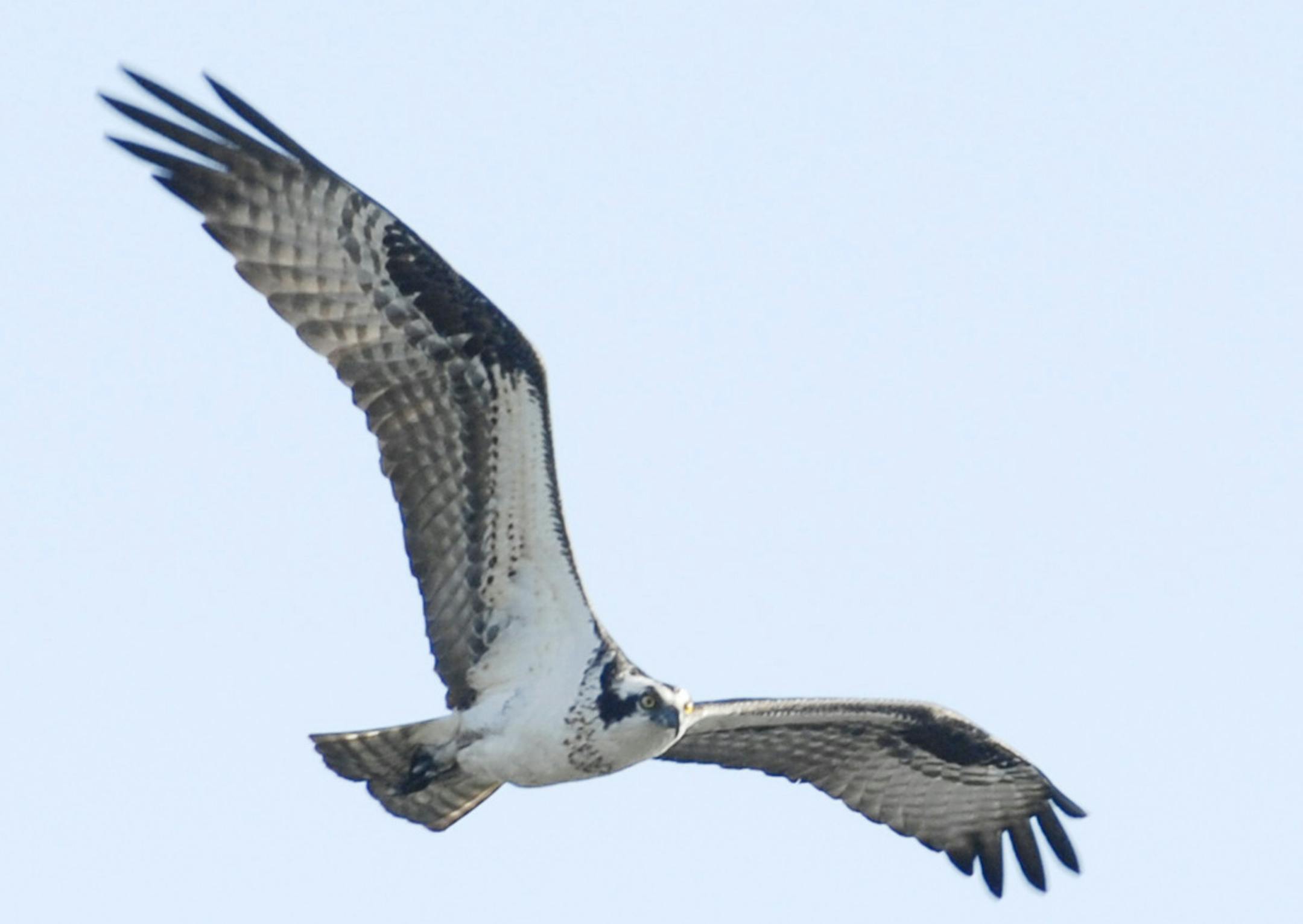
It was time to band young osprey at Carver Park Reserve in Victoria one morning in late June. A bucket truck led the way to a tall utility pole sitting incongruously in the middle of a meadow. The truck's boom lifted and swung over to the platform on the pole's top, then human arms reached out for the avian cargo. Back on the ground, a slender woman hopped out of the bucket, holding a box containing a handsome bird covered in dark, gold-tipped feathers — a very young osprey.
Its parents had built their nest on the platform at the top of the pole in late April, and the youngster had hatched there in late May. The nestling's growth had been fueled by a steady diet of fish caught by its solicitous parents, now calling uneasily high in the sky over the small crowd on the ground.
Thirty years ago we couldn't have gathered under an osprey nest in Victoria or anywhere else in the southern half of the state. Their preferred nesting sites — tall trees around lakes — had been lost to development, and this, combined with the use of DDT (before the ban) and indiscriminate shooting (before it became illegal), meant osprey stopped breeding locally. The Three Rivers Park District set out to correct that dismal fact, beginning in 1984, with a reintroduction program whose results we were witnessing.
We were guests of the park district at this osprey banding session and naturalist Judy Voigt Englund had brought along a set of metal bands to attach to the young bird's leg to aid in future identification. The chick was now five weeks old, too young to fly to escape the banders but with adult-sized legs, so the bands would hold.
Reversing the trend
Thinking back, I recall the early years of the reintroduction program, when I was a volunteer keeping an eye on released young osprey as they tried their wings at Lake Vadnais in Ramsey County. With the approval of federal and state agencies, osprey chicks were removed from nests in northern Minnesota, where the birds were still plentiful, and brought to the metro area. They spent the first few weeks of their new lives in protected boxes on lakeshores like Vadnais.
Another key element of the reintroduction was nesting platforms erected on poles like the one our group visited in June. The reintroduction effort has continued for 12 years and has been highly successful.
"The first chick hatched in 1988, and we had 90 pairs nesting in the eight-county metro area this spring," says Voigt Englund, who's been involved in the reintroduction since the beginning.
Nearly all, if not all of the adults and their chicks in the metro area are descendants of the reintroduced birds. Many use the platforms while a few "freelance," building large stick nests on the tops of utility poles, freeway light towers, athletic field lights and even wind turbines.


