
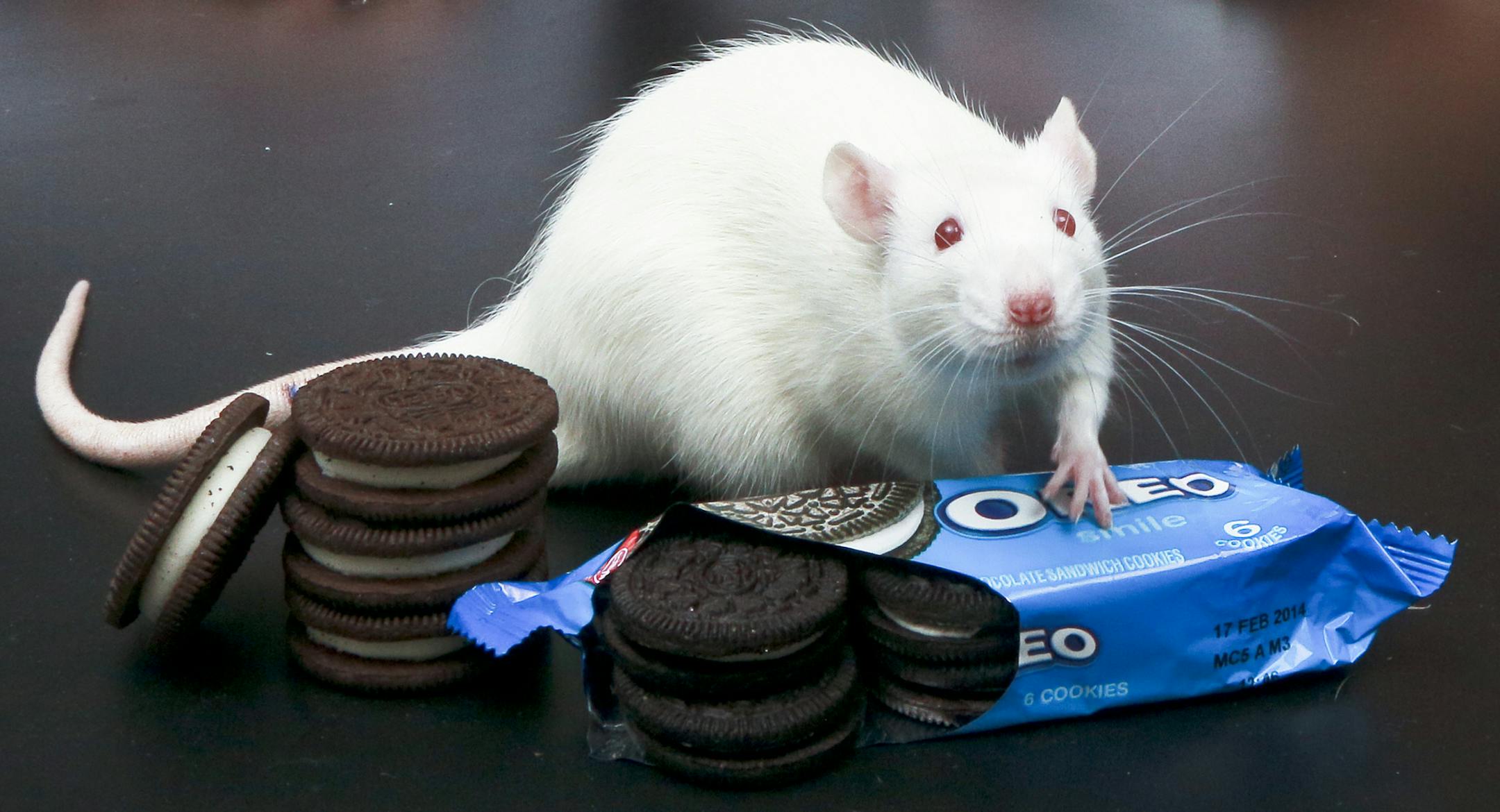
Oreo cookies may be as addictive as drugs, study shows

The cookie, chock full of sugar and fat, stimulated the "pleasure center" in rats more than cocaine.

October 20, 2013 at 9:00PM
Joseph Schroeder (left), assistant professor of neuroscience at Connecticut College, and Lauren Cameron (right), a senior at Connecticut College and student researcher in Schroeder’s lab, found that in lab rats, eating Oreos activated more neurons in the brain’s “pleasure center” than exposure to drugs of abuse. Photo by Bob MacDonnell, courtesy of Connecticut College.
Eating Oreos activated more neurons in the brain's "pleasure center" of lab rats than exposure to drugs, a study found. (The Minnesota Star Tribune)

Don't be so hard on yourself if you're unable to resist tearing into a bright blue bag of Oreos. Turns out that little cookie may be as addictive as cocaine.

Researchers at Connecticut College made the discovery recently, after studying the effects of high-fat, high-sugar foods on rats' brains. They found that eating Oreos activated more neurons in a region of the brain known as the "pleasure center" than exposure to "drugs of abuse."

"It means that something that is pleasurable — eating Oreo cookies — activates the brain in the same manner, and to a greater degree even than cocaine or morphine," explained Joseph Schroed­er, a psychology professor at the college who worked with four students on the study.

The findings, which have yet to be published, could affect understanding of obesity in humans. "People who have eating disorders and are susceptible to obesity may be viewed as someone who has a problem with drugs of abuse," said Schroeder, who also is director of the college's behavioral neuroscience program.

The research idea came from a neuroscience student named Jamie Honohan, who was interested in the prevalence of obesity in low-income neighborhoods, where healthy food options are often scarce.

Researchers could have used any snack high in sugar and fat, but chose to feed the rats Oreos because they wanted something palatable to humans, too.

One not-so-surprising finding: The rats, like most humans, ate the creamy middle first. □

Allie Shah • 612-673-4488

about the writer

about the writer

Allie Shah

Deputy editor

Allie Shah is deputy local editor. She previously supervised coverage of K-12 and higher education issues in Minnesota. In her more than 20 year journalism career at the Minnesota Star Tribune, Shah has reported on topics ranging from education to immigration and health.

See Moreicon

More from Minnesota Star Tribune

See More
card image
J. SCOTT APPLEWHITE, ASSOCIATED PRESS/The Minnesota Star Tribune

The "winners" have all been Turkeys, no matter the honor's name.

In this photo taken Monday, March 6, 2017, in San Francisco, released confidential files by The University of California of a sexual misconduct case, like this one against UC Santa Cruz Latin Studies professor Hector Perla is shown. Perla was accused of raping a student during a wine-tasting outing in June 2015. Some of the files are so heavily redacted that on many pages no words are visible. Perla is one of 113 UC employees found to have violated the system's sexual misconduct policies in rece