

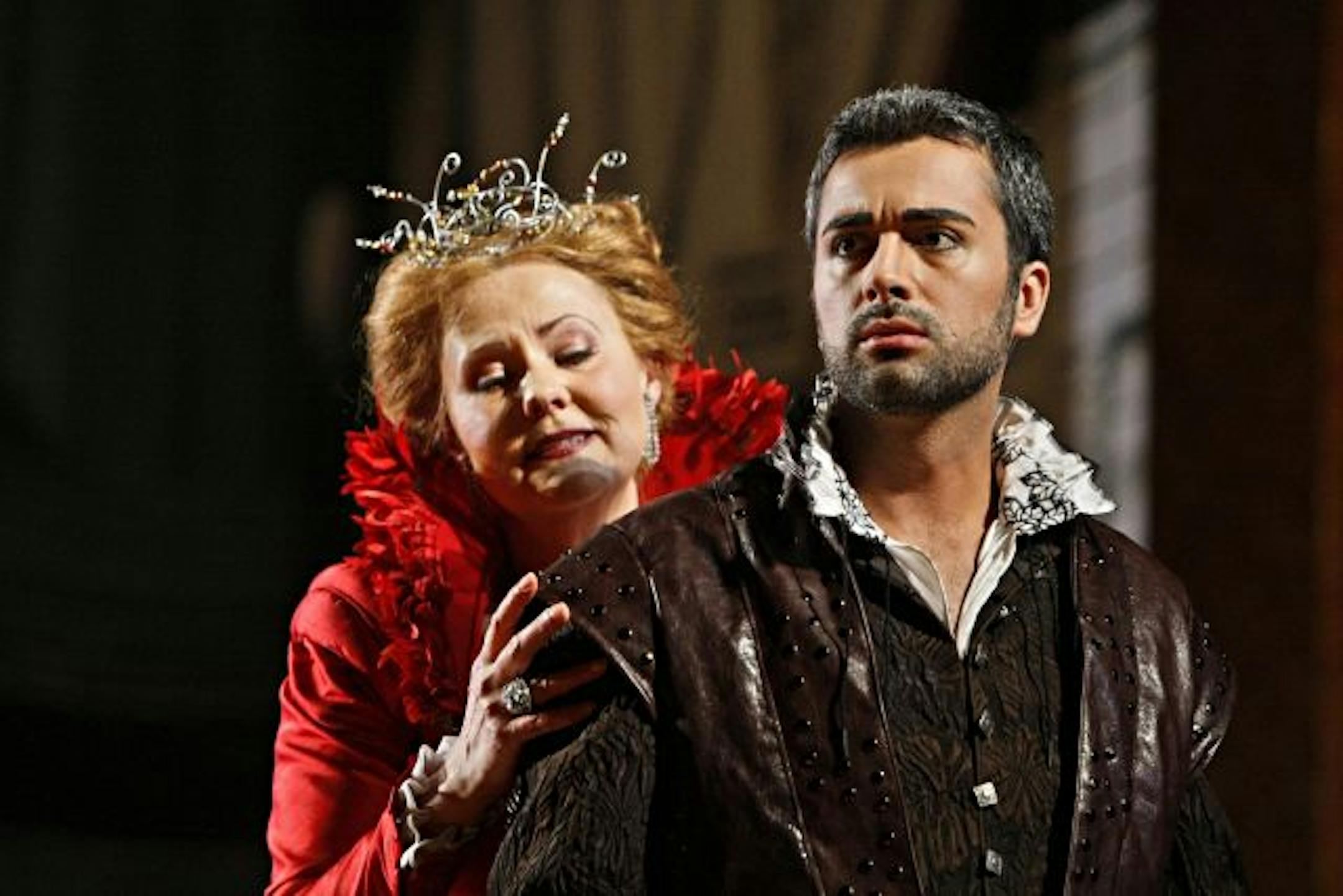
When Gaetano Donizetti (1797-1848) wrote "Roberto Devereux," which opened Saturday at the Ordway Center in a terrific new staging by the Minnesota Opera, he was Italy's foremost active composer. The year was 1837. Rossini, opera's comic genius, had fallen silent. Bellini, master of the long-limbed melody, was dead. Verdi, who would filch material from "Devereux" for at least three of his own operas, wasn't yet a contender. But Donizetti's fortunes would soon ebb. By the 1880s, his 70 stage works seemed like relics; only a few of his comedies lingered in the repertoire.
That began to change in the 1950s, when Maria Callas spearheaded a revival. But Callas never sang in "Devereux," and a trailblazing recording by Beverly Sills failed to excite enduring interest. Hence the Minnesota Opera's vivid production, which taps deeply into the currents of jealousy, guilt, remorse and grief that run throughout the piece, may strike even Donizetti devotees as revelatory.
To the conventional love triangle, Salvadore Cammarano's well-made libretto adds an extra wrinkle: Queen Elizabeth loves Devereux (aka the Earl of Essex), who loves the queen's confidante Sara, who is married to the Duke of Nottingham, who is Devereux's staunchest friend. The composer -- sporadic lapses into generic, march-like music notwithstanding -- projects the tensions between and within these characters, Elizabeth above all, through vocal lines (and occasional orchestral passages) of the utmost expressiveness.
In soprano Brenda Harris (who made her Minnesota Opera debut in 1988), the company has an Elizabeth of surpassing gifts, wholly equal to the rigors of the role. Steely when she wishes it so, her voice is supple and multi-hued, with a convincing trill and ravishing diminuendos on sustained high notes. Yet it sounds lived-in -- ideal for the aged Elizabeth. Harris is also a resourceful actor, able to make the woman's vulnerability visible beneath the queen's hauteur. Her "Quel sangue versato," near the opera's end, is shiver-inducing. (She returns next January in "Anna Bolena," the second installment of Donizetti's so-called Tudor Trilogy.)
Portuguese tenor Bruno Ribeiro is equipped for stardom; his portrayal of the ill-fated Devereux needs only a bit more modulation and variety of timbre. The same could be said of Lester Lynch's vocally and physically charismatic Nottingham, who persuasively negotiates the sudden turn from stalwart ally to enraged husband. Tamara Klivadenko is an affecting Sara; conductor Francesco Maria Colombo makes the orchestra sing.
Led by director Kevin Newbury, the production team is especially sensitive to the clash of public and private, and to religious dimensions of the action. Neil Patel's sets descend, oddly but effectively, from an ornate, gilded ceiling; Jessica Jahn's farthingales for Elizabeth are appropriately prison-like; D.M. Wood plays dramatically with light and shadow.
Larry Fuchsberg writes regularly about music.


