

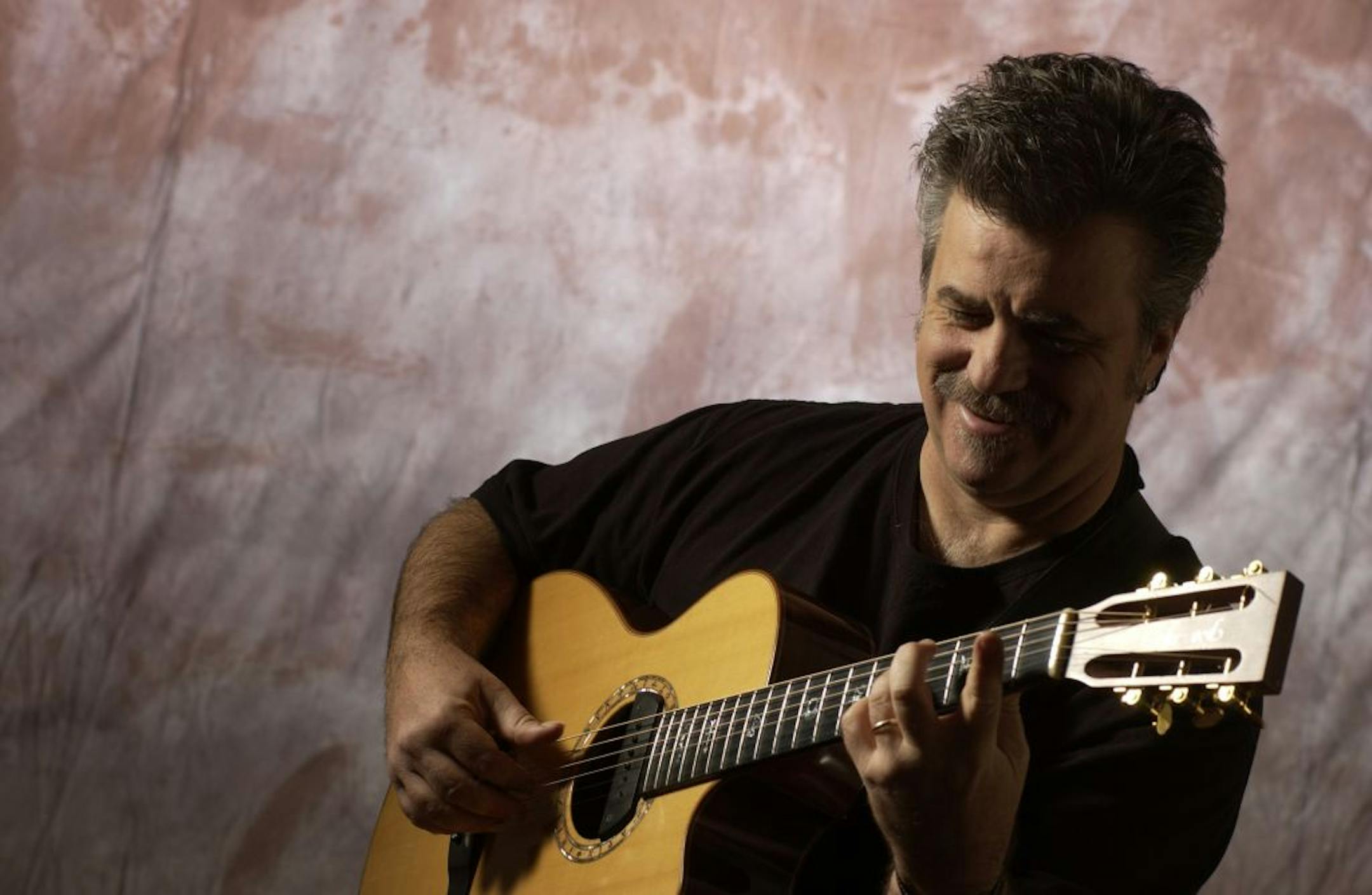
Minnesota guitarist Tim Sparks has spent the past 20 years on a remarkable journey that has taken him from his blues and jazz roots deep into surprising ethnic realms, especially Balkan and traditional Jewish music. Along the way, he has solidified his reputation not only as a brilliant fingerstyle guitarist, but also as a savvy, even daring arranger who has significantly added to the guitar canon.
Now Sparks is coming full circle in a sense, re-releasing his first solo album, "The Nutcracker Suite," and playing much of its material Wednesday at the Guthrie's Dowling Studio.
The disc, originally issued in Germany in 1992, not only features Sparks' striking solo guitar interpretation of Tchaikovsky's masterpiece, but also "Balkan Dreams Suite" -- his adaptations of regional folk music -- plus one original that stirs in the blues.
"This 'Balkan Dreams Suite' is a linchpin to a lot of things I did afterwards," Sparks reflected last week at a St. Paul coffee shop, shortly after returning from a European tour.
"I got this handle on this Near Eastern and southeastern European and Mediterranean guitar thing," he explained in a soft drawl that evokes his native North Carolina. "One component of this music is what they call odd meters or asymmetrical meters. This was a novel project for solo guitar, working out these dance rhythms that are asymmetrical."
That experience provided the foundation for an acclaimed series of Jewish music albums he recorded beginning in the late '90s.
As for "The Nutcracker," Sparks, who long ago studied classical guitar with Jesus Silva, a protégé of the great Andrés Segovia, tackled the adaptation around the end of his decade-long run with Rio Nido, the popular Twin Cities vintage-jazz group.
"After trying to learn Gershwin and jazz standards, there was something about the Tchaikovsky pieces -- they're short and succinct," he said. "I could see the logic in it and it didn't seem that far-fetched. And a composer like Tchaikovsky is really a foundation for a lot of pop music that came out of Tin Pan Alley and Broadway in the '20s and '30s."


