

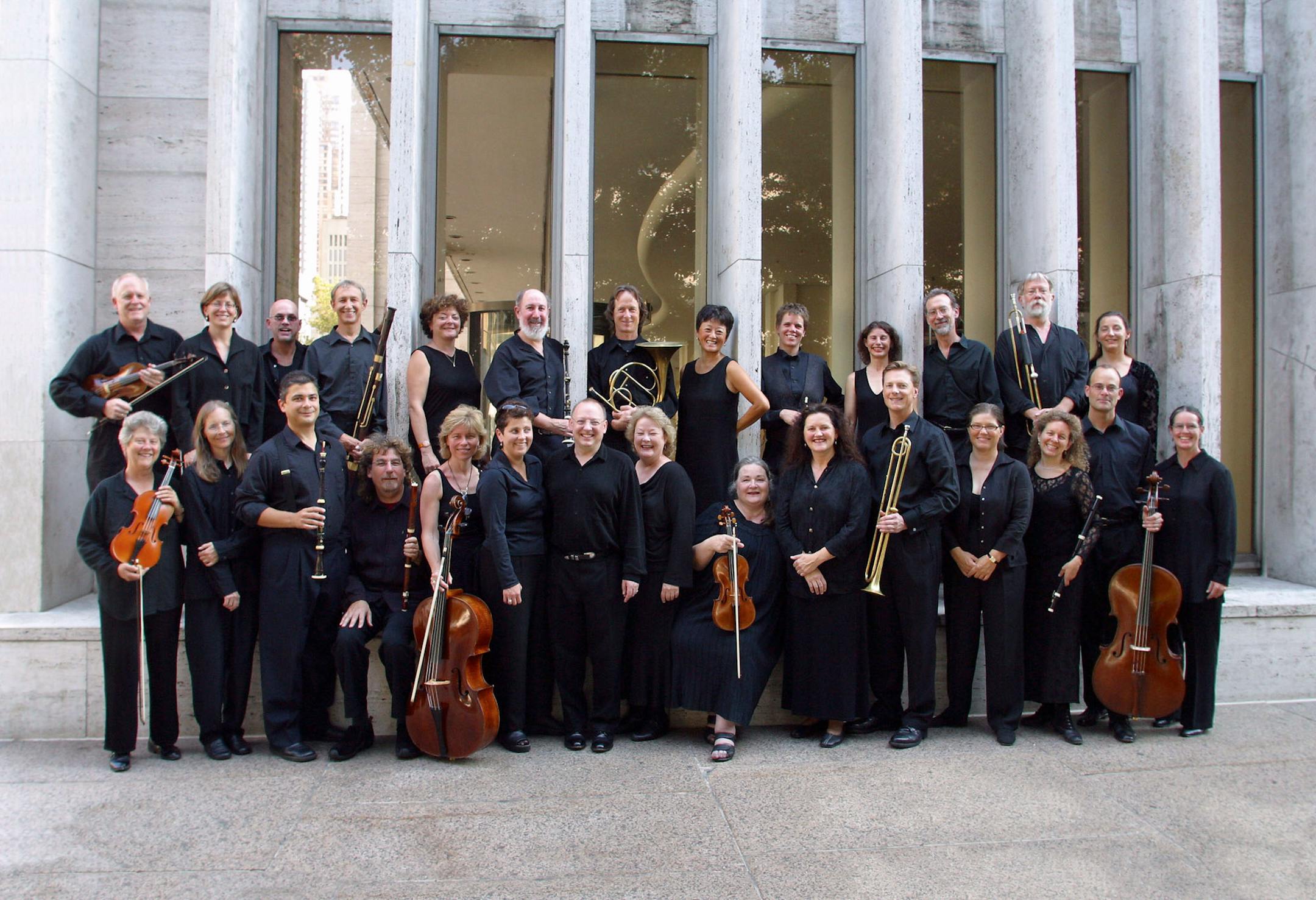
When marking major anniversaries, orchestras commonly beat their own drum. They arrange tours to cultural capitals, or publish anthologies of their recordings, or commission new pieces that showcase the players' virtuosity. The St. Paul Chamber Orchestra, celebrating its first half-century this season, has found a stimulating alternative to such self-advertisement (although the group has lately made a European jaunt, and a coffee-table book is in the works).
As the centerpiece of its anniversary observances, the SPCO has organized a four-week, 20-concert International Festival of Chamber Orchestras and invited four prominent European and North American ensembles -- bands that might be considered rivals -- to take part. The focus, atypically, is on the medium itself; the SPCO's website promises "an in-depth look at what it means to be a chamber orchestra in the 21st century."
A different visiting orchestra is in residence during each week of the festival; five of the concerts draw performers from more than one ensemble. There seems to be no precedent for this -- except, perhaps, for an ordinary month in London. All three festival imports -- the Chamber Orchestra of Europe (COE), the London Sinfonietta and the Orchestra of the Age of Enlightenment (OAE) -- are headquartered in that music-infested metropolis, where some 30 orchestras, large and small, vie for audiences and subsidies.
The fourth of the visitors is the San Francisco Bay Area-based Philharmonia Baroque Orchestra, led by the irrepressible Nicholas McGegan, an SPCO favorite for the past two decades. "The ethos of the SPCO is to look outward, not inward," said conductor Douglas Boyd (like McGegan, a Scotsman), who'll be on the podium for the opening concerts. An artistic partner of the SPCO, Boyd also is a founding member of the COE and was its principal oboe for 21 years. He now leads both ensembles regularly. "The festival is the culmination of that ethos." Two musicians walk into a bar ...
In the United States, Boyd said, "orchestras tend to be the center of their own universe because they're the only show for miles around. In Europe, everyone is keenly aware of the competition. It's a matter of proximity." The festival, Boyd believes, will occasion a similar awareness on local soil. "Put musicians together in a restaurant," he said with a laugh, "and you get a flow of camaraderie and creativity that's unbeatable. It should give everyone a shot in the arm."
Sarah Lutman, recently named to replace the ailing Bruce Coppock as SPCO president, offers a somewhat different perspective on the event. Lutman, who took up her new post in late November, earlier served on an SPCO task force charged with outlining the organization's 50th anniversary festivities. "We thought of doing something big in New York or Europe," Lutman said. "Then someone said that what we should really do is to give back to the community that has made us possible. One thing led to another, and the festival was born." She puts its cost at around $1 million, all of it covered by donations.
"I was surprised that we were able to pull it off," Lutman said. "Schedules were complicated, but it all came together. And the interaction between our artistic partners and the artistic leadership of the other organizations produced interesting results, which will help our community discover what our chamber orchestra 'family' is like."
Different stripes
There would be little point in parading five chamber orchestras through the snowdrifts of Minnesota if they didn't differ appreciably. Happily, they do. One could easily spend the entire festival discussing their similarities and dissimilarities. Below, a few notes to jump-start that discussion:
Performance practice and repertoire. Beginning in the 1950s as a fringe phenomenon, historically informed performance (HIP) has become the central musical ideology of our day. (If the battles fought over HIP in the '70s and '80s now seem overwrought, they felt momentous then.)
Some chamber orchestras were founded in the context of the HIP movement, or took prominent roles in the HIP wars. But those on the sidelines have also had to respond to HIP's challenges -- in particular, to the widespread adoption of original or period instruments (valveless brass, keyless woodwinds, gut strings played with little or no vibrato). Cross-fertilization is now the norm: 'Conventional' instrumentalists have learned to emulate the sound and style of their period colleagues, while some of the latter have moved boldly into the 19th century, scrutinizing composers like Brahms and Bruckner through an HIP lens.


