
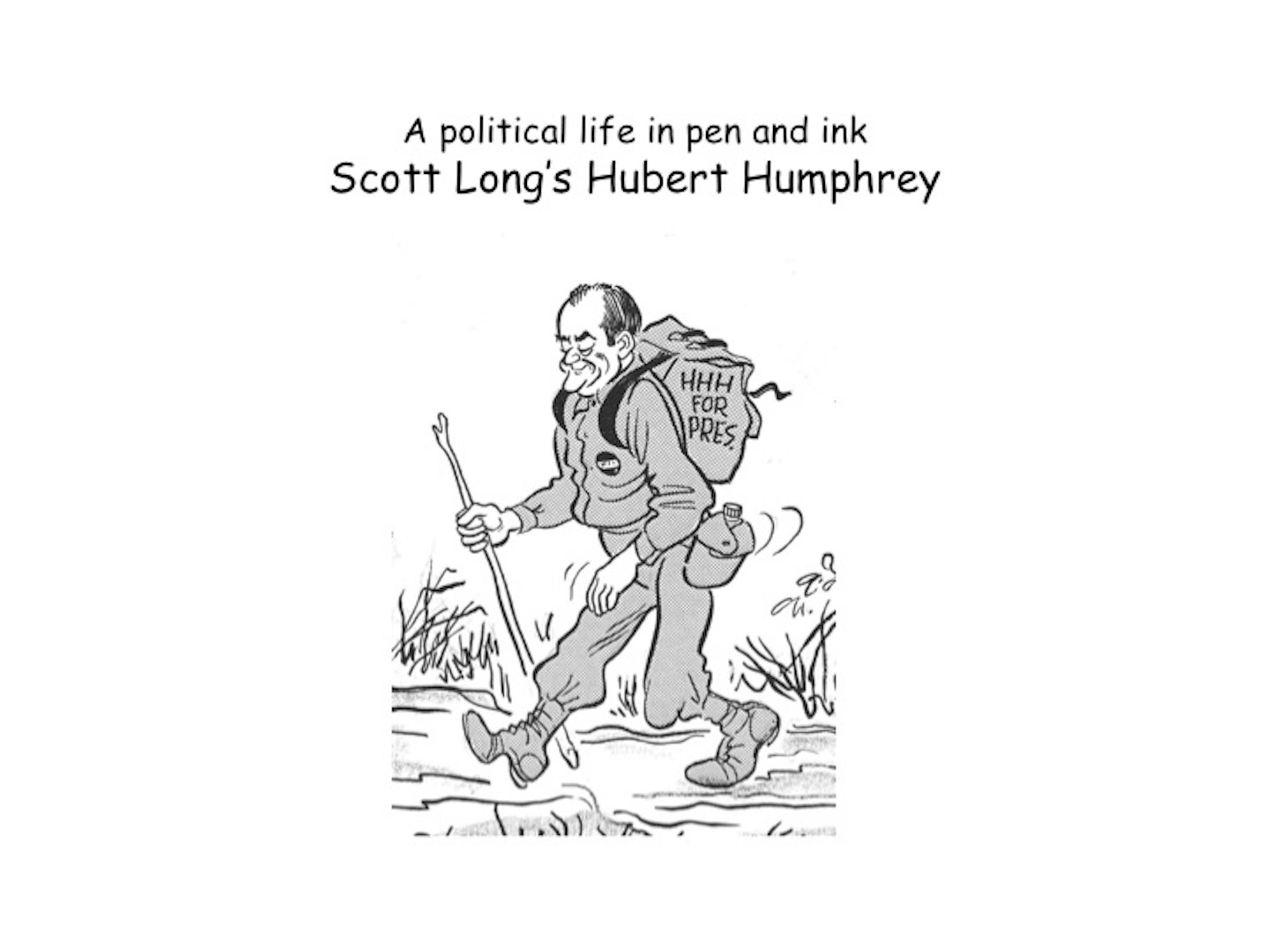
On Humphrey's trail with editorial cartoons

A Minnesota politician through the eyes of an editorial cartoonist

May 2, 2011 at 12:07PM
(Susan Hogan — Scott Long/The Minnesota Star Tribune)

It was one of his most jubilant moments.

"I would be less than honest if I didn't say I am very happy and excited," declared Hubert Humphrey on Nov. 3, 1964, as he was elected vice president of the United States.

That fall on the campaign trail, he had logged thousands of miles crisscrossing the country in his chartered Cessna, named the "Happy Warrior," a title bestowed on Humphrey by his friend, Minnesota Gov. Karl Rolvaag.

During Humphrey's momentous career, which extended over four decades, there were other jubilant moments, but there were painful times as well, stinging defeats along with triumphant victories, for Minnesota's premier 20th-century political figure.

Now, as the centenary of Humphrey's birth on May 27 draws near, his high and low moments remain frozen in time through the pen of the Minneapolis Tribune's longtime political cartoonist Scott Long.

The Hennepin History Museum will be sponsoring an exhibit of Long's Humphrey cartoons in the Minneapolis City Hall Rotunda starting on Tuesday.

For more than 30 years, from 1946 until he retired in 1980, Long depicted a vast array of political figures who paraded through the news pages of the Tribune -- one of the Star Tribune's predecessors -- during the postwar era. Six days a week, his imaginative political cartoons appeared at the top of the paper's opinion page.

Long used his fast-moving pen to aim gently satiric barbs at people in the news. Some days his subjects were City Hall politicians; other days they were world leaders.

Long's humorous take on the issues and personalities of the day masked a deadly serious approach to his work. He was fiercely proud of his independence and resisted efforts by the Tribune's management to shape the content of his drawings.

Long almost relished the outrage that his work occasionally provoked in some readers.

In a 1962 article for a national journalism magazine, he wrote: "Those of you who have been on the muzzle end of a cartoon blast know the effectiveness of a good cartoon, and you have proven it to those of us who fire the blast by your heated phone calls to our homes at tender hours."

Long's career at the Tribune coincided with Humphrey's years in public office, giving the cartoonist an opportunity to sketch one of his favorite subjects more than 50 times, from Humphrey's early days as mayor of Minneapolis until his death in office as a U.S. senator in 1978.

Long did not always draw Humphrey in human form. In his first drawing of the future vice president, he depicted Humphrey as a happy mouse, nibbling at a wedge of cheese labeled "Minneapolis Mayoralty" while a frightened GOP elephant looks down from a nearby treetop.

Later, Long would portray Humphrey as a bird, a dolphin and even a hippopotamus. At one point, Humphrey became a speeding rocket returning back to Earth as he made a political comeback following his presidential loss to Richard Nixon in 1968.

During Humphrey's first year in office as a U.S. senator, in a cartoon titled "A Day in the Life of Senator Humph," Long drew Humphrey as he sped through the day in a whirlwind of activity. One panel showed the freshman senator holding four phone conversations at one time.

Other panels depicted him arguing at a committee meeting, attending to a constituent, speaking on the Senate floor and then coming home at night to repair the family lawn mower.

The last panel showed an exhausted Long himself being carried out on a stretcher. The caption read "local cartoonist who tried to keep pace with Senator Humph for a day in Washington is being sent home to get some rest."

Known for his upbeat personality, Humphrey was not always upbeat in Long's cartoons. In 1968, weighted down by his ties to the Johnson administration's war in Vietnam, Humphrey often appeared dejected in Long's drawings.

But then four years later, as Humphrey considered another run at the presidency, Long showed a smiling Hubert sitting up in bed, looking out at the rising sun of 1972.

At the drawing board, Long found Humphrey a challenging subject, not easily caricatured in a cartoon. Humphrey lacked prominent physical features like Johnson's protruding ears or Nixon's five-o'clock shadow. Long had to settle for Humphrey's receding hairline and his pointed chin that began to sag as he aged.

Usually, Long labeled Humphrey "HHH," but sometimes he used the nickname "Humph." In one cartoon, entitled "Flying the Humph," the Republican helicopter is shown flying over Humphrey as an erupting volcano.

At one, point, the former vice president was able to turn the table on the Tribune cartoonist and comment on Long's work in a review of Long's book-length collection of his Lyndon Johnson cartoons -- "Hey, Hey, LBJ."

"Like all great editorial cartoonists," Humphey wrote, "Long uses a long, satiric sweep of the pen to express the underlying issues in public life today. ... His message is solid -- and wit and style are the mediums he employs to make sure we get the message."

Long's lasting gift in this Humphrey centenary year is his portrait of a major Minnesota political leader, etched in emotional terms that words alone cannot convey.

At a time when American political life has been coarsened by attack ads and cable TV rants, Long's Hubert Humphrey reminds us of the important role the cartoonist's pen can play in humanizing politics and softening its rough edges.

Jada Hansen is executive director of the Hennepin History Museum. Iric Nathanson is author of "The Hand on the Pen: Scott Long's Hubert Humphrey" in the Spring 2011 issue of Hennepin History Magazine, which is excerpted in part in this article.

about the writer

about the writer

JADA HANSEN and IRIC NATHANSON

More from Commentaries

See More
card image
card image