

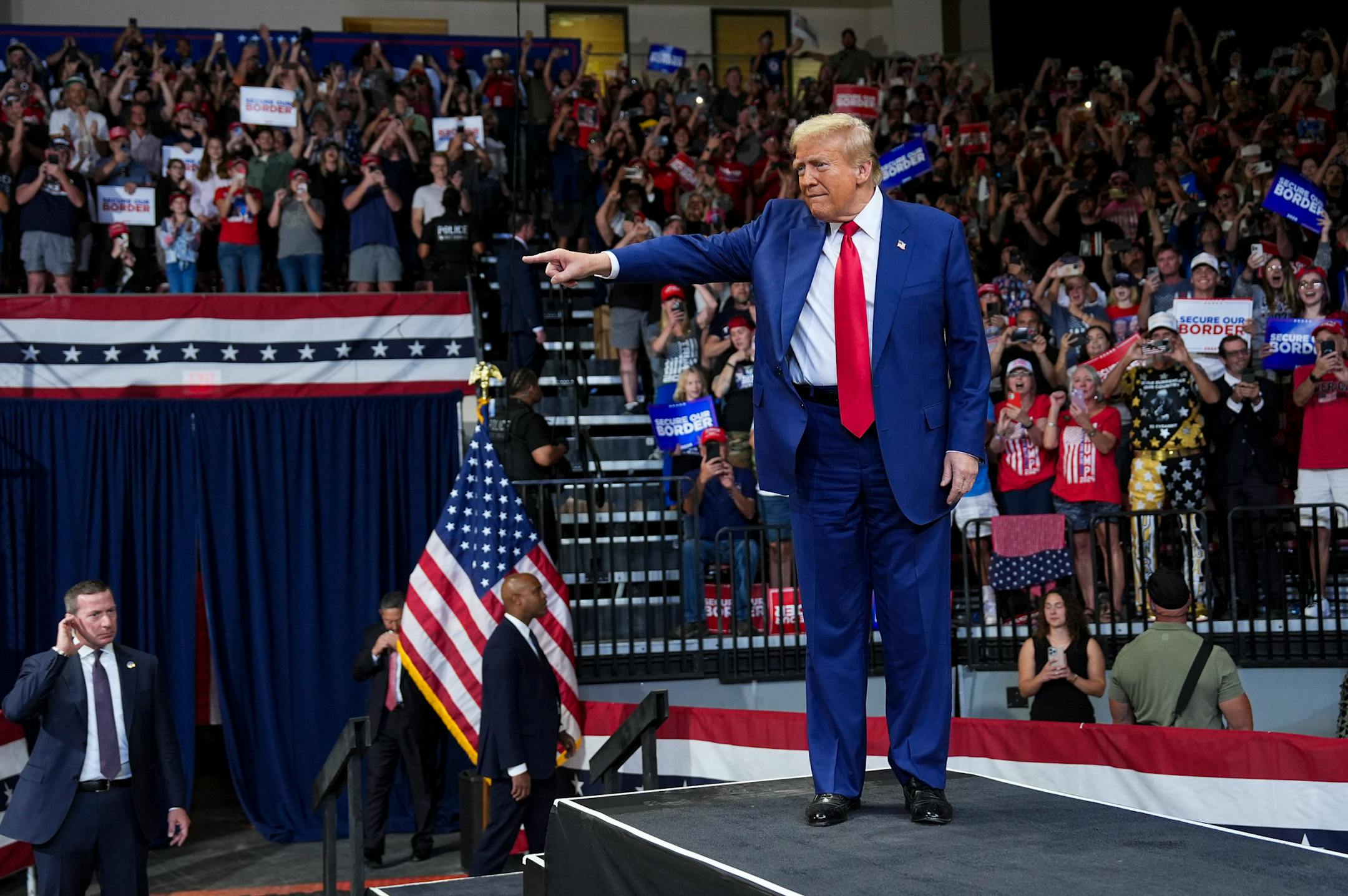
Former President Donald Trump is campaigning on the most significant increase in tariffs in close to a century, preparing an attack on the international trade order that would likely raise prices, hurt the stock market and spark economic feuds with much of the world.
Trump’s trade plans, a staple of his stump speeches, have fluctuated, but he consistently calls for steep duties to discourage imports and promote domestic production. The former president has floated “automatic” tariffs of 10% to 20% on every U.S. trading partner, 60% levies on goods from China, and rates as high as 100, 200 or even 1,000% in other circumstances.
These proposals would go far beyond the disruptive trade wars of his first term even if they are only partially implemented. They would wrench the nation out of the system of global interdependence that arose in recent decades, making the U.S. economy much more isolated and autonomous, like it was in the late 19th century. (Trump last week falsely claimed that the United States was never richer than in the 1890s, when it had high trade barriers.)
“To me, the most beautiful word in the dictionary is tariff. And it’s my favorite,” Trump said in Chicago on Tuesday. “I’m a believer in tariffs.”
The consequences would be far-reaching: Americans would be hit by higher prices for grocery staples from abroad, such as fruit, vegetables and coffee. Domestic firms dependent on imports would need to either figure out new supply chains or raise costs for consumers. U.S. manufacturers would almost certainly see sharp declines in orders from abroad as foreign nations impose retaliatory tariffs.
“We are talking about a plan of historic significance: It would be enormous, and the blowback would be even more enormous,” said Douglas A. Irwin, an economist at Dartmouth College who authored a 2017 book on the history of U.S. trade policy. “This would stand way off the charts.”
Companies and governments around the world have begun preparing contingency plans for the potential Trump tariffs. Diplomats and business leaders from Latin America, Europe, Asia and even Canada have in recent weeks asked their U.S. counterparts about Trump’s intentions and authorities, according to interviews with several domestic and international economic advisers, some of whom spoke on the condition of anonymity to reflect private planning.
While some business leaders and congressional Republicans remain optimistic that the former president is engaged in election-year posturing, Trump has repeatedly insisted that tariffs represent an unmitigated positive for the U.S. economy, recently calling them “the greatest thing ever invented.” Tariffs have been a constant bedrock of his economic agenda since he first ran in 2016, along with lower taxes, increased energy production and deregulation.
